All species › Cranes, rails and allies › Rails, gallinules and coots › White-throated Crake
White-throated Crake | Laterallus albigularis
Witkeeldwergral | Polluela gargantiblanca | Sanã-de-garganta-branca
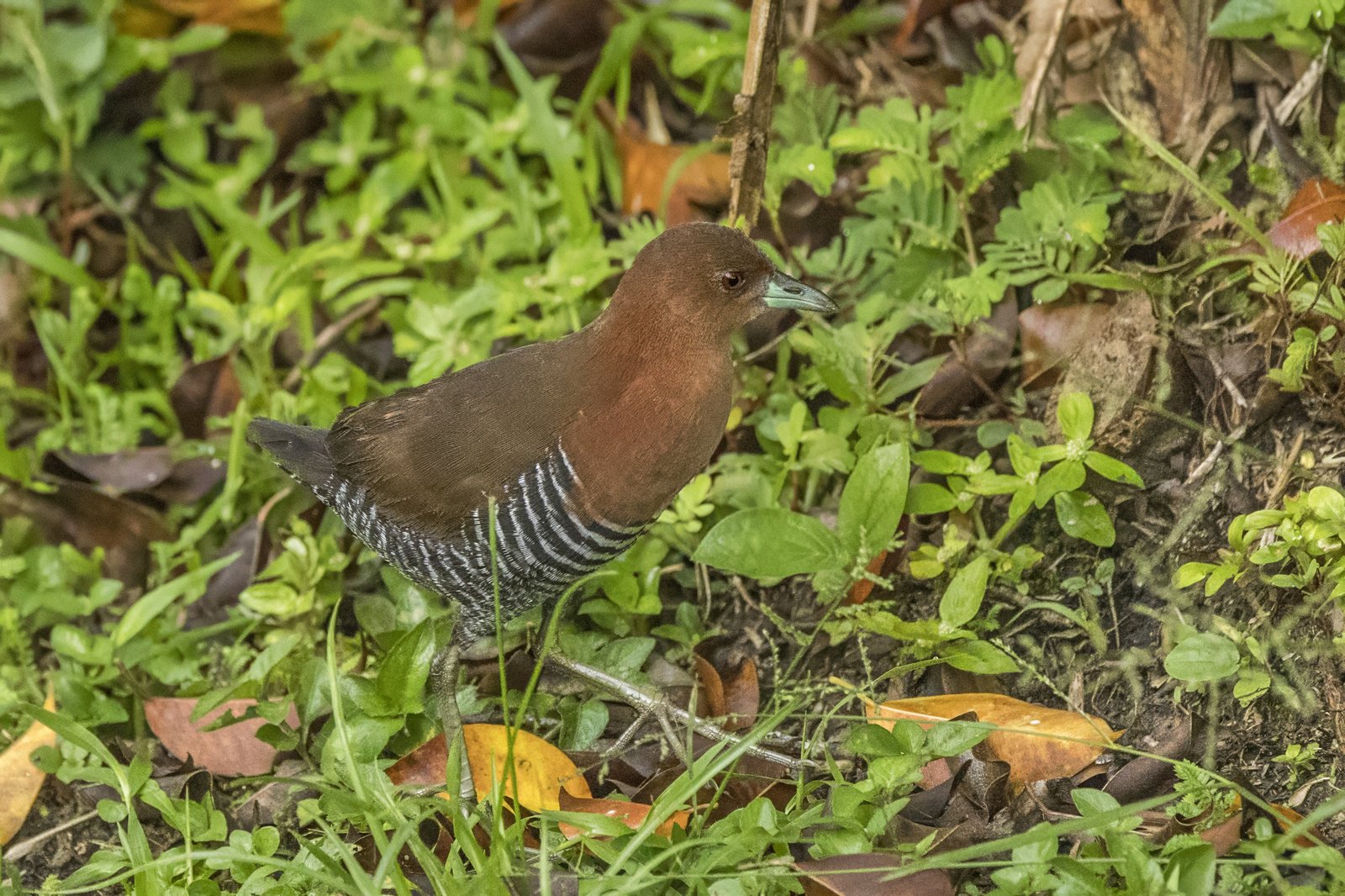
The White-throated Crake is the common small crake of wet grassland and ditches west of the Andes. It has a rufous head and breast, a white throat and black-and-white barred flanks. Its loud, descending rattle is a familiar sound in the western lowlands of Colombia and Ecuador.
Voice
A loud, fast rattle that fades away descending, often given by several birds together; also short, sharp calls. It calls at any hour of the day.
Recording: Juan Freile — CC BY-NC-SA 4.0 · xeno-canto
Identification
14–16 cm. Crown and upperparts olive-brown. Sides of the head and neck and the breast rufous, the throat white. Flanks, rear belly and undertail coverts are boldly barred black and white. The bill is greenish, the legs brownish and the eyes red. The sexes are alike; juveniles are duller and greyer.
Confusion species
Rufous-sided Crake Laterallus melanophaius is very similar, but has a white centre to the breast and rufous undertail coverts, and lives east of the Andes. Grey-breasted Crake Laterallus exilis has a grey head and breast and a rufous nape. Paint-billed Crake Mustelirallus erythrops is larger, with a grey head and breast and a red base to the bill. Colombian Crake Mustelirallus colombianus is larger, with a grey head, an ochre belly and unbarred flanks.
Habitat
Wet grassland, ditches, marsh edges, rice fields and damp pastures with tall grass, also rank growth along forest edges, from the lowlands to about 1500 m. It forages on the ground for insects and other invertebrates. The nest is a domed ball of grass in dense vegetation.
Where the bird is most at home, classified by the vegetation units of the Andes and the west coast.


Range and movements
In Colombia in the lowlands along the Pacific and Caribbean coasts and in the Magdalena and Cauca valleys. In Ecuador in the western lowlands and on the lower western slope. In Peru only scarce in the far north-west. Absent from Bolivia and the Galápagos. Outside the guide area from Honduras to Panama.
- Resident
- dark = core range, pale = thinly spread
How and when to look
Listen for the rattle along ditches and wet pastures in the western lowlands of Ecuador and Colombia; the bird usually stays under cover, but sometimes crosses a path or ditch.
Conservation status
Least Concern. The species tolerates land altered by people well and locally uses ditches and wet pastures.
Scientific name
Laterallus albigularis | (Lawrence, 1861)
Lawrence described the species in 1861 as Corethrura albigularis; because it was later moved to another genus, the author and year stand in brackets. The genus Laterallus was introduced in 1855 by Gray. The genus name is a portmanteau of Rallus lateralis, an old name of the Rufous-sided Crake (Latin lateralis, 'of the side'). The species name comes from Latin albus, 'white', and gularis, 'of the throat'. The specimen the first description was based on came from Caribbean side of the Isthmus of Panama.