All species › Passerines › Ovenbirds and woodcreepers › Duida Woodcreeper
Duida Woodcreeper | Lepidocolaptes duidae
Duidamuisspecht | Trepatroncos del Duida | Arapaçu-do-duida
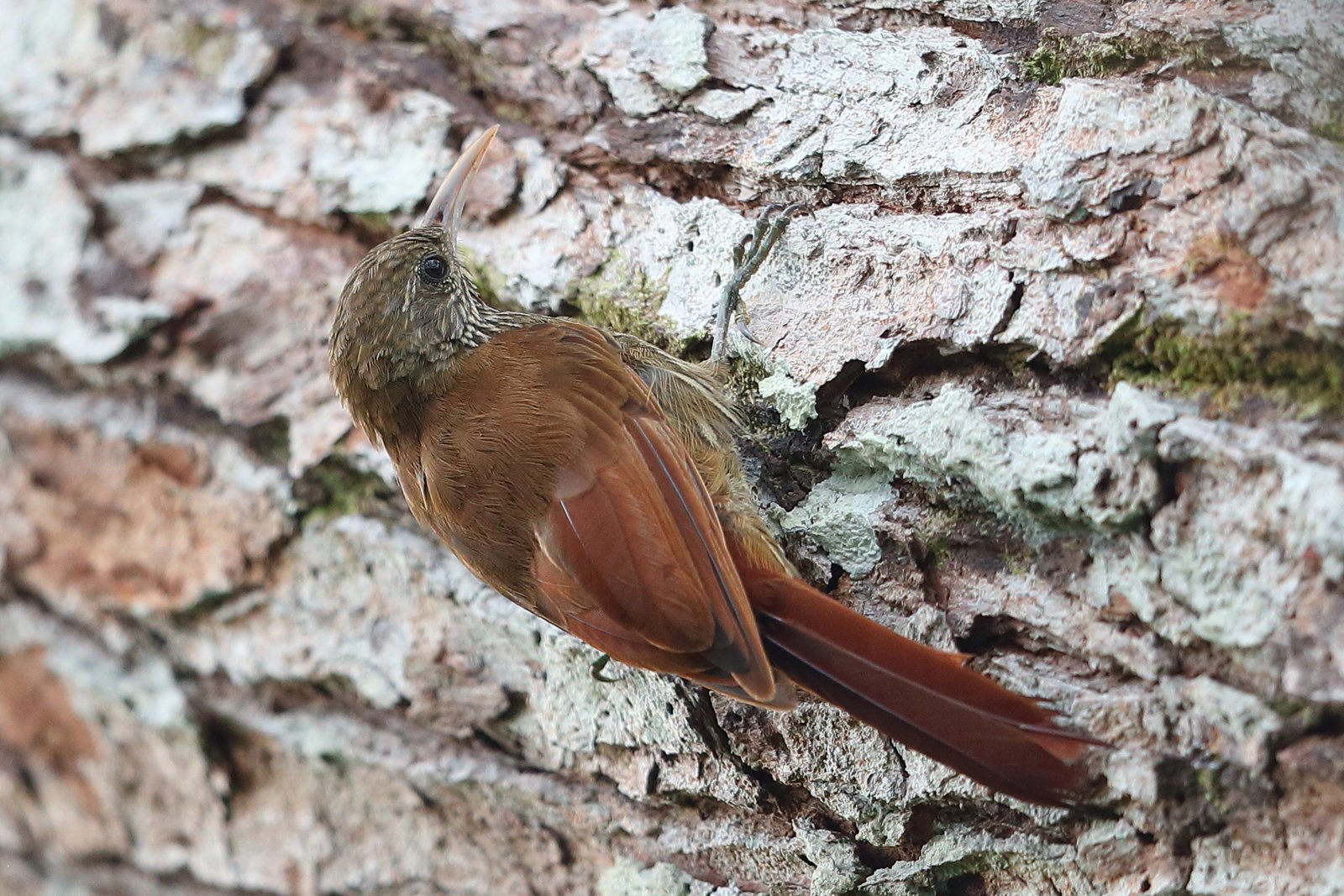
The Duida Woodcreeper is a small, slender woodcreeper of the Amazonian rainforest canopy north of the Amazon. It was split from the former, broadly defined Lineated Woodcreeper, mainly on the basis of its song. It forages high in the trees along branches and is therefore often seen only from below.
Voice
The song is a series of about eight to twelve thin, high, somewhat bouncing notes in just over two seconds. It differs from the song of the related species and was an important argument for the split.
Recording: John V. Moore — CC BY-NC-SA 4.0 · xeno-canto
Identification
17–19 cm, small and slender, with a thin, slightly decurved, pale bill and a rufous tail. The crown is dark with fine whitish streaks. The upperparts are olive-brown, the wings and tail rufous. The throat and underparts are brown to greyish brown with narrow, white, black-edged streaks. The sexes are alike.
Confusion species
Inambari Woodcreeper Lepidocolaptes fatimalimae is almost identical, but lives south of the Amazon and the Marañón and differs mainly in song. Streak-headed Woodcreeper Lepidocolaptes souleyetii is larger and warmer brown, with buff streaks, and lives in a different area. Xiphorhynchus woodcreepers such as Buff-throated Woodcreeper Xiphorhynchus guttatus are larger, with a heavier, straighter bill.
Habitat
The interior and edges of tall terra firme and floodplain forest, less in swamp forest and várzea, also older secondary forest, mostly below 1000 m. It searches thin branches and the canopy for insects, often in mixed flocks. The nest is probably in a tree cavity or crevice.
Where the bird is most at home, classified by the vegetation units of the Andes and the west coast.


Range and movements
Colombia: only undocumented sight records from the south-east; the species is treated there as hypothetical. Ecuador: in the Amazonian lowlands. Peru: in the north-east, north of the Amazon and the Marañón. Absent from Bolivia and the Galápagos. Outside the guide area in southern Venezuela and in Brazil north of the Solimões and west of the Rio Negro.
- Resident
- dark = core range, pale = thinly spread
How and when to look
In the rainforest canopy of eastern Ecuador and north-eastern Peru, look for a small, streaked woodcreeper in mixed flocks; a canopy tower or high viewpoint helps. The thin, bouncing song is the best clue.
Conservation status
Least Concern. The species has a large range in largely intact forest, but is sensitive to logging of tall forest.
Scientific name
Lepidocolaptes duidae | Zimmer, 1934
Zimmer described the species in 1934 and placed it straight away in the genus where it still stands. The genus Lepidocolaptes was introduced in 1853 by Reichenbach. The genus name combines Greek lepis, 'scale', with kolaptēs, 'pecker', after the scaly plumage. The species name refers to Cerro Duida, a tepui in southern Venezuela. The specimen the first description was based on came from Cerro Duida, Amazonas, Venezuela.