All species › Passerines › Ovenbirds and woodcreepers › Montane Woodcreeper
Montane Woodcreeper | Lepidocolaptes lacrymiger
Bergmuisspecht | Trepatroncos montano | Arapaçu-montano
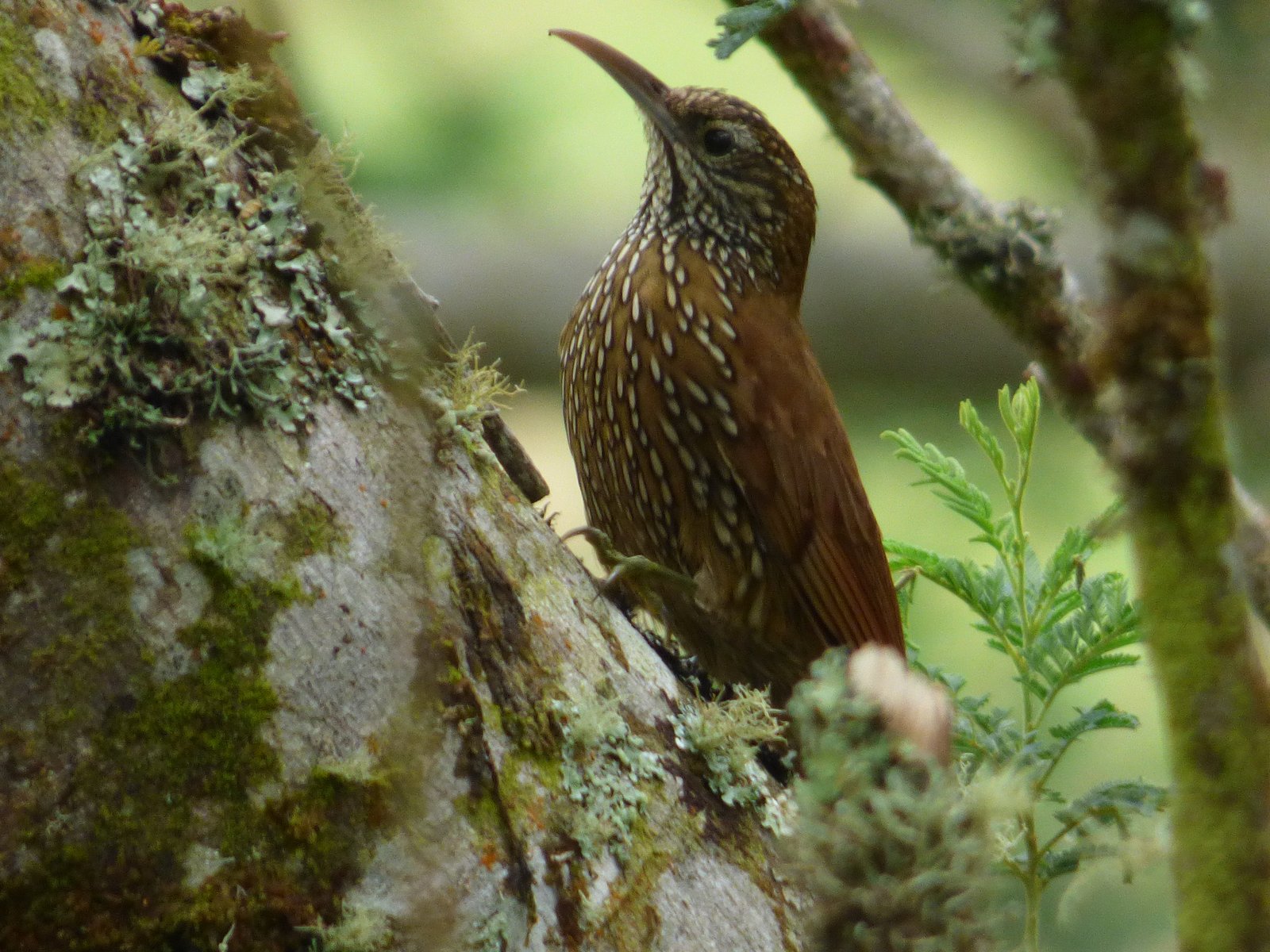
The Montane Woodcreeper is the commonest woodcreeper of Andean montane forest. It climbs trunks and especially mossy side branches, often in mixed flocks with tanagers and furnariids. It was formerly included in the Spot-crowned Woodcreeper of Central America.
Voice
The song is a fast, high series of thin notes, often first rising slightly and then falling, tsee-tsee-tsee-tsee-tsee. The call is a short, high tseet.
Recording: LUIS SALAGAJE — CC BY-NC-SA 4.0 · xeno-canto
Identification
19–21 cm, slender, with a thin, slightly decurved, pale bill and a rufous tail. The crown is dark brown with small, pale buff spots; the back is brown, the wings and rump rufous. The face shows a narrow pale supercilium. The throat is pale buff, and the underparts brown with broad, drop-shaped, pale buff streaks edged black. The sexes are alike.
Confusion species
Streak-headed Woodcreeper Lepidocolaptes souleyetii has a finely streaked crown and narrower streaks below and lives in the lowlands. Olive-backed Woodcreeper Xiphorhynchus triangularis is larger, with a heavier, straighter, dark bill and a scaled throat. Other species of the genus Xiphorhynchus have a straighter, partly dark bill and live lower. Olivaceous Woodcreeper Sittasomus griseicapillus is smaller and almost unmarked.
Habitat
Humid montane forest, cloud forest and upper montane forest, forest edges and older secondary forest, mostly between about 1500 and 3000 m, locally from 900 to 3500 m. It climbs trunks and branches, often in the middle and upper levels of the trees, and searches moss, epiphytes and bark for insects and spiders. The nest is in a tree cavity or crevice.
Where the bird is most at home, classified by the vegetation units of the Andes and the west coast.


Range and movements
Colombia: in all three Andean ranges, in the Sierra Nevada de Santa Marta and the Serranía de Perijá. Ecuador: on both slopes of the Andes. Peru: on the eastern slope along its whole length and in the north also on the western slope. Bolivia: on the eastern slope of the Andes south to Cochabamba and Santa Cruz. Absent from the Galápagos. Outside the guide area in the Andes and coastal mountains of Venezuela.
- Resident
- dark = core range, pale = thinly spread
How and when to look
In montane forest, check mixed flocks; the Montane Woodcreeper often climbs mossy side branches and keeps fairly high in the trees. The high, fast song is heard throughout the day.
Conservation status
Least Concern. The species is common in suitable montane forest and tolerates forest edge and secondary forest, but disappears where forest is cleared completely.
Scientific name
Lepidocolaptes lacrymiger | (des Murs, 1849)
Des Murs described the species in 1849 as Dendrocolaptes lacrymiger; because it was later moved to another genus, the author and year stand in brackets. The genus Lepidocolaptes was introduced in 1853 by Reichenbach. The genus name combines Greek lepis, 'scale', with kolaptēs, 'pecker', after the scaly plumage. The species name comes from Latin lacrima, 'tear', and -ger, 'bearing': 'tear-bearing', after the teardrop-shaped spots. The specimen the first description was based on came from Bogotá, Colombia.