All species › Passerines › Tyrant flycatchers and allies › Dusky-chested Flycatcher
Dusky-chested Flycatcher | Myiozetetes luteiventris
Kortsnaveltiran | Mosquero pechioscuro | Bem-te-vi-barulhento
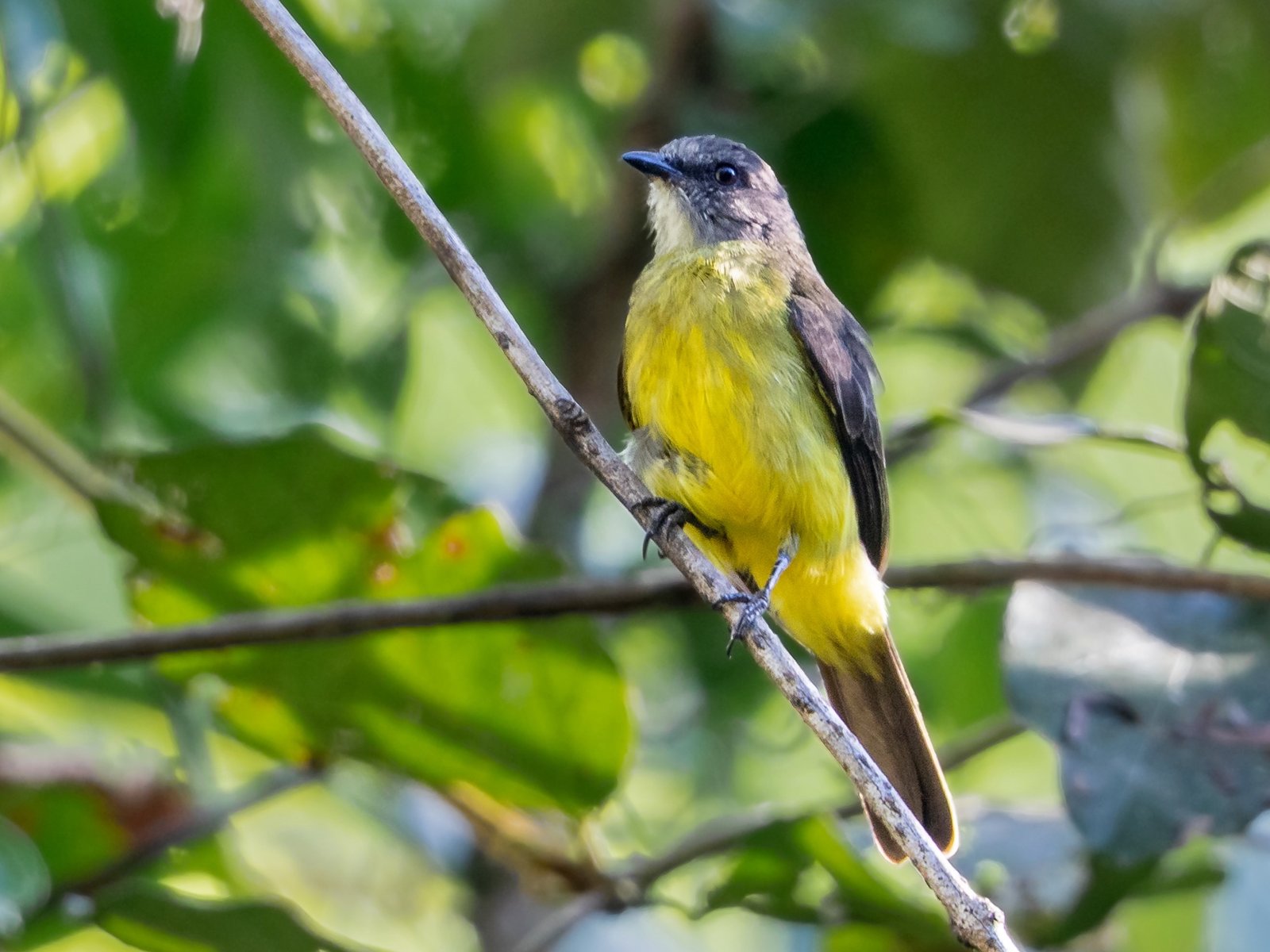
The Dusky-chested Flycatcher is the smallest and darkest of the Myiozetetes flycatchers and lives high in the canopy of Amazonian rainforest. It has a very short bill and a mottled, dark breast. It is usually detected by its plaintive, nasal calls from the treetops.
Voice
A nasal, plaintive nyeeu or keeu, often in series, and a fast, chattering duet by the pair.
Recording: Jaime Suárez — CC BY-NC-SA 4.0 · xeno-canto
Identification
14–15 cm, with a short, stubby, black bill. The upperparts and head are dark olive-brown, without a clear supercilium; there is a concealed orange crown patch. The throat is whitish, the breast olive-brown with faint paler mottling or streaks, the belly yellow. The wing feathers have narrow pale edges. The sexes are alike.
Confusion species
Grey-capped Flycatcher Myiozetetes granadensis is larger, with a grey crown, a white forehead and a plain yellow breast. Piratic Flycatcher Legatus leucophaius has a boldly striped head with a white supercilium and malar stripe and a streaked breast. Crowned Slaty Flycatcher Empidonomus aurantioatrocristatus is greyer, with a black cap. Flatbills (Tolmomyias) have a broader, flatter bill and pale wing bars.
Habitat
The canopy and edges of humid terra firme and várzea forest, also tall trees at clearings and along rivers, in the lowlands to about 800 m. It lives in pairs in the treetops, catches insects in short sallies and eats small fruits, including mistletoe. The nest is poorly described.
Where the bird is most at home, classified by the vegetation units of the Andes and the west coast.


Range and movements
Colombia: in the lowlands of the south-east (Amazonia). Ecuador: in the lowlands east of the Andes. Peru: in the lowlands east of the Andes. Bolivia: known only from the far north. Absent from the Galápagos. Outside the guide area in southern Venezuela, the Guianas and Amazonian Brazil.
- Resident
- dark = core range, pale = thinly spread
How and when to look
From towers or riverbanks with a view over the canopy, look for pairs of small, dark flycatchers in the treetops, and listen for the nasal nyeeu.
Conservation status
Least Concern. The species has a large range, but is patchily distributed and depends on tall forest.
Scientific name
Myiozetetes luteiventris | (Sclater, 1858)
Sclater described the species in 1858 as Elaenia luteiventris; because it was later moved to another genus, the author and year stand in brackets. The genus Myiozetetes was introduced in 1859 by Sclater. The genus name combines Greek muias, 'fly', and zētētēs, 'searcher'. Latin luteus, 'yellow', and venter, 'belly', for the yellow belly. The specimen the first description was based on came from Río Napo, Ecuador.