All species › Passerines › Tyrant flycatchers and allies › Vermilion Flycatcher
Vermilion Flycatcher | Pyrocephalus rubinus
Rode tiran | Mosquero cardenal | Príncipe
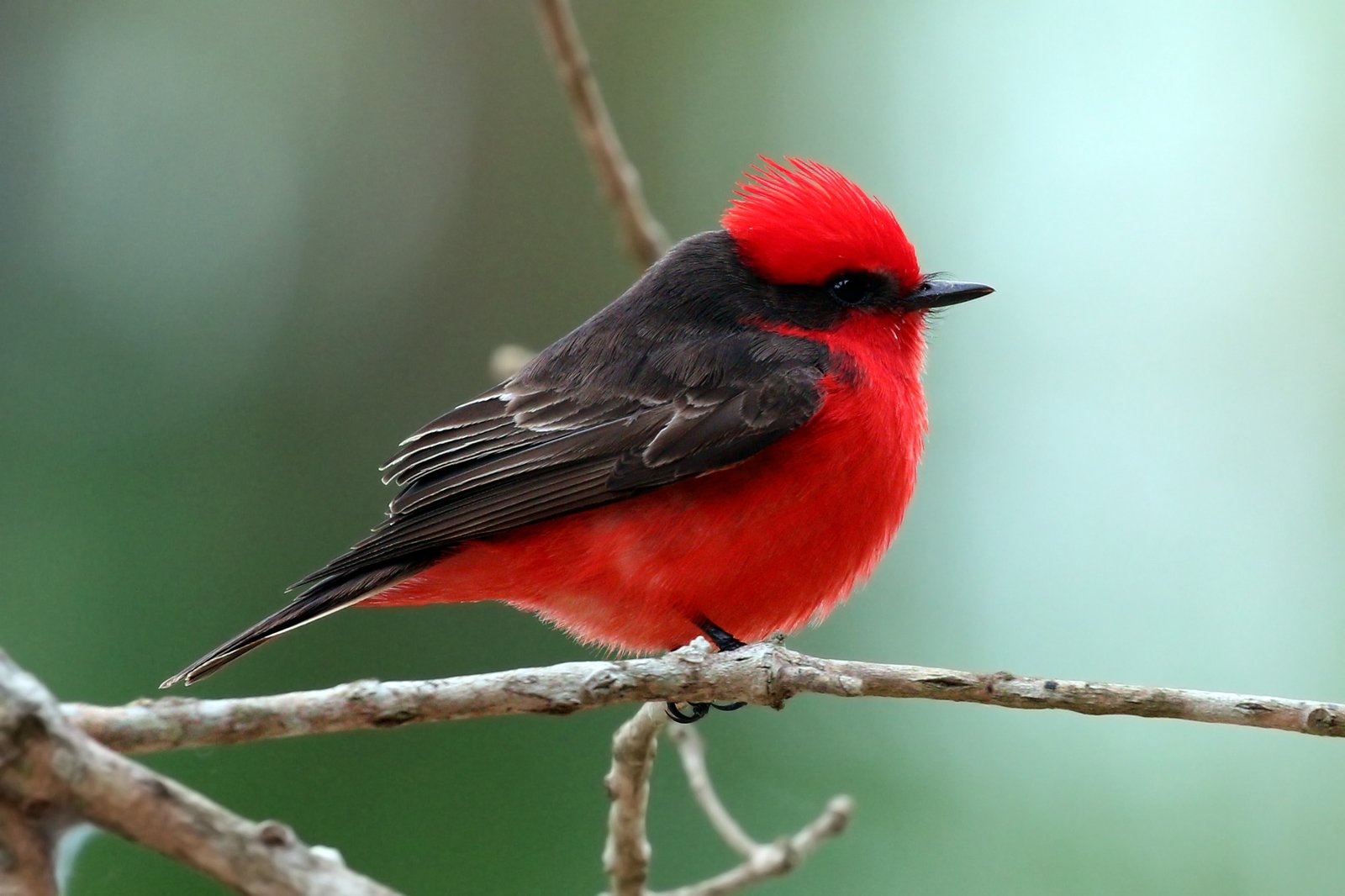
The Vermilion Flycatcher is a small tyrant of open, dry country, whose male has a scarlet crown and underparts. In display the male rises fluttering with puffed-up feathers and sings in the air. In the guide area the species is widespread along the Pacific coast and in the dry valleys, and southern birds migrate to Amazonia in the austral winter. The taxonomy is in flux: the birds of the Galápagos and those of North and Central America are treated by some authors as separate species.
Voice
A sharp peest as a call. The song is a tinkling series, pit-pit-pit-sreee, given by the male in display flight or from a perch, often before sunrise.
Recording: JAYRSON ARAUJO DE OLIVEIRA — CC BY-NC-SA 4.0 · xeno-canto
Identification
13–14 cm. The male has a scarlet crown and underparts, a dark brown mask through the eye and dark brown upperparts, wings and tail. The female is greyish-brown above, with a white throat, a finely streaked, whitish breast and a salmon-pink to pale yellow belly. Around Lima and elsewhere on the Peruvian coast a dark morph occurs, the male of which is entirely sooty brown, sometimes with some red on the belly. On the Galápagos the birds are smaller; there males have a less deep red underside and females a yellow belly. Juveniles resemble the female, with a spotted breast and a white or yellowish belly.
Confusion species
The male cannot be confused with any other species in the guide area. Females and juveniles can resemble a phoebe or a small pewee, such as Southern Tropical Pewee Contopus cinereus, but these lack the fine streaking on the breast and the pink or yellow belly. Austral Negrito Lessonia rufa is a ground bird with a rufous back. Black Phoebe Sayornis nigricans resembles the dark morph, but has a white belly and perches by running water.
Habitat
Open, dry country with scattered trees and shrubs: thorn scrub, coastal desert with oases, fields and irrigated farmland, parks and gardens in towns, and dry valleys in the Andes to about 3000 m; on the Galápagos mainly in the humid highland zone; wintering birds in open country, riverbanks and villages in the Amazonian lowlands. It hunts flying insects from a low perch, often on the ground. The nest is a shallow cup on a horizontal branch.
Where the bird is most at home, classified by the vegetation units of the Andes and the west coast.


Range and movements
Colombia: in the Caribbean lowlands, in the dry valleys between the Andean ranges and in the Llanos. Ecuador: in the western lowlands and the dry Andean valleys; in the Amazonian lowlands as an austral winter visitor. Galápagos: on a number of the larger islands, mainly in the highlands. Peru: along the coast and the western slope, in the Marañón valley and in the dry inter-Andean valleys; in the Amazonian lowlands as an austral winter visitor. Bolivia: in the lowlands of the east and south, the Chaco and the dry Andean valleys; southern birds pass through and winter in the north. Outside the guide area from the south-western United States to Argentina.
- Resident
- dark = core range, pale = thinly spread
How and when to look
Search fields, parks and oases along the coast of Peru and western Ecuador, where the male often perches on a post or shrub and regularly drops to the ground. Around Lima the dark morph can also be found in city parks.
Conservation status
Least Concern. Widespread and common. On the Galápagos the island form has declined sharply; the San Cristóbal form is considered extinct.
Scientific name
Pyrocephalus rubinus | (Boddaert, 1783)
Boddaert described the species in 1783 as Muscicapa rubinus; because it was later moved to another genus, the author and year stand in brackets. The genus Pyrocephalus was introduced in 1838 by Gould. The genus name comes from Greek pur, 'fire', and kephalē, 'head': 'fire-head'. The species name comes from medieval Latin rubinus, 'ruby-red', after the male's red plumage. The specimen the first description was based on came from Tefé, Amazonas, Brazil.