All species › Passerines › Tyrant flycatchers and allies › Crowned Chat-Tyrant
Crowned Chat-Tyrant | Silvicultrix frontalis
Kroontapuittiran | Pitajo coronado | Papa-moscas-coroado
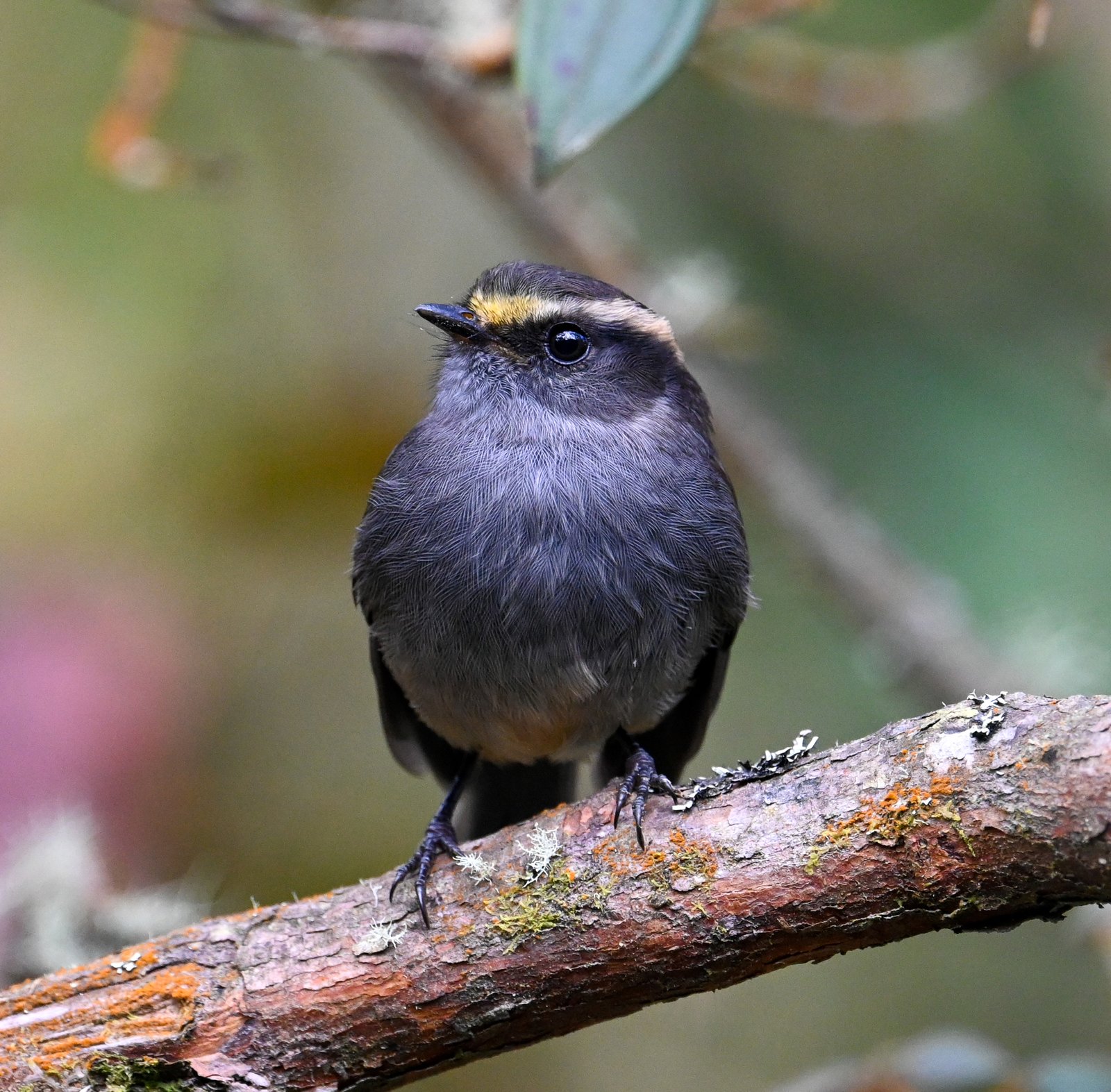
The Crowned Chat-Tyrant is a small, dark tyrant flycatcher of the understorey of the highest montane forest, often just below treeline. It stands out by a long, pale supercilium that runs from the forehead to well behind the eye. Northern and southern birds differ in the colour of the supercilium and in having wing bars or not.
Voice
High, thin, slightly descending whistles, roughly tsiiu, and a rapid, dry trill.
Recording: Lelis Navarrete — CC BY-NC-SA 4.0 · xeno-canto
Identification
12.5 cm, with a thin, black bill and an upright posture. The upperparts are dark greyish brown, the head darker. The long supercilium is yellow to ochre-yellow on the forehead and becomes white towards the rear; in Colombia it is whitish throughout. The underparts are dark grey, the lower belly browner. Northern birds have plain dark wings; birds from central and southern Peru and Bolivia have two rufous wing bars. The sexes are alike.
Confusion species
Golden-browed Chat-Tyrant Silvicultrix pulchella has a golden-yellow supercilium along its whole length, rufous wing bars and an olive belly. Yellow-bellied Chat-Tyrant Silvicultrix diadema has yellow underparts and usually lives lower. Jelski's Chat-Tyrant Silvicultrix jelskii is paler grey below, has clear rufous wing bars and lives on the western side. Brown-backed Chat-Tyrant Ochthoeca fumicolor is larger, with a rufous-brown belly, and perches more in the open.
Habitat
The dense understorey of humid, mossy upper montane forest and elfin forest at treeline, also bamboo thickets and scrub at the edge of the páramo, roughly between 2600 and 3600 m. It lives alone or in pairs, keeps low and hidden and makes short sallies to insects on leaves and twigs. The nest is a cup of moss, often against a steep bank or in a crevice.
Where the bird is most at home, classified by the vegetation units of the Andes and the west coast.


Range and movements
Colombia: in the Central Andes and the south of the Eastern Andes. Ecuador: along both slopes of the Andes. Peru: along the eastern side of the Andes through almost the whole country. Bolivia: in the Yungas of La Paz and Cochabamba. Absent from the Galápagos. Does not occur outside the guide area.
- Resident
- dark = core range, pale = thinly spread
How and when to look
Search at the edge of the highest cloud forest, where forest gives way to páramo or puna, for instance along trails in the early morning; look for a small, dark flycatcher darting off low in the scrub.
Conservation status
Not evaluated under the species limits followed here. The population is probably stable; forest at treeline is locally lost to fire and grazing.
Scientific name
Silvicultrix frontalis | (de Lafresnaye, 1847) (GBIF: Ochthoeca frontalis)
De Lafresnaye described the species in 1847 as Tyrannula frontalis; because it was later moved to another genus, the author and year stand in brackets. The genus Silvicultrix was introduced in 1986 by Lanyon. The genus name is Latin silvicultrix, 'forest-dweller', from silva, 'forest', and cultrix, 'inhabitant'. The species name comes from Latin frons, 'forehead': 'of the forehead', after the pale frontal band. The specimen the first description was based on came from Pasto, Nariño, Colombia.