All species › Passerines › Tyrant flycatchers and allies › Jelski's Chat-Tyrant
Jelski's Chat-Tyrant | Silvicultrix jelskii
Jelski's tapuittiran | Pitajo de Jelski | Papa-moscas-de-jelski
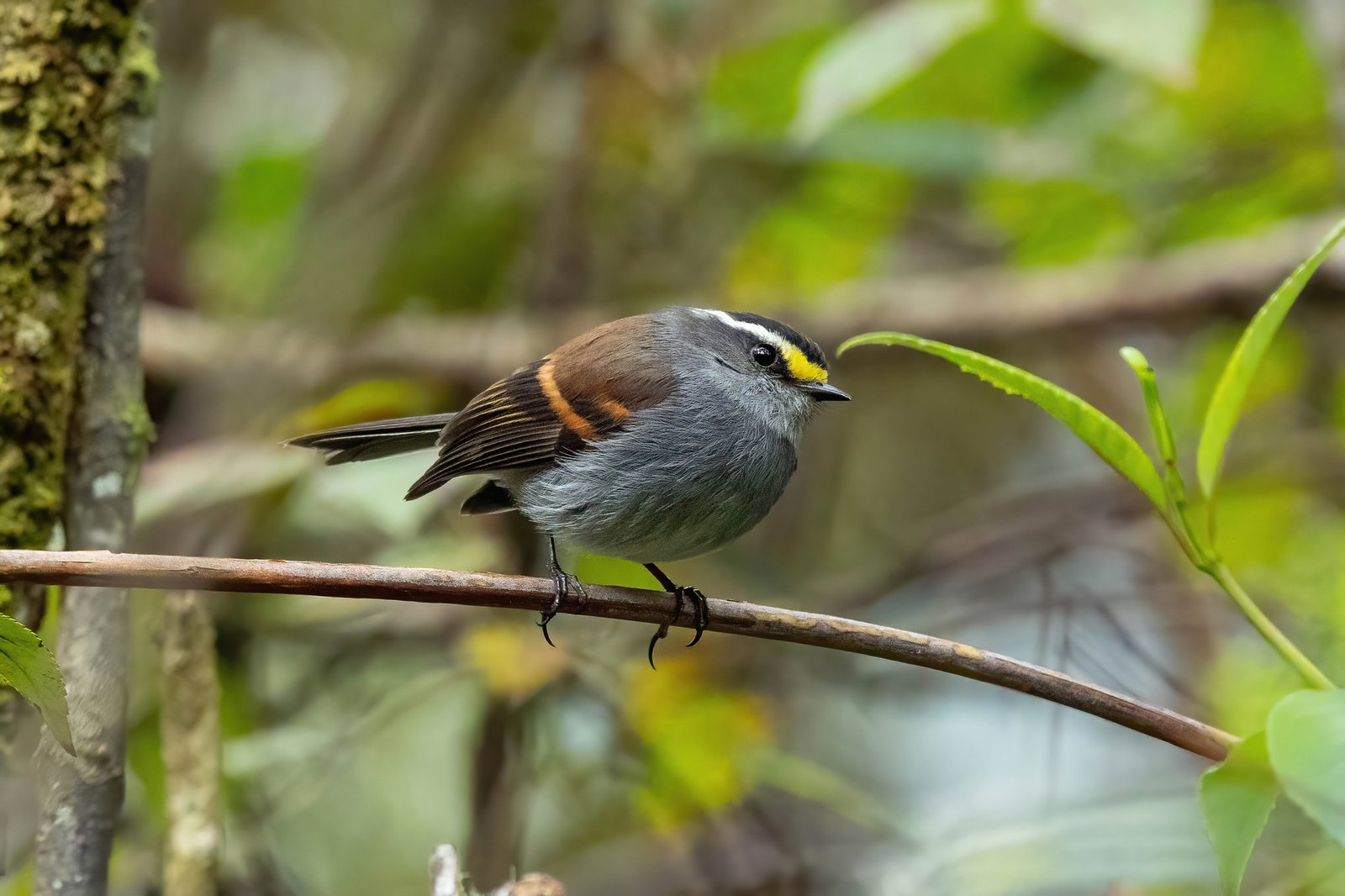
Jelski's Chat-Tyrant is a small chat-tyrant of shrubby montane forest on the western side of the Andes, from the far south of Ecuador to central Peru. It resembles the other yellow-browed chat-tyrants, but is paler grey below and lives in drier, more open woodland. The species is named after the Polish collector Konstanty Jelski.
Voice
A high, thin whistle, roughly tsiiu, and a short, rapid trill.
Recording: Paul Coopmans — CC BY-NC-SA 4.0 · xeno-canto
Identification
12.5 cm, with a thin, black bill. The upperparts are olive-brown, the crown darker. The forehead and the front of the supercilium are yellow, the rear part white. The wings have two clear rufous wing bars. The throat and breast are grey, the belly whitish with a pale brown lower belly. The sexes are alike.
Confusion species
Golden-browed Chat-Tyrant Silvicultrix pulchella has a golden-yellow supercilium along its whole length, darker underparts and lives on the eastern side of the Andes. Crowned Chat-Tyrant Silvicultrix frontalis is darker grey below and lives higher, in wetter forest. Yellow-bellied Chat-Tyrant Silvicultrix diadema has yellow underparts. Piura Chat-Tyrant Ochthoeca piurae lacks the yellow in the supercilium and lives in drier scrub.
Habitat
The understorey and edges of humid to semi-humid montane forest, shrubby ravines, riverside scrub and Polylepis groves, roughly between 2000 and 3300 m. It lives alone or in pairs, keeps low and catches insects with short sallies to leaves and twigs. Little is known about the nest.
Where the bird is most at home, classified by the vegetation units of the Andes and the west coast.


Range and movements
Ecuador: only locally in the far south, in Loja. Peru: along the western slope of the Andes and in the upper parts of the inter-Andean valleys, from the north to the centre of the country. Absent from Colombia, Bolivia and the Galápagos. Does not occur outside the guide area.
- Resident
- dark = core range, pale = thinly spread
How and when to look
Search shrubby ravines and forest remnants on the western slope in northern and central Peru, or at Utuana in southern Ecuador; look for a small flycatcher with a yellow forehead low in the vegetation.
Conservation status
Least Concern. The range is fairly small and the forest remnants on the western slope are under pressure from clearing, fire and grazing.
Scientific name
Silvicultrix jelskii | (Taczanowski, 1883) (GBIF: Ochthoeca jelskii)
Taczanowski described the species in 1883 as Ochthoeca Jelskii; because it was later moved to another genus, the author and year stand in brackets. The genus Silvicultrix was introduced in 1986 by Lanyon. The genus name is Latin silvicultrix, 'forest-dweller', from silva, 'forest', and cultrix, 'inhabitant'. The species name honours Konstanty Jelski (1837–1896), a Polish zoologist who collected birds in Peru from 1868 to 1875 for Władysław Taczanowski. The specimen the first description was based on came from Montaña de Nancho, Cajamarca, Peru.