All species › Passerines › Antbirds › Dusky-tailed Antbird
Dusky-tailed Antbird | Drymophila malura
Temmincks miervogel | Tiluchí estriado oriental | Choquinha-carijó
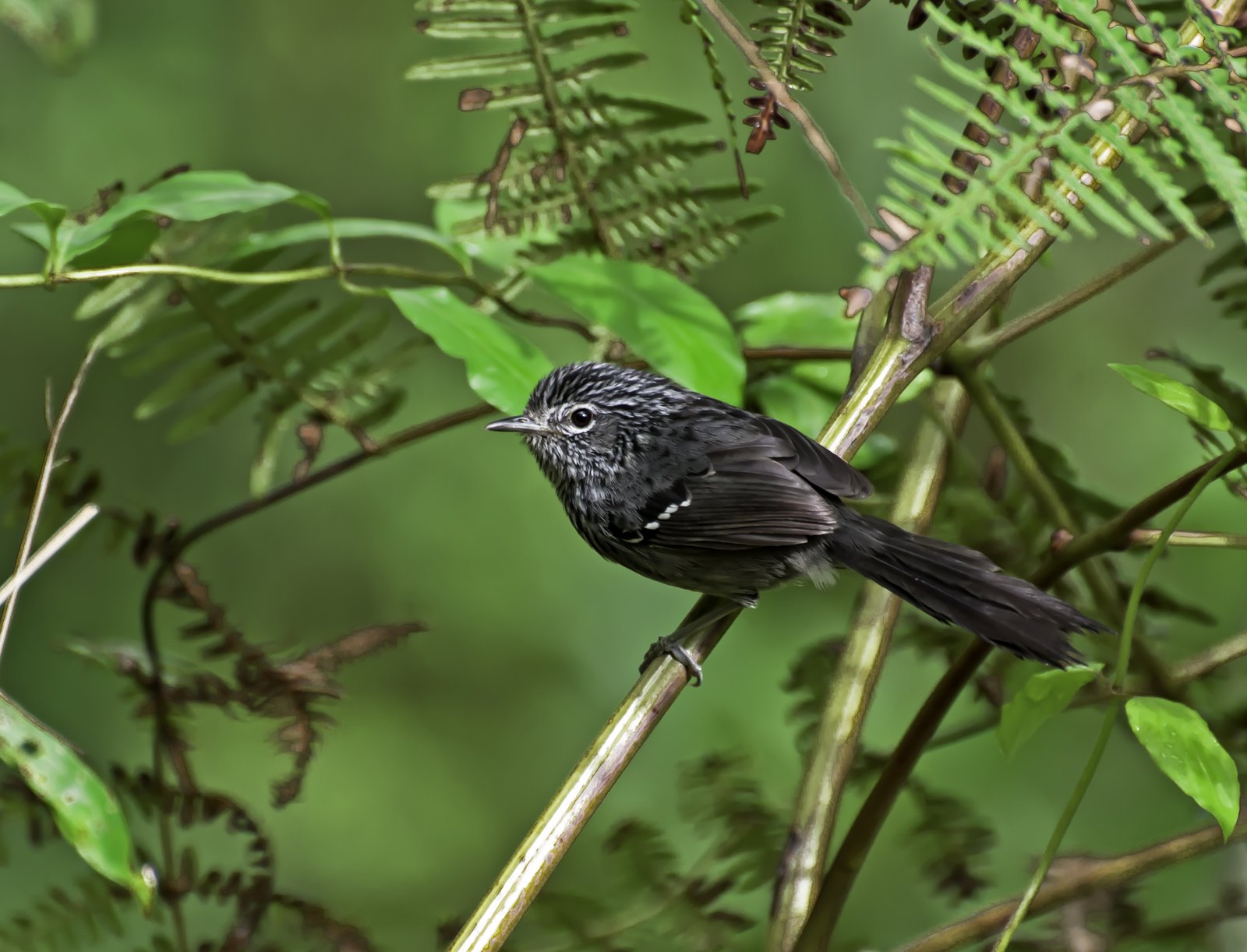
The Dusky-tailed Antbird is a long-tailed antbird of the Atlantic Forest of south-eastern South America. In the guide area it is only a rare vagrant, known from a few isolated records. It lives in dense bamboo and rank growth at forest edges, far outside the Andean countries.
Voice
The song is a short series of hoarse, buzzy notes that accelerate slightly; partners answer each other. The call is a dry, short chip.
Recording: Ricardo José Mitidieri — CC BY-NC-SA 4.0 · xeno-canto
Identification
14–15 cm, much of it tail. The male is grey, with black and white streaks on the crown and mantle, white streaks on the throat and breast and black wing coverts with white spots. The long, graduated tail is plain dark grey-brown, without white tips. The female is browner, with buff streaks on the head and breast and ochre-brown flanks.
Confusion species
Striated Antbird Drymophila devillei lives in bamboo in the Amazonian lowlands of the guide area; it has white underparts with black streaks, rufous flanks and a black tail with white tips. The other antbirds of the genus Drymophila in the guide area live in the Andes and likewise have white tail tips and rufous flanks.
Habitat
In its own range in dense bamboo, thickets and rank growth at forest edges and in secondary forest, from the lowlands into the mountains. It searches for insects and spiders among leaves and stems, usually low in the vegetation. The nest is a cup low in dense vegetation.
Where the bird is most at home, classified by the vegetation units of the Andes and the west coast.


Range and movements
Colombia, Ecuador and Peru: absent. Bolivia: only a few isolated records; no established population is known. Absent from the Galápagos. Outside the guide area in south-eastern Brazil, eastern Paraguay and north-eastern Argentina.
How and when to look
A record in the guide area is exceptional. A bird with a plain dark tail without white tips in bamboo in eastern Bolivia calls for a photograph or sound recording.
Conservation status
Least Concern. Locally common in the Atlantic Forest, but dependent on forest remnants and bamboo that have been fragmented by deforestation.
Scientific name
Drymophila malura | (Temminck, 1825)
Temminck described the species in 1825 as Myothera malura; because it was later moved to another genus, the author and year stand in brackets. The genus Drymophila was introduced in 1824 by Swainson. The genus name combines Greek drumos, 'wood, copse', and philos, 'fond of'. The species name comes from Greek malos (properly amalos), 'soft, weak', and -ouros, 'tailed', from oura, 'tail'. The specimen the first description was based on came from Ipanema (Iperó), São Paulo, Brazil.