All species › Passerines › Antbirds › Ferruginous-backed Antbird
Ferruginous-backed Antbird | Myrmoderus ferrugineus
Roestrugmiervogel | Hormiguero dorsiferrugíneo | Formigueiro-ferrugem
The Ferruginous-backed Antbird is a ground-dwelling antbird of the Guiana Shield and north-eastern Amazonia. It walks in pairs over the forest floor, pumping its tail and rear body. In the guide area it is known only as a very rare vagrant.
Voice
The male's song is a short, very high whistle that first rises and then slows on a level pitch. Calls are rattles of varying length, often in series.
Recording: Tristan Guillebot de Nerville — CC BY-NC-SA 4.0 · xeno-canto
Identification
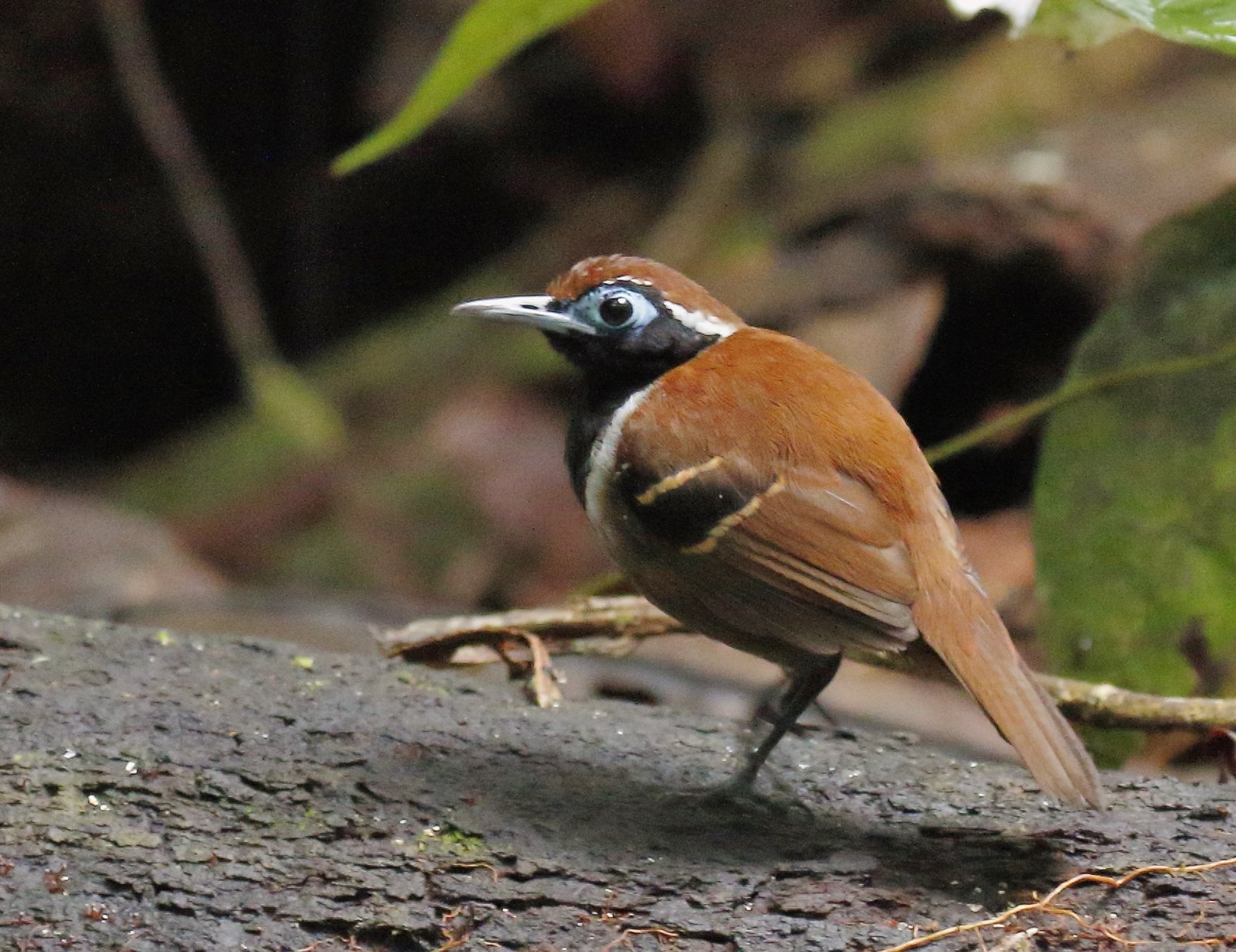
14–15 cm, with a fairly long bill, long legs and bare blue skin around the eye. The crown, back and wings are chestnut and the tail rufous-brown. The wing coverts are black with broad buff tips. In the male the face, throat and breast are black, separated from the upperparts by a white line; the flanks and undertail coverts are warm buff-brown. The female has a white throat and a pale grey belly.
Confusion species
Cordillera Azul Antbird Myrmoderus eowilsoni, its closest relative, is browner and lives only on a few ridges in Peru. White-browed Antbird Myrmoborus leucophrys lacks the spotted wing and perches more often in shrubbery above the ground. Common Scale-backed Antbird Willisornis poecilinotus has a scaled back and grey or brown underparts without a black breast.
Habitat
Understorey and floor of evergreen terra firme lowland forest and adjacent old secondary forest, also forest on sandy soils. It walks over the ground, fallen trunks and branches, picking insects and spiders from the leaf litter; it sometimes briefly follows army-ant swarms. The cup-shaped nest is on or near the ground.
Where the bird is most at home, classified by the vegetation units of the Andes and the west coast.


Range and movements
A very rare vagrant in the guide area; definite records from Colombia, Ecuador, Peru and Bolivia are scarcely or not documented. Absent from the Galápagos. Outside the guide area in eastern Venezuela, the Guianas and Amazonian Brazil, north of the Amazon and south of it between the Madeira and the Tapajós.
How and when to look
A ground-dwelling antbird with a chestnut back and black breast in lowland forest in the east of the guide area is worth checking; document a sighting with photographs or a sound recording.
Conservation status
Least Concern. In its core range the species is fairly common in undisturbed forest.
Scientific name
Myrmoderus ferrugineus | (Müller, 1776) (GBIF: Myrmeciza ferruginea)
Müller described the species in 1776 as Turdus ferrugineus; because it was later moved to another genus, the author and year stand in brackets. The genus Myrmoderus was introduced in 1909 by Ridgway. The genus name combines Greek murmos, 'ant', with derō, 'to flay, to cudgel'. The species name is Latin ferrugineus, 'rust-coloured', for the rufous back. The specimen the first description was based on came from Cayenne, French Guiana.