All species › Passerines › Antpittas › Ochre-breasted Antpitta
Ochre-breasted Antpitta | Grallaricula flavirostris
Okerborstdwergmierpitta | Gralarita ocrácea | Tovaquinha-de-peito-ocre
The Ochre-breasted Antpitta is a small, upright antpitta of the undergrowth of humid forest on the lower and middle slopes of the Andes. Unlike the large antpittas of the genus Grallaria, it does not forage on the ground but from low twigs, from which it snatches prey off leaves. Of the small Grallaricula antpittas it has the largest range in the guide area.
Voice
A high, soft, descending whistle, peeeuw, repeated at intervals, sometimes in a short series. It usually sings from a low branch.
Recording: José María Loaiza B. — CC BY-NC-SA 4.0 · xeno-canto
Identification
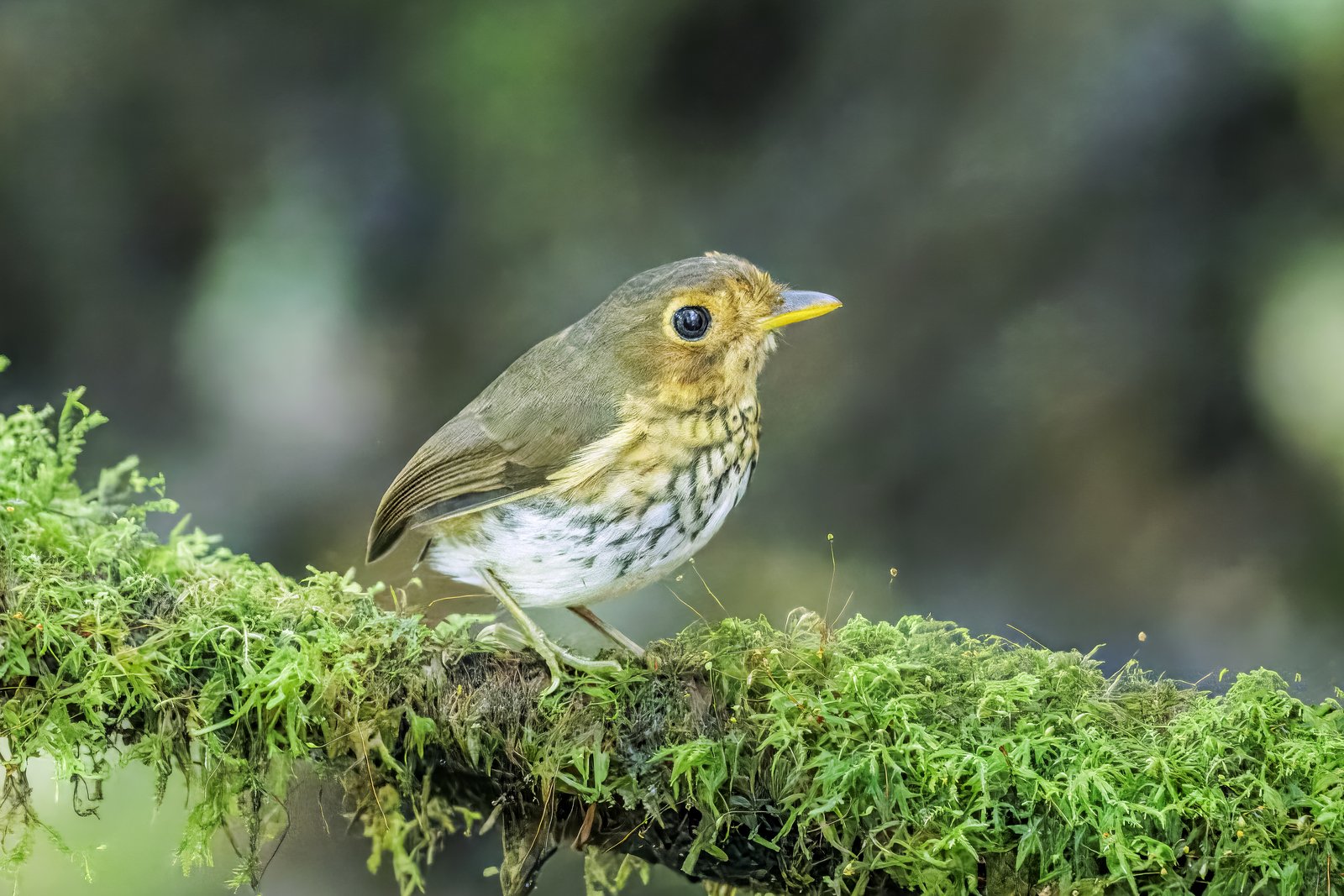
10 cm, round and short-tailed, on long legs, with a relatively large head and large dark eyes. The upperparts are olive-brown. The lores, eye-ring and face are ochre-yellow. The throat and breast are warm ochre, depending on the subspecies almost unstreaked or with dark streaks on the breast; the belly is white. The bill is yellow to orange-yellow, in some subspecies with a dark culmen. The legs are pink to yellowish. The sexes are alike.
Confusion species
Slaty-crowned Antpitta Grallaricula nana has a slate-grey crown, rufous underparts and a white crescent on the lower throat, and lives higher. Rusty-breasted and Rufous-breasted Antpittas (Grallaricula ferrugineipectus and Grallaricula leymebambae) have darker rufous underparts with a white throat crescent and a dark bill. Peruvian Antpitta Grallaricula peruviana and Ochre-fronted Antpitta Grallaricula ochraceifrons have white underparts scaled or streaked with black.
Habitat
The undergrowth of humid foothill and montane forest, especially along streams and in dense, damp patches with ferns and saplings, roughly between 700 and 2400 m. It sits motionless on a low perch, 0.5 to 2 m above the ground, and sallies briefly to leaves to take insects and other small invertebrates. The nest is a shallow cup of moss on a platform of sticks, low in a shrub or sapling.
Where the bird is most at home, classified by the vegetation units of the Andes and the west coast.


Range and movements
In Colombia on the slopes of all three Andean ranges, including the Pacific side. In Ecuador on the western and eastern slopes. In Peru on the eastern slope along almost the entire length of the country. In Bolivia on the eastern slope in the north and centre. Does not occur on the Galápagos. Outside the guide area in the mountains of Costa Rica and Panama.
- Resident
- dark = core range, pale = thinly spread
How and when to look
Walk slowly along shady trails and stream valleys in humid montane forest and listen for the soft whistle. The bird often sits still on a low twig right next to the trail, making short sideways movements of body and wings.
Conservation status
Least Concern. Locally reduced by clearance of montane forest, but the species is widespread.
Scientific name
Grallaricula flavirostris | (Sclater, 1858)
Sclater described the species in 1858 as Grallaria flavirostris; because it was later moved to another genus, the author and year stand in brackets. The genus Grallaricula was introduced in 1858 by Sclater. The genus name is a diminutive of the genus Grallaria, Modern Latin for 'stilt-walker'. The species name comes from Latin flavus, 'yellow', and rostrum, 'bill'. The specimen the first description was based on came from Río Napo, Ecuador.