All species › Passerines › Antpittas › Hooded Antpitta
Hooded Antpitta | Grallaricula cucullata
Roodkapdwergmierpitta | Ponchito encapuchado | Tovaquinha-encapuzada
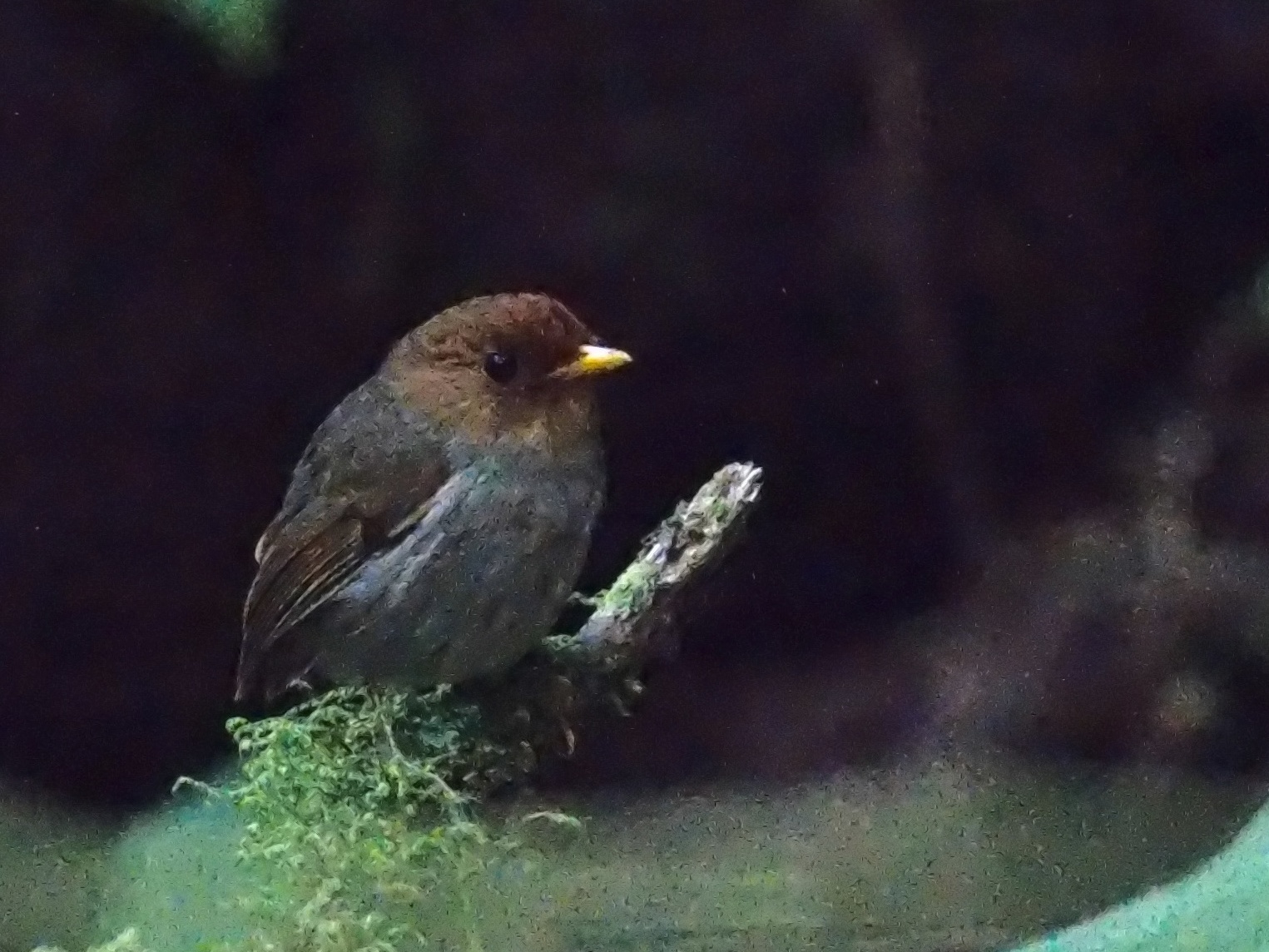
The Hooded Antpitta is a small antpitta with a bright orange-rufous hood covering the head, neck and throat. In the guide area it occurs only in the Colombian Andes, where it lives patchily in the undergrowth of humid montane forest. It forages from low twigs and rarely comes to the ground.
Voice
The song is a series of eight to ten high whistles that first rise and then fall. Also a high, clear call of two or three syllables, repeated two or three times.
Recording: Jean-Esteban Liberek — CC BY-NC-SA 4.0 · xeno-canto
Identification
10–11 cm, round and short-tailed, on long grey legs. The head, neck and throat are bright orange-rufous. The upperparts and tail are olive-brown. A thin, indistinct white crescent separates the throat from the pale grey breast and flanks; the centre of the lower breast and belly is white. The bill is pale yellow to orange-pink. The sexes are alike. Birds of the subspecies venezuelana have an olive wash on the breast and a creamy yellow lower belly.
Confusion species
No other Grallaricula in the guide area has a wholly orange-rufous head. Slaty-crowned Antpitta Grallaricula nana has a slate-grey crown and rufous underparts. Rusty-breasted Antpitta Grallaricula ferrugineipectus has a brown crown, a pale eye-ring and a rufous breast. Ochre-breasted Antpitta Grallaricula flavirostris has an olive-brown crown and an ochre-yellow breast.
Habitat
The undergrowth of humid montane forest, roughly between 1500 and 2800 m, including dense forest edge and older secondary forest. It forages low in the vegetation, taking insects and other invertebrates from leaves and twigs. Little is known about its breeding; a female collected in September held a shelled egg.
Where the bird is most at home, classified by the vegetation units of the Andes and the west coast.


Range and movements
Only in Colombia: in the Western Andes (Valle del Cauca, Cauca), on the western slope of the Central Andes (Antioquia, Risaralda, Valle del Cauca) and on the western slope of the Eastern Andes in Huila. The subspecies venezuelana lives on the eastern slope of the Eastern Andes in Cundinamarca. Absent from Ecuador, Peru, Bolivia and the Galápagos. Outside the guide area in western Venezuela (Táchira, Apure).
- Resident
- dark = core range, pale = thinly spread
How and when to look
A well-known site is the Otún Quimbaya reserve near Pereira in the Central Andes. Listen early in the morning in dense undergrowth for the rising and falling series of whistles; the bird perches low and still.
Conservation status
Near Threatened. The population, estimated at 10,000 to 20,000 mature individuals, is fragmented and declining through conversion of montane forest to farmland and pasture, logging and road building.
Scientific name
Grallaricula cucullata | (Sclater, 1856)
Sclater described the species in 1856 as Conopophaga cucullata; because it was later moved to another genus, the author and year stand in brackets. The genus Grallaricula was introduced in 1858 by Sclater. The genus name is a diminutive of the genus Grallaria, Modern Latin for 'stilt-walker'. The species name comes from Latin cucullatus and means 'hooded', after the rufous head. The specimen the first description was based on came from Bogotá, Colombia.