All species › Passerines › Antpittas › Peruvian Antpitta
Peruvian Antpitta | Grallaricula peruviana
Piuradwergmierpitta | Ponchito peruano | Tovaquinha-peruana
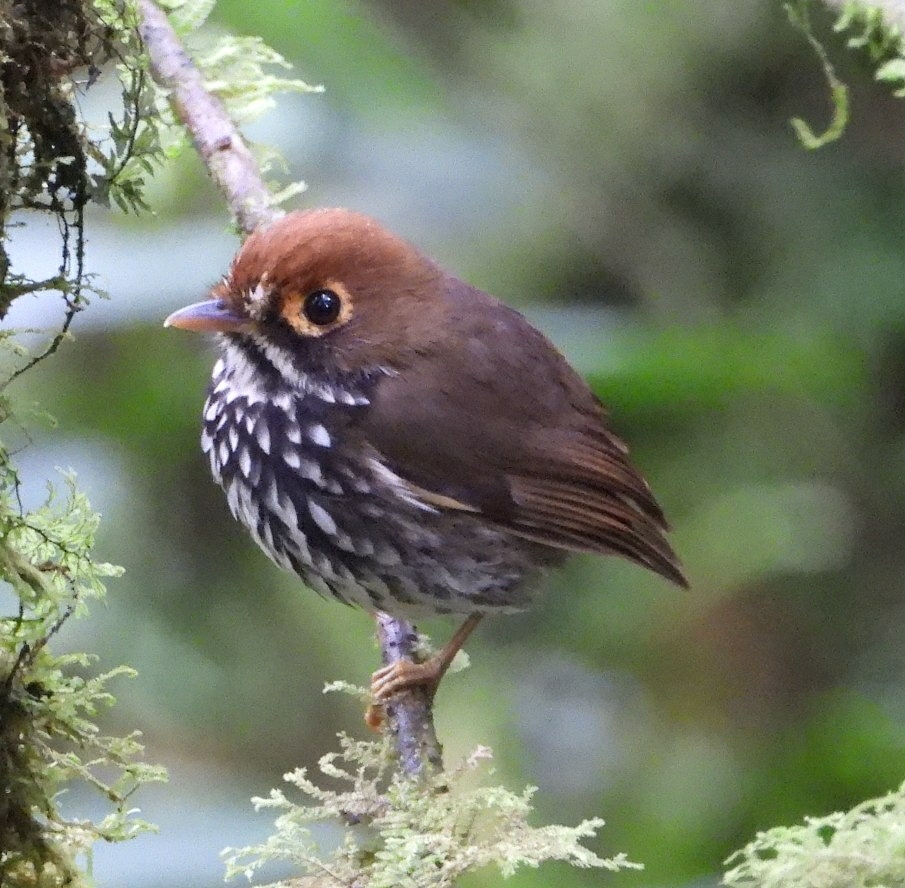
The Peruvian Antpitta is a small antpitta of the eastern slope of the Andes in southern Ecuador and northern Peru. The male has an orange-rufous crown, a white moustache and white underparts scaled with black. It lives hidden in the undergrowth of undisturbed montane forest and forages almost entirely above the ground.
Voice
Probably the song: a single whistle that rises and falls again, repeated every 4 to 15 seconds. When alarmed a repeated, piercing call, eeeup.
Recording: Mitch Lysinger — CC BY-NC-SA 4.0 · xeno-canto
Identification
10 cm. The male has a bright orange-rufous crown and upper nape, a creamy to rufous loral spot, a whitish partial eye-ring and a white moustache bordered below by a black line on a brown face. The throat is white; the breast and belly are white with heavy black scaling that fades on the centre of the breast and the lower belly. The female has a rufous-brown crown and nape, a buff loral spot and eye-ring and a white moustache that continues as a crescent across the upper breast. Both sexes have brown upperparts, a dark bill with a pale tip and pinkish-grey legs.
Confusion species
Ochre-fronted Antpitta Grallaricula ochraceifrons, south of the Marañón, has in the male an ochre forehead and face with an olive-brown hindcrown, and streaked rather than scaled underparts. Ochre-breasted Antpitta Grallaricula flavirostris has an ochre-yellow breast and a yellow bill. Slaty-crowned Antpitta Grallaricula nana has a slate-grey crown and rufous underparts.
Habitat
The undergrowth of humid, undisturbed montane forest, often along streams and in ravines, roughly between 1600 and 2200 m. It avoids disturbed forest. It takes insects, other invertebrates and small frogs from leaves low in the vegetation, rarely on the ground. The nest is a shallow cup of moss on a platform of sticks, 0.8 to 2.4 m up in a sapling; the clutch is a single egg, incubated by both parents.
Where the bird is most at home, classified by the vegetation units of the Andes and the west coast.


Range and movements
In Ecuador on the eastern slope, mainly in Morona-Santiago and Zamora-Chinchipe, with scattered records north to Napo. In Peru on the eastern slope in the north, to the Marañón in Cajamarca, and in the highlands of eastern Piura. Absent from Colombia, Bolivia and the Galápagos. Does not occur outside the guide area.
- Resident
- dark = core range, pale = thinly spread
How and when to look
Listen in undisturbed montane forest on the eastern slope of southern Ecuador for the single rising and falling whistle. The bird sits still on a low branch in dense undergrowth, often along a stream.
Conservation status
Near Threatened. The range is small and the population, estimated at 2,500 to 10,000 mature individuals, is declining through logging, clearance for farming and pasture, and mining.
Scientific name
Grallaricula peruviana | Chapman, 1923
Chapman described the species in 1923 and placed it straight away in the genus where it still stands. The genus Grallaricula was introduced in 1858 by Sclater. The genus name is a diminutive of the genus Grallaria, Modern Latin for 'stilt-walker'. The species name refers to Peru. The specimen the first description was based on came from Chaupe, Peru.