All species › Passerines › Antpittas › Ochre-fronted Antpitta
Ochre-fronted Antpitta | Grallaricula ochraceifrons
Okerkapdwergmierpitta | Ponchito frentiocre | Tovaquinha-de-testa-ocre
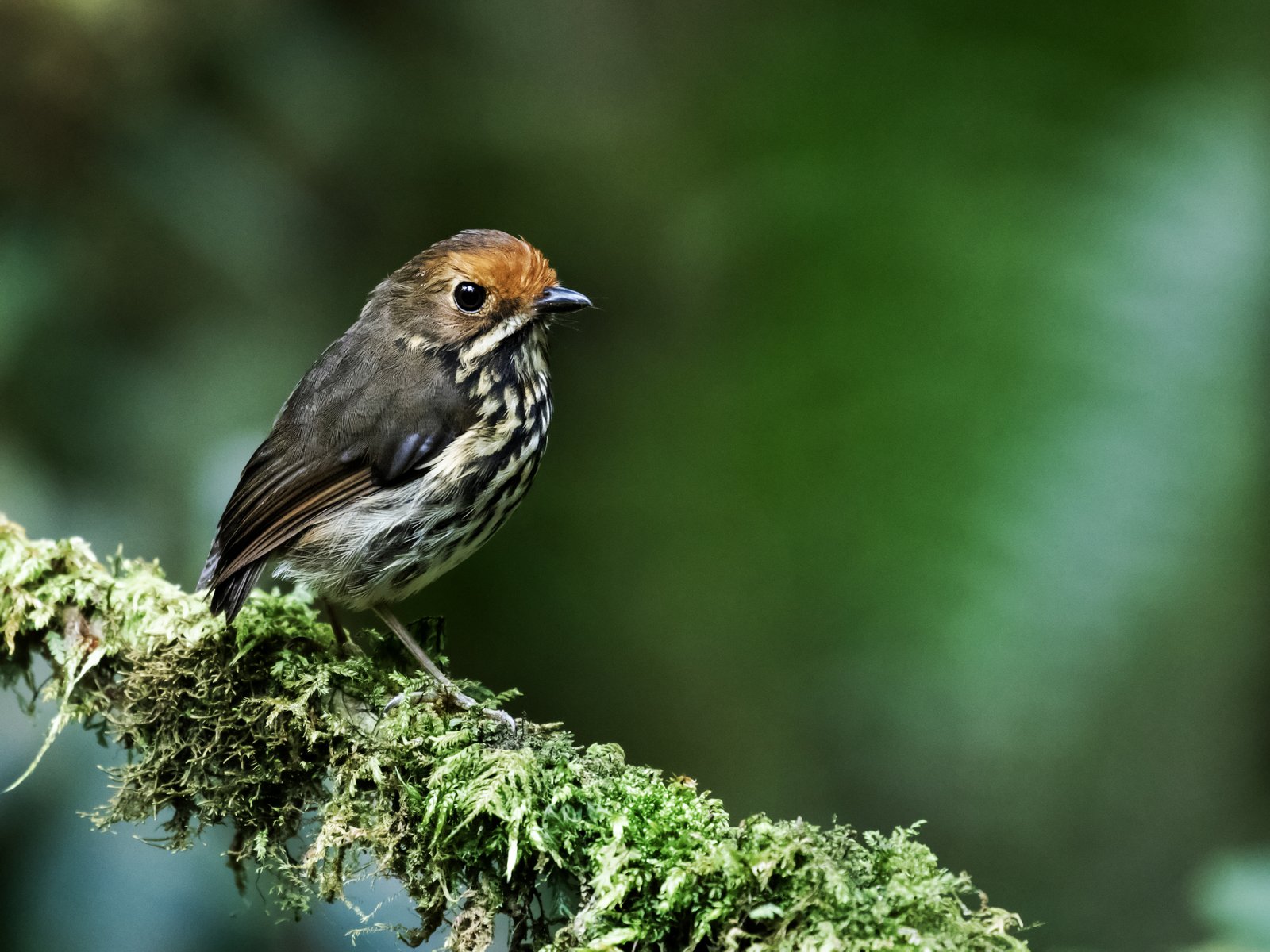
The Ochre-fronted Antpitta occurs only in a small area on the eastern slope of the Andes in northern Peru, south of the Marañón. The male has an ochre forehead and face above white, black-streaked underparts. The species was described only in 1983.
Voice
A descending whistle, wheeuw, and a series of four notes, the last one the strongest and longest and rising. It usually sings from a perch; females sing louder than males.
Recording: Ross Gallardy — CC BY-NC-SA 4.0 · xeno-canto
Identification
10–11 cm. The male has an ochre forehead, forecrown and face with a broad eye-ring; the hindcrown and upperparts are olive-brown. The chin and throat are white, bordered by a black malar stripe; the breast is white with broad black streaks, and the flanks are buff with olive-brown streaks. The bill is black with a pink base to the lower mandible. The female lacks the ochre on the head: the crown is brown with at most a trace of ochre, the eye-ring is broad and creamy white and the upperparts are darker brown.
Confusion species
Peruvian Antpitta Grallaricula peruviana, north of the Marañón, has in the male an orange-rufous crown and scaled rather than streaked underparts. Ochre-breasted Antpitta Grallaricula flavirostris has an ochre-yellow breast and a yellow bill. Rufous-breasted Antpitta Grallaricula leymebambae has rufous underparts and a white throat crescent.
Habitat
Dense undergrowth of wet, epiphyte-laden cloud forest, both tall forest and lower, stunted forest on ridges, roughly between 1800 and 2500 m. It forages low above the ground, taking insects from leaves and twigs. Little is known about its breeding.
Where the bird is most at home, classified by the vegetation units of the Andes and the west coast.


Range and movements
Only in Peru, on the eastern slope of the Andes in southern Amazonas (Cordillera de Colán) and northern San Martín (Abra Patricia and surroundings). Absent from Colombia, Ecuador, Bolivia and the Galápagos. Does not occur outside the guide area.
- Resident
- dark = core range, pale = thinly spread
How and when to look
The area around Abra Patricia in northern Peru is where the species is most often seen. Listen there in the dense undergrowth of the cloud forest for the descending whistle.
Conservation status
Vulnerable. The range is very small, and forest is being lost to logging and farming, accelerated by the road over Abra Patricia and increasing settlement in the region.
Scientific name
Grallaricula ochraceifrons | Graves, O'Neill & Parker, 1983
Graves, O'Neill & Parker described the species in 1983 and placed it straight away in the genus where it still stands. The genus Grallaricula was introduced in 1858 by Sclater. The genus name is a diminutive of the genus Grallaria, Modern Latin for 'stilt-walker'. The species name comes from Modern Latin ochraceus, 'ochre-coloured', and Latin frons, 'forehead'. The specimen the first description was based on came from Abra Patricia, San Martín, Peru.