All species › Passerines › Antpittas › Rusty-breasted Antpitta
Rusty-breasted Antpitta | Grallaricula ferrugineipectus
Noordelijke roestborstdwergmierpitta | Ponchito pechicastaño norteño | Tovaquinha-de-peito-ferrugíneo
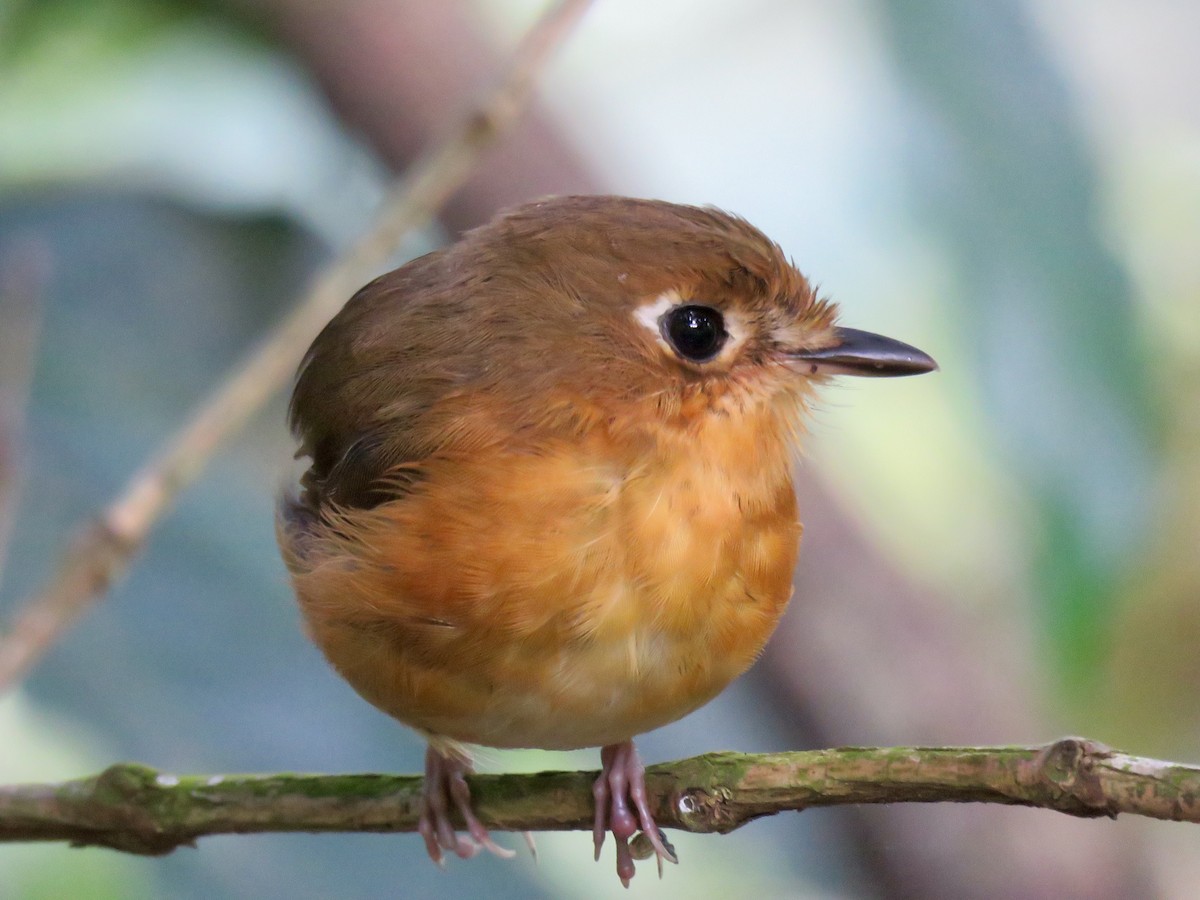
The Rusty-breasted Antpitta is a small antpitta with rufous underparts and a pale eye-ring. Since the split of the former Rusty-breasted Antpitta into a northern and a southern species, it occurs in the guide area only in Colombia. It lives in the undergrowth of humid forest at lower and middle elevations and tolerates some disturbance.
Voice
The song is a short series of clear whistles falling in pitch, faster and lower than in Rufous-breasted Antpitta. Also single soft whistles.
Recording: Brayan Coral Jaramillo — CC BY-NC-SA 4.0 · xeno-canto
Identification
10–11 cm, round and short-tailed, on long pinkish-grey legs. The upperparts are dark brown to slate-brown. The lores and a distinct eye-ring are pale rufous to ochre. The throat and breast are rufous, with a white crescent on the lower throat; the centre of the belly is white. The bill is dark with a paler base. The subspecies rara of the Eastern Andes and Perijá is warmer rufous, including the crown and face. The sexes are alike.
Confusion species
Rufous-breasted Antpitta Grallaricula leymebambae is slightly larger and darker, sings slower and higher and lives higher in bamboo-rich montane forest; it does not occur in Colombia. Slaty-crowned Antpitta Grallaricula nana has a slate-grey crown contrasting with the face, and lives higher. Ochre-breasted Antpitta Grallaricula flavirostris has a paler, ochre-yellow breast and a yellow bill.
Habitat
The undergrowth of humid and semi-humid foothill and montane forest, older secondary growth and forest edge, in the guide area roughly between 1000 and 2200 m. Not tied to bamboo. It forages low in the vegetation, taking insects and other invertebrates from leaves. The nest is a shallow cup of moss on a platform of sticks, low in the undergrowth.
Where the bird is most at home, classified by the vegetation units of the Andes and the west coast.


Range and movements
Only in Colombia: in the Sierra Nevada de Santa Marta, the Serranía de Perijá and the Eastern Andes, with an isolated population in the Cauca Valley (Caldas). Absent from Ecuador, Peru, Bolivia and the Galápagos; birds there belong to Rufous-breasted Antpitta. Outside the guide area in northern and western Venezuela.
- Resident
- dark = core range, pale = thinly spread
How and when to look
Search the Sierra Nevada de Santa Marta or the slopes of the Eastern Andes in dense undergrowth along forest edges. The bird often sits motionless on a low perch and gives itself away by its series of whistles.
Conservation status
Least Concern. It tolerates some forest degradation, but logging and clearance of forest on the lower slopes locally reduce its habitat.
Scientific name
Grallaricula ferrugineipectus | (Sclater, 1857)
Sclater described the species in 1857 as Grallaria ferrugineipectus; because it was later moved to another genus, the author and year stand in brackets. The genus Grallaricula was introduced in 1858 by Sclater. The genus name is a diminutive of the genus Grallaria, Modern Latin for 'stilt-walker'. The species name comes from Latin ferrugineus, 'rusty', and pectus, 'breast'. The specimen the first description was based on came from Caracas, Venezuela.