All species › Passerines › Antbirds › Leaden Antwren
Leaden Antwren | Myrmotherula assimilis
Pelzelns miersluiper | Hormiguerito plomizo | Choquinha-cinzenta
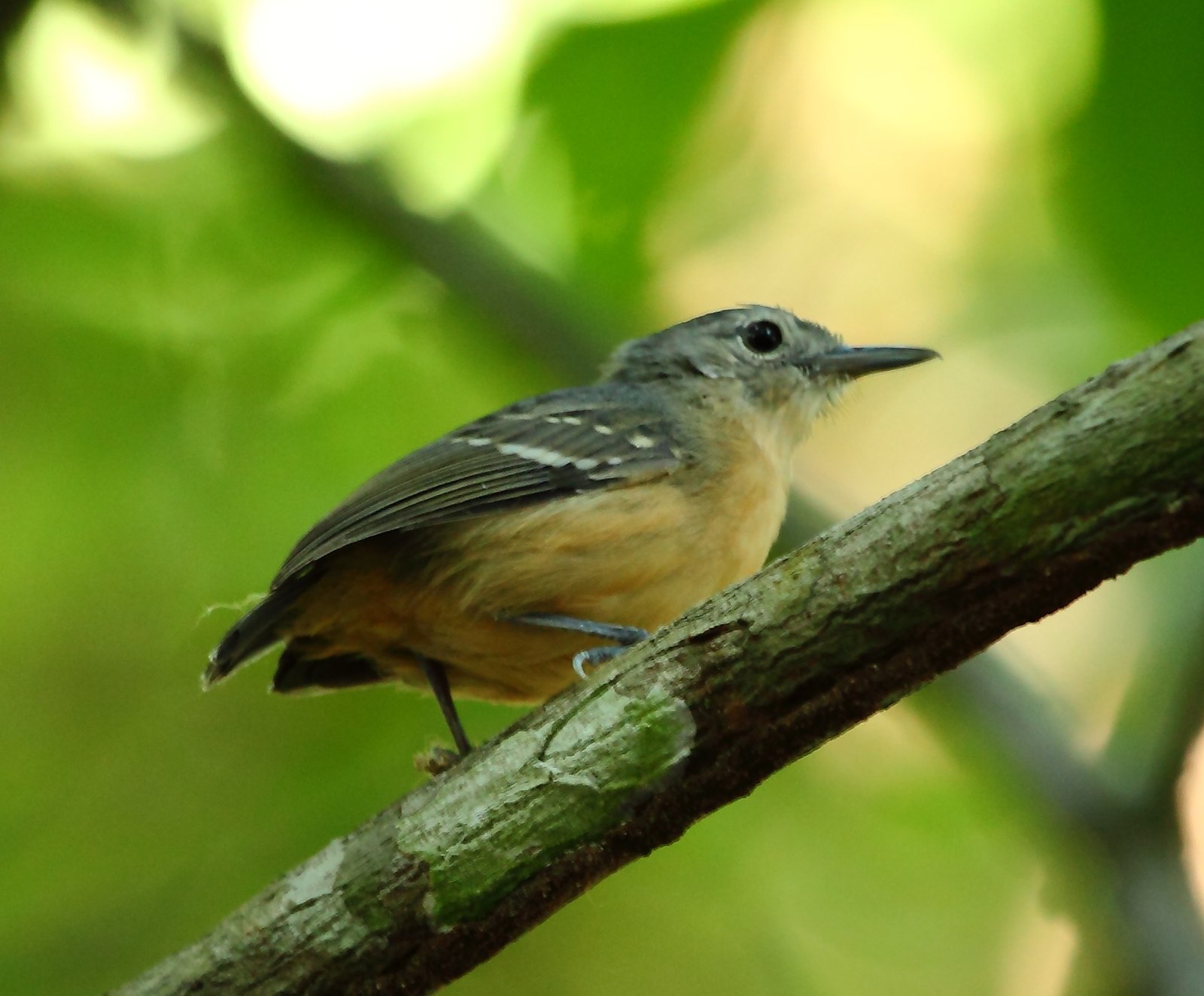
The Leaden Antwren is a small, mainly grey antwren of the flooded forest along the large rivers of Amazonia. It is closely tied to river islands and várzea and is almost absent from terra firme forest. Pairs travel with mixed flocks in the midstorey and lower canopy.
Voice
The song is a short, fast series of high, clear notes. Calls include soft, falling whistles and dry ticks.
Recording: JAYRSON ARAUJO DE OLIVEIRA — CC BY-NC-SA 4.0 · xeno-canto
Identification
9–10 cm, with a short tail and a thin bill. The male is plain pale grey, slightly paler below, without a black throat; the wing coverts are dark grey with white tips forming two or three narrow wing bars, and the tail feathers have narrow white tips. The female is greyish brown above, with buff wing bars, and ochre to buff below, with a paler throat.
Confusion species
The male Grey Antwren Myrmotherula menetriesii has a black throat patch and lives in terra firme forest; the female is warmer ochre below without distinct wing bars. Males of White-flanked Antwren Myrmotherula axillaris and Long-winged Antwren Myrmotherula longipennis have a black throat and breast. Plain-throated Antwren Isleria hauxwelli has black wings with broad white bars and lives close to the ground in terra firme forest.
Habitat
Flooded forest (várzea), river-island forest and forest edges along the large rivers, in the lowlands up to about 300 m. It gleans small insects and spiders from leaves and vine tangles in the midstorey and lower canopy, often in pairs and with mixed flocks. The nest is a small cup suspended in a branch fork.
Where the bird is most at home, classified by the vegetation units of the Andes and the west coast.


Range and movements
Colombia: only in the far south, along the Amazon near Leticia. Ecuador: very scarce; only a few records from river islands in the east. Peru: locally along the Amazon, Marañón, Ucayali and their tributaries in the north-east and east. Bolivia: in the north, in Pando and Beni, and locally in northern Santa Cruz. Absent from the Galápagos. Outside the guide area along the rivers of Brazilian Amazonia.
- Resident
- dark = core range, pale = thinly spread
How and when to look
Visit river islands in the Amazon near Iquitos or Leticia and search the young forest and vine tangles for mixed flocks. Look for a small, grey antwren without a black throat.
Conservation status
Least Concern. The species is locally common in suitable riverine forest; river islands and várzea are still largely intact in many places.
Scientific name
Myrmotherula assimilis | Pelzeln, 1868
Pelzeln described the species in 1868 and placed it straight away in the genus where it still stands. The genus Myrmotherula was introduced in 1858 by Sclater. The genus name is a diminutive of Myrmothera (Greek murmos, 'ant', and thēras, 'hunter'): little ant-hunter. The species name is Latin assimilis, 'similar', for its likeness to related species. The specimen the first description was based on came from Rio Amajaú, Rio Negro, Amazonas, Brazil.