All species › Passerines › Antbirds › Grey Antwren
Grey Antwren | Myrmotherula menetriesii
Grijze miersluiper | Hormiguerito gris | Choquinha-de-garganta-cinza
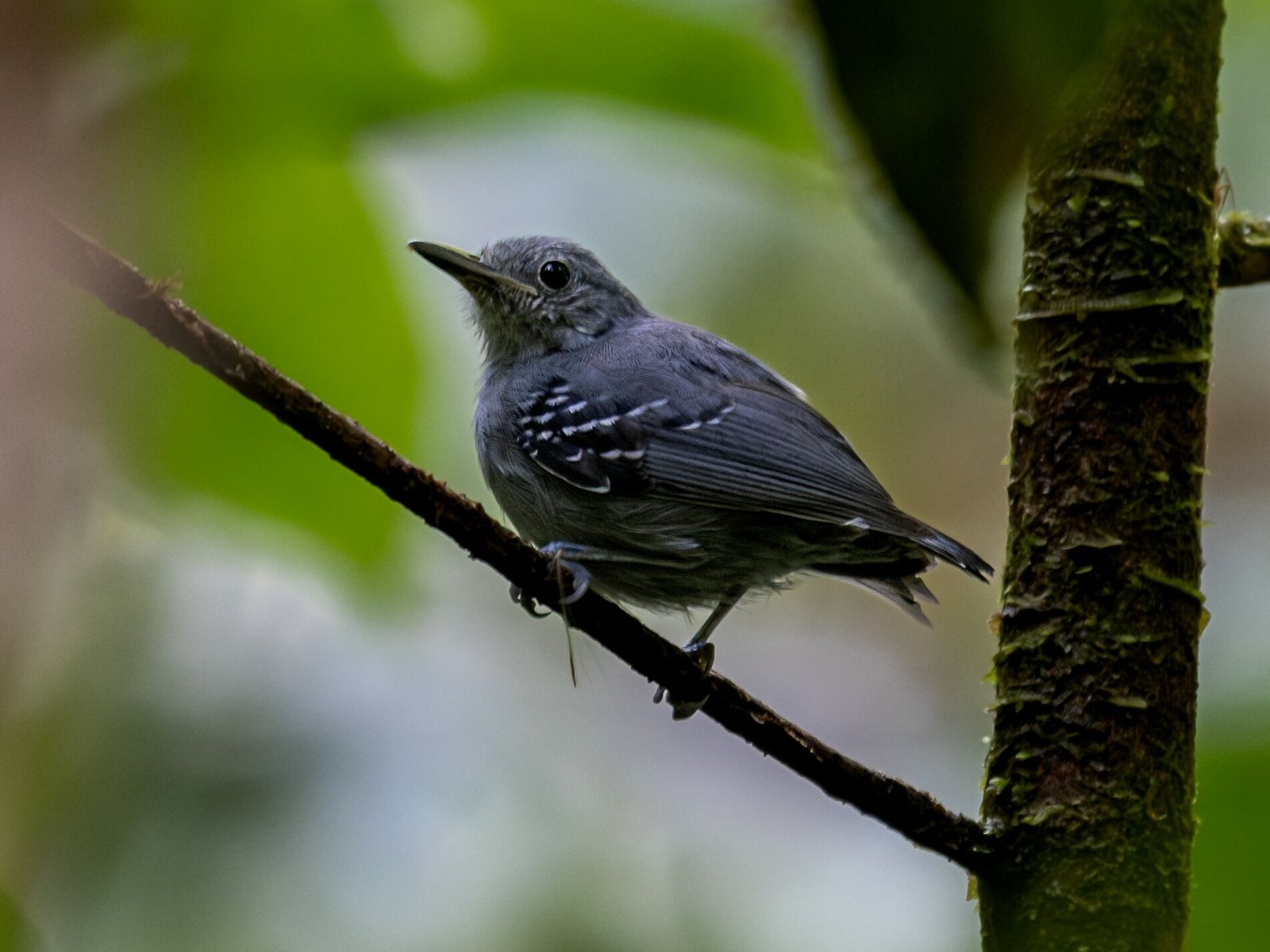
The Grey Antwren is a common, short-tailed antwren of the Amazonian lowlands. It forages higher in the forest than most related species, in the middle storey, and is a regular member of mixed flocks. Among antwrens, the female can be recognised by the combination of grey upperparts and ochre underparts.
Voice
The song is a series of rising, clear notes that speeds up slightly, roughly wee-wee-wee-wee. Calls are short, high notes.
Recording: Jacob Wijpkema — CC BY-NC-SA 4.0 · xeno-canto
Identification
9–10 cm, small, with a short tail. The male is bluish grey, with a black throat patch that varies in size between regions, and black wing coverts with white edges. The female is grey above and uniform ochre-yellow below, without wing bars.
Confusion species
Long-winged Antwren Myrmotherula longipennis forages lower in the forest; the female is brown above. The male White-flanked Antwren Myrmotherula axillaris is blackish below and has white flank plumes. Leaden Antwren Myrmotherula assimilis lives in várzea and on river islands; the male has no black throat and the female is paler below. Ihering's Antwren Myrmotherula iheringi lives in bamboo and the female has wing bars.
Habitat
Middle storey of humid lowland forest, both terra firme and várzea, and mature secondary forest, up to about 1000 m. It searches for insects on the undersides of leaves and on twigs, often with quick wing movements, and almost always travels with mixed flocks.
Where the bird is most at home, classified by the vegetation units of the Andes and the west coast.


Range and movements
Colombia: in the lowlands east of the Andes. Ecuador: in the eastern lowlands. Peru: in the eastern lowlands throughout the country. Bolivia: in the northern and central lowlands. Absent west of the Andes and from the Galápagos. Outside the guide area in Venezuela, the Guianas and Brazilian Amazonia.
- Resident
- dark = core range, pale = thinly spread
How and when to look
Check mixed flocks in the middle storey of lowland forest, from eye level to a few metres above. In females, look for the grey back above the ochre underparts.
Conservation status
Least Concern. Common in extensive lowland forest; locally declining through deforestation.
Scientific name
Myrmotherula menetriesii | (d'Orbigny, ACVMD, 1838)
D'Orbigny, ACVMD described the species in 1838 as Myrmothera Menetriesii; because it was later moved to another genus, the author and year stand in brackets. The genus Myrmotherula was introduced in 1858 by Sclater. The genus name is a diminutive of Myrmothera (Greek murmos, 'ant', and thēras, 'hunter'): little ant-hunter. The species name honours Édouard Ménétries (1802–1861), French entomologist and zoologist who collected in Brazil and later worked in Saint Petersburg. The specimen the first description was based on came from Yuracarés region, Cochabamba, Bolivia.