All species › Passerines › Antbirds › Plain-winged Antwren
Plain-winged Antwren | Myrmotherula behni
Behns miersluiper | Hormiguerito alillano | Choquinha-de-asa-lisa
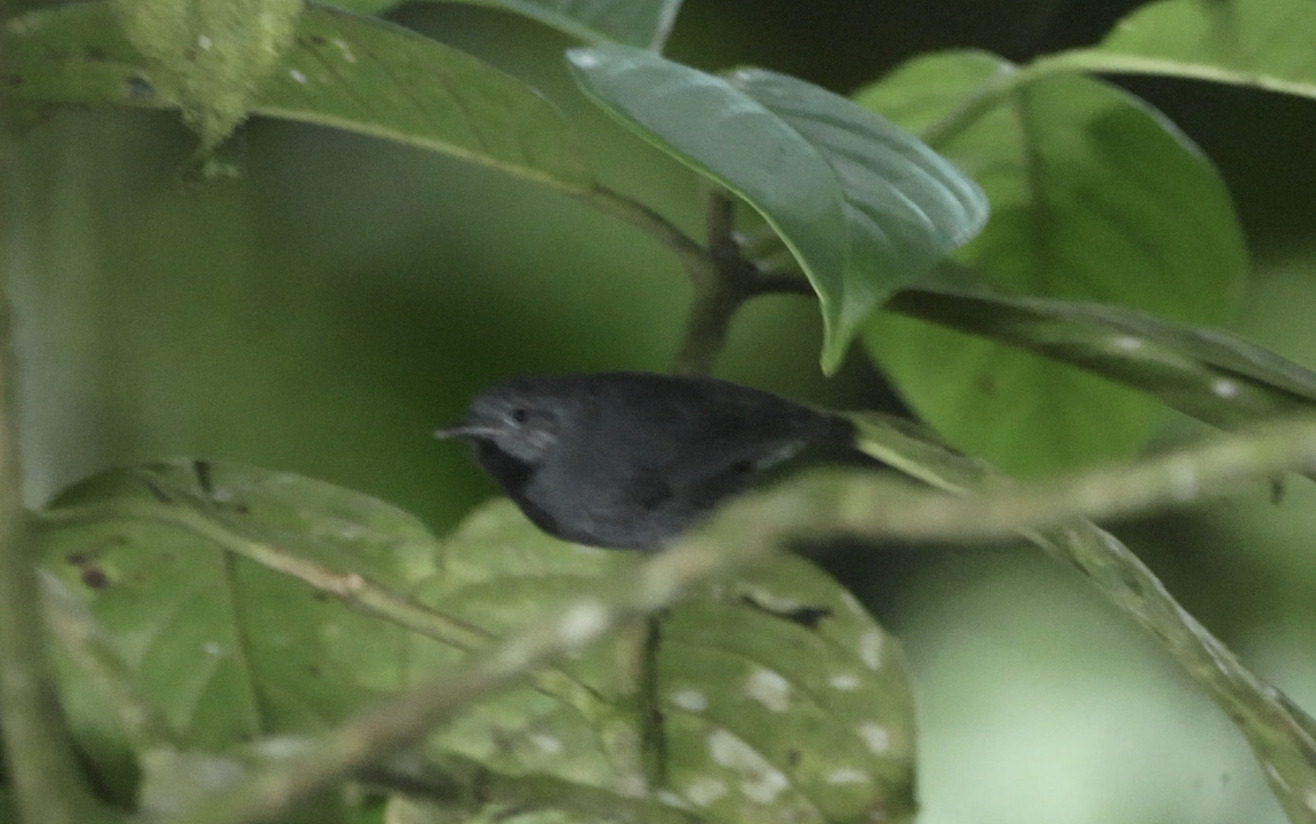
The Plain-winged Antwren is a small grey antwren of foothill and lower montane forest. The male lacks the white wing markings of most related species, to which the English name refers. In the guide area it lives very locally on the eastern slope of the Andes in Ecuador and in the Serranía de la Macarena in Colombia.
Voice
The song is a series of high, simple, slightly downslurred notes, roughly tiuw. Calls are a sharp swee-eek and a nasal kyunh.
Recording: Mitch Lysinger — CC BY-NC-SA 4.0 · xeno-canto
Identification
9 cm, with a short tail. The male is almost entirely grey, paler below, with a black chin, throat and upper breast; the wings are plain, without white tips. The female is olive-brown above with a greyish crown and nape, has a whitish throat and is olive-buff below.
Confusion species
Slaty Antwren Myrmotherula schisticolor lives at the same elevations; the male has white tips to the wing coverts and the female is warmer ochre below. Long-winged Antwren Myrmotherula longipennis and Grey Antwren Myrmotherula menetriesii live lower and have marked wings. Plain Antvireo Dysithamnus mentalis is larger, with a thicker bill.
Habitat
Understorey and middle storey of evergreen foothill and lower montane forest, in Ecuador mostly between 800 and 1600 m and in Colombia between 1200 and 1800 m. In Ecuador often in damp ravines with Guadua bamboo. Pairs glean insects from leaves, often with mixed flocks.
Where the bird is most at home, classified by the vegetation units of the Andes and the west coast.


Range and movements
Colombia: only in the Serranía de la Macarena in Meta. Ecuador: local on the eastern slope, from Sucumbíos to Zamora-Chinchipe. Absent from Peru, Bolivia and the Galápagos. Outside the guide area on the tepuis of southern Venezuela, northern Brazil and Guyana.
- Resident
- dark = core range, pale = thinly spread
How and when to look
Search mixed flocks in foothill forest on the eastern slope of Ecuador, especially in damp ravines with bamboo. In grey antwrens, look for the plain wings of the male.
Conservation status
Least Concern. Scarce and local in the guide area; clearance of foothill forest is the main threat.
Scientific name
Myrmotherula behni | Berlepsch & Leverkühn, PGHMR, 1890
Berlepsch & Leverkühn, PGHMR described the species in 1890 and placed it straight away in the genus where it still stands. The genus Myrmotherula was introduced in 1858 by Sclater. The genus name is a diminutive of Myrmothera (Greek murmos, 'ant', and thēras, 'hunter'): little ant-hunter. The species name honours Wilhelm Friedrich Georg Behn (1808–1878), German zoologist and traveller in South America. The specimen the first description was based on came from Bogotá, Colombia.