All species › Passerines › Antbirds › Yungas Antwren
Yungas Antwren | Myrmotherula grisea
Carrikers miersluiper | Hormiguerito ceniciento | Choquinha-das-yungas
The Yungas Antwren is a grey antwren with a small range in the Yungas of Bolivia and the far south-east of Peru. The English name refers to that region, the Dutch name to M. A. Carriker, who described the species. It is almost entirely confined to the guide area.
Voice
The song is a series of clear, descending whistles. Calls are short, high notes.
No recording with a suitable Creative Commons licence is available for this species yet.
Identification
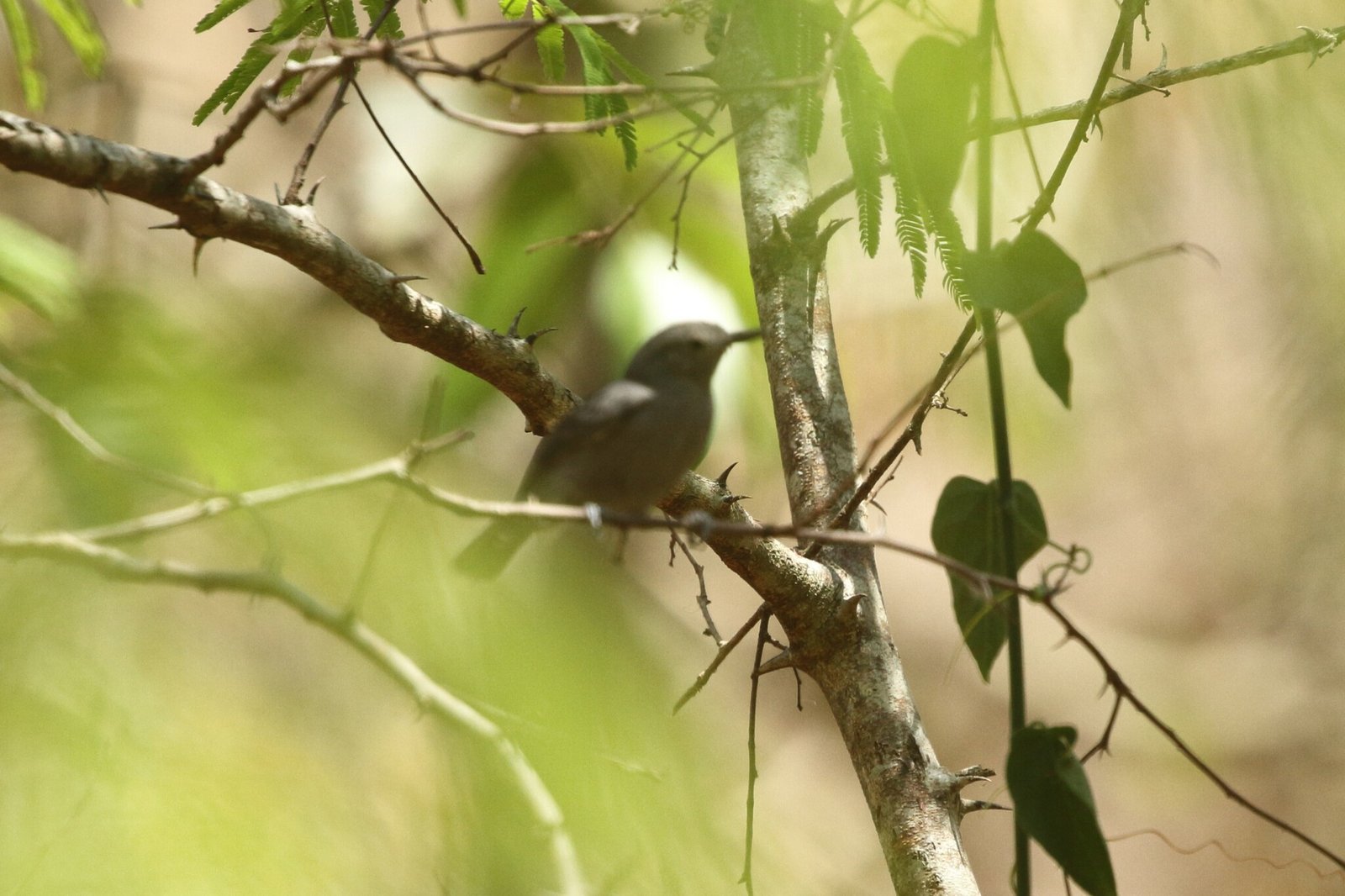
9–10 cm, with a short tail. The male is uniform grey, slightly paler below, with a black throat and upper breast; the wings show at most faint pale tips to the coverts. The female is olive-brown above and warm ochre-yellow below.
Confusion species
Slaty Antwren Myrmotherula schisticolor lives on the eastern slope of Peru south to Puno; the male has distinct white tips to the wing coverts. Long-winged Antwren Myrmotherula longipennis and Grey Antwren Myrmotherula menetriesii live lower, in the Amazonian lowlands, and the males have marked wings. Plain Antvireo Dysithamnus mentalis is larger, with a thicker bill.
Habitat
Understorey and middle storey of humid foothill and lower montane forest, also forest edges, mature secondary forest and vine-rich patches, roughly between 600 and 1650 m. Pairs glean insects from leaves, often with mixed flocks.
Where the bird is most at home, classified by the vegetation units of the Andes and the west coast.


Range and movements
Bolivia: in the Yungas of La Paz, Beni and Cochabamba. Peru: only in the far south-east, in the valleys of Puno near the Bolivian border. Absent from Colombia, Ecuador and the Galápagos. Not known outside the guide area.
- Resident
- dark = core range, pale = thinly spread
How and when to look
Search mixed flocks along roads through foothill and lower montane forest in the Yungas of La Paz and Cochabamba. In grey antwrens, look for the almost unmarked wings of the male.
Conservation status
Least Concern. Because of its small range, however, it depends on the survival of foothill forest, which is locally cleared for agriculture.
Scientific name
Myrmotherula grisea | Carriker, 1935
Carriker described the species in 1935 and placed it straight away in the genus where it still stands. The genus Myrmotherula was introduced in 1858 by Sclater. The genus name is a diminutive of Myrmothera (Greek murmos, 'ant', and thēras, 'hunter'): little ant-hunter. The species name comes from Medieval Latin griseus, 'grey'. The specimen the first description was based on came from Santa Ana, Río Coroico, La Paz, Bolivia.