All species › Passerines › Manakins › Dwarf Tyrant-Manakin
Dwarf Tyrant-Manakin | Tyranneutes stolzmanni
Dwergtiranmanakin | Saltarín enano | Uirapuruzinho
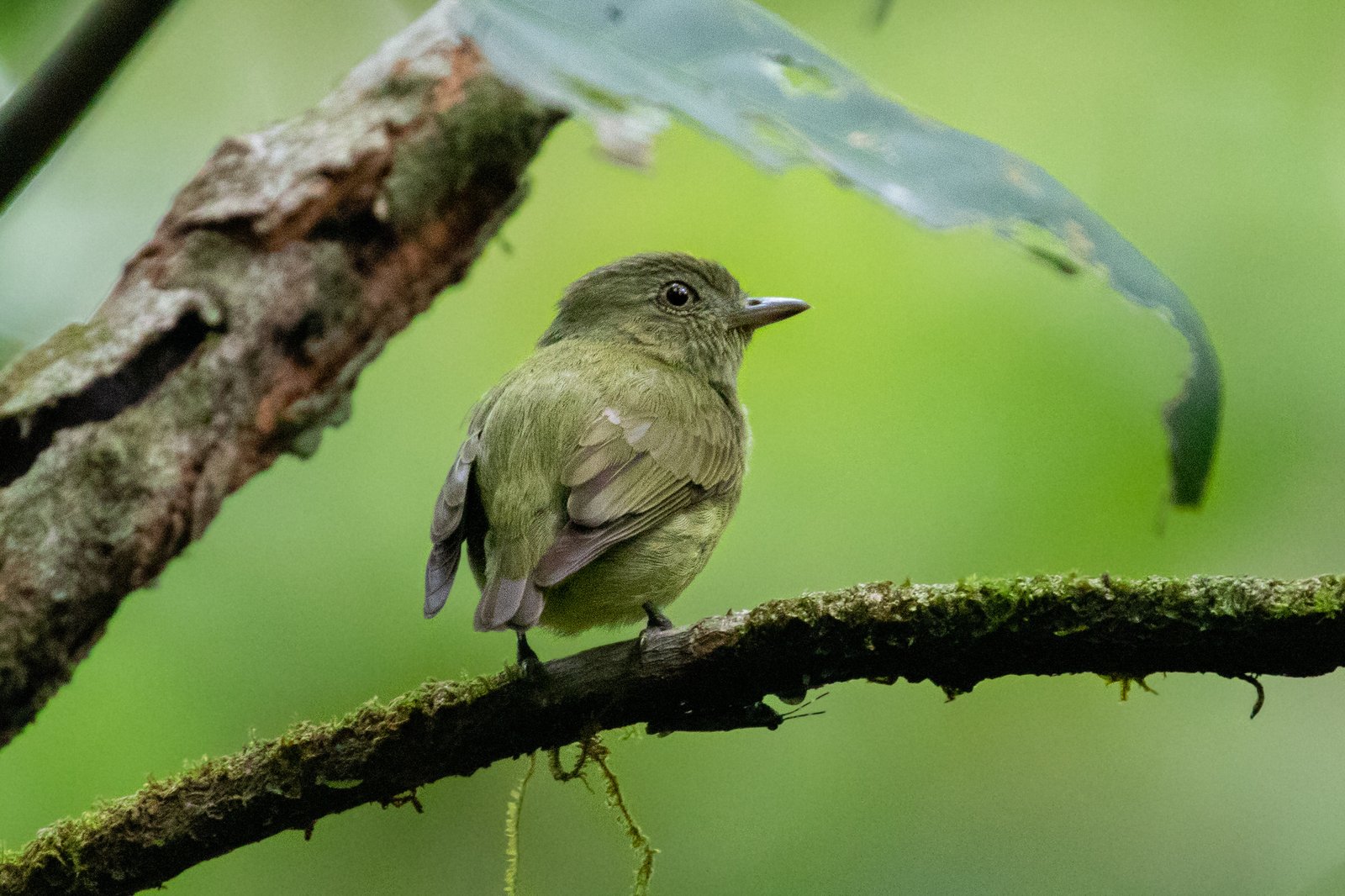
The Dwarf Tyrant-Manakin is one of the smallest passerines of Amazonia: a plain olive-green bird with a stubby tail. In the forest it is noticed mainly by its song, a two-syllabled call repeated day after day from a fixed perch in the middle storey. Males sing scattered through the forest, some distance apart.
Voice
A short, two-part jew-weet or chew-peet, repeated at intervals of a few seconds, sometimes for hours from the same branch. It is one of the sounds heard most often in terra firme forest of western Amazonia.
Recording: JAYRSON ARAUJO DE OLIVEIRA — CC BY-NC-SA 4.0 · xeno-canto
Identification
8 cm, with a small, short bill and a very short tail that gives it a compact look. The upperparts are plain olive-green. The throat and breast are pale grey with an olive wash, and the belly is pale yellow. The iris is pale grey to whitish. There is no crown patch and there are no wing bars. The sexes are alike.
Confusion species
Female Blue-capped Manakin Lepidothrix coronata is greener above, yellowish green below and has a dark iris. Sulphur-bellied Tyrant-Manakin Neopelma sulphureiventer and Saffron-crested Tyrant-Manakin Neopelma chrysocephalum are much larger, with a longer tail and a yellow crown. Females of other manakins, such as White-crowned Manakin Pseudopipra pipra, are larger and have a dark iris.
Habitat
Humid terra firme rainforest, locally also older secondary forest and the edge of várzea, from the lowlands up to about 1000 m in the foothills. It lives in the lower and middle storeys and eats small fruits and insects, which it plucks from leaves in a short sally.
Where the bird is most at home, classified by the vegetation units of the Andes and the west coast.


Range and movements
In Colombia in the lowlands east of the Andes. In Ecuador and Peru in the eastern lowlands and foothills. In Bolivia in the north, in Pando, Beni, La Paz and northern Cochabamba and Santa Cruz. Absent from the Galápagos. Outside the guide area in southern Venezuela and western and central Amazonian Brazil.
- Resident
- dark = core range, pale = thinly spread
How and when to look
In terra firme forest around lodges in Ecuador and Peru, such as at Yasuní or Tambopata, listen for the repeated jew-weet. Then scan the middle storey for a small, motionless bird; it often stays on the same branch for a long time.
Conservation status
Least Concern. The species is common over a large range with much intact rainforest; locally forest is lost to deforestation.
Scientific name
Tyranneutes stolzmanni | (Hellmayr, 1906)
Hellmayr described the species in 1906 as Pipra stolzmanni; because it was later moved to another genus, the author and year stand in brackets. The genus Tyranneutes was introduced in 1881 by Sclater & Salvin. The genus name comes from Greek turanneuō, 'to be a tyrant', from turannos, 'tyrant'. The species name honours Jan Sztolcman (Stolzmann) (1854–1928), a Polish zoologist who collected birds in Peru and Ecuador. The specimen the first description was based on came from Marabitanas, Rio Negro, Amazonas, Brazil.