All species › Passerines › Sapayoa › Sapayoa
Sapayoa | Sapayoa aenigma
Breedbekmanakin | Sapayoa | Sapayoa
The Sapayoa is the only member of the family Sapayoidae. It was long placed with the manakins, but DNA studies place it in an old lineage of suboscine passerines related to the broadbills and pittas of Africa and Asia. In the guide area it lives only in the Chocó rainforest of western Colombia and north-western Ecuador.
Voice
Poorly known. A soft trill and a louder chipping call have been reported.
Recording: Andrew Spencer — CC BY-NC-SA 3.0 · xeno-canto
Identification
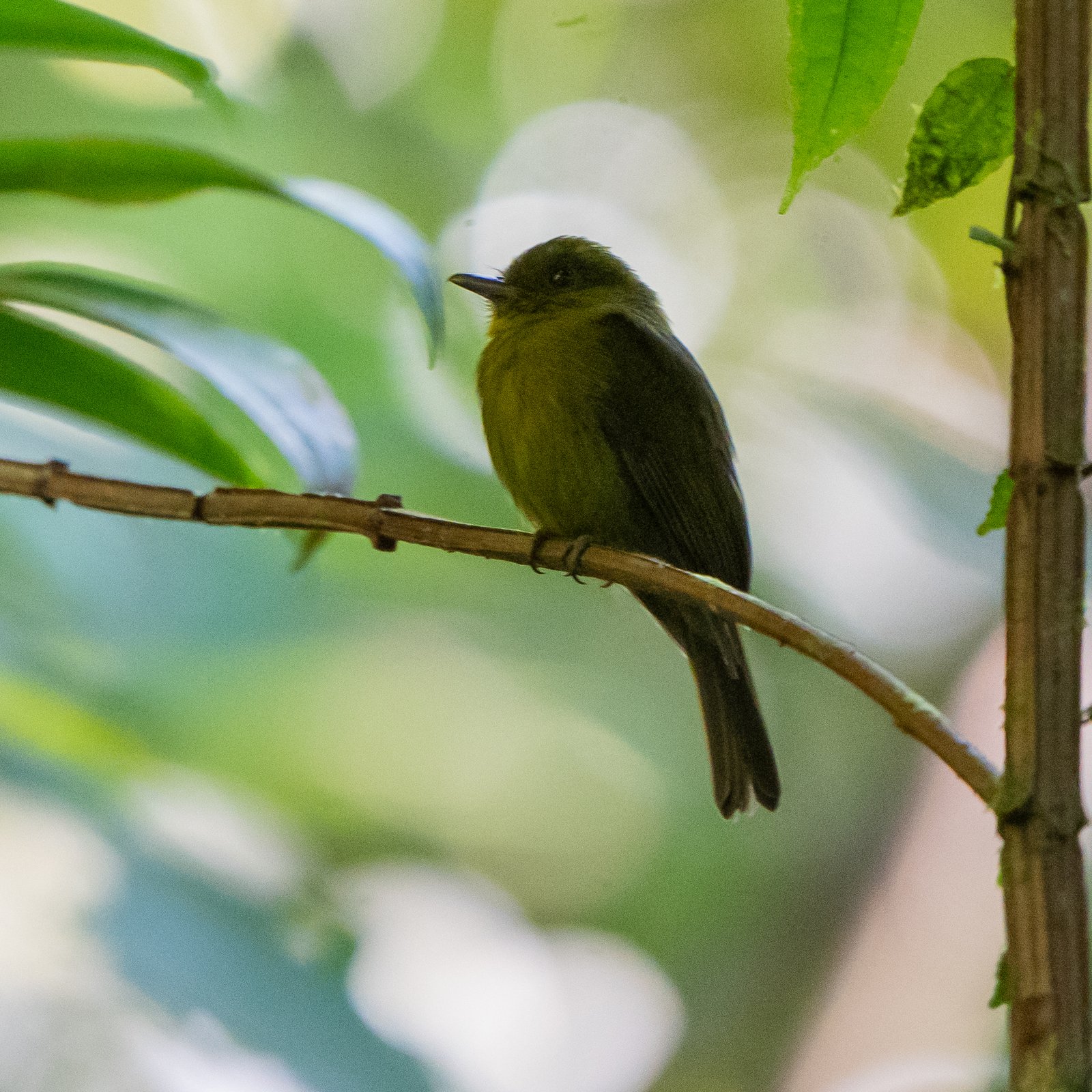
15 cm. Olive-green above with darker wings and tail, yellower olive-green below, without wing bars or other markings. The bill is broad, flat and black, with rictal bristles; the iris is dull reddish brown and the legs are grey. The male has a concealed yellow crown stripe, which the female lacks or shows only faintly.
Confusion species
Female manakins, such as Green Manakin Cryptopipo holochlora, are just as olive-green but smaller, with a shorter tail and a thin, short bill. Pacific Flatbill Rhynchocyclus pacificus also has a broad, flat bill, but has yellow edges to the wing feathers and a larger head. Brown-winged Schiffornis Schiffornis turdina is browner and has a narrow bill.
Habitat
Understorey and mid-storey of humid lowland and hill forest, often in ravines along streams. In Colombia up to about 1200 m, in Ecuador up to about 500 m. It perches still for long periods and sallies out to catch insects; it also eats small fruits and often joins mixed-species feeding flocks. The nest is a pear-shaped, hanging ball of bark strips and fibres with a side entrance, usually over a stream; at one nest an adult male and young males helped the female feed the chicks.
Where the bird is most at home, classified by the vegetation units of the Andes and the west coast.


Range and movements
Colombia: Pacific lowlands and the lower western slope of the West Andes, from the Panama border south into Nariño. Ecuador: the north-west, mainly in Esmeraldas. Absent from Peru, Bolivia and the Galápagos. Outside the guide area only in eastern Panama.
- Resident
- dark = core range, pale = thinly spread
How and when to look
In undisturbed Chocó forest, look for a quiet, olive-green bird with a broad bill in the understorey along streams and ravines, for example in north-western Esmeraldas. The species regularly turns up in mixed flocks with antbirds and flycatchers.
Conservation status
Least Concern. The population is poorly known and probably declining through deforestation in the Chocó; the species is described everywhere as rare to fairly uncommon and local.
Scientific name
Sapayoa aenigma | Hartert, 1903
Hartert described the species in 1903 and placed it straight away in the genus where it still stands. He introduced the genus Sapayoa in that same work. The genus name refers to the Río Sapayo (now Zapallo Grande) in Esmeraldas, Ecuador, where the type was collected. The species name aenigma means 'enigma', because the relationships of the species were long unclear. The specimen the first description was based on came from Zapallo Grande, Esmeraldas, Ecuador.