All species › Parrots › African and New World parrots › Perija Parakeet
Perija Parakeet | Pyrrhura caeruleiceps
Perijaparkiet | Perico de Perijá | Tiriba-de-perijá
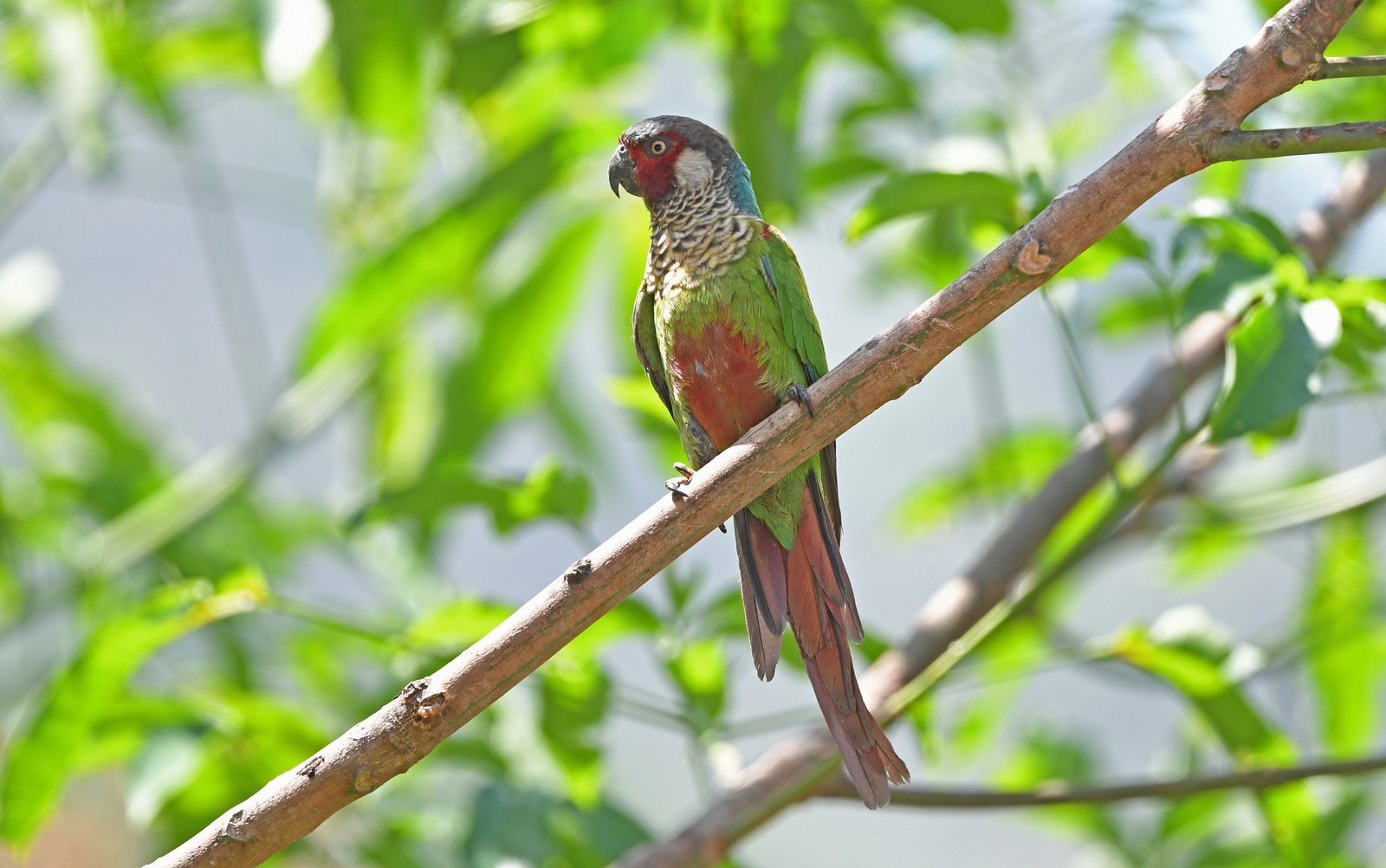
The Perija Parakeet is a Pyrrhura parakeet found only in the Serranía de Perijá, the mountain range on the border of Colombia and Venezuela. It was long regarded as a form of the Painted Parakeet. Its small range and the deforestation within it make it threatened.
Voice
Shrill, grating calls in flight, rapidly repeated by the group, and soft chattering from feeding groups, as in other Pyrrhura species.
No recording with a suitable Creative Commons licence is available for this species yet.
Identification
22 cm, slim, with a long, graduated tail. The plumage is largely green. The forehead and crown are bluish, the face is reddish brown and there is a pale ear patch. The throat and breast are dark with pale edges, giving a scaly pattern. There is a reddish-brown patch in the centre of the belly. The primaries are blue, the tail reddish brown above. The sexes are alike; juveniles are duller.
Confusion species
Scarlet-fronted Parakeet Psittacara wagleri is larger and plain green, with a red forehead and no scaling on the breast. Brown-throated Parakeet Eupsittula pertinax has a brownish throat and breast without scaling and lives mainly lower, in drier country. Santa Marta Parakeet Pyrrhura viridicata has a green breast without scaling and lives only in the Sierra Nevada de Santa Marta.
Habitat
Humid montane forest, cloud forest and their edges, also forest fragments, secondary forest and shade coffee, mainly between about 1000 and 2500 m, locally lower. It eats fruit, seeds and flowers in the treetops. It lives in groups. The nest is in a tree cavity.
Where the bird is most at home, classified by the vegetation units of the Andes and the west coast.


Range and movements
In Colombia on the western slope of the Serranía de Perijá, in Cesar and La Guajira. Absent from the rest of Colombia and from Ecuador, Peru, Bolivia and the Galápagos. Outside the guide area on the Venezuelan side of the Serranía de Perijá.
How and when to look
Search along forest edges and in shade coffee on the Colombian slope of the Serranía de Perijá, for example above Manaure in Cesar; groups give themselves away by their shrill calls.
Conservation status
Endangered. The range is small and the forest in the Serranía de Perijá is being cleared for farming and cattle; the population is small and declining.
Scientific name
Pyrrhura caeruleiceps | Todd, 1947
Todd described the species in 1947 and placed it straight away in the genus where it still stands. The genus Pyrrhura was introduced in 1856 by Bonaparte. The genus name comes from Greek purrhos, 'flame-coloured', and oura, 'tail'. Latin caeruleus, 'blue', and -ceps, 'headed', after the bluish crown. The specimen the first description was based on came from (as per the description).