All species › Parrots › African and New World parrots › Golden-winged Parakeet
Golden-winged Parakeet | Brotogeris chrysoptera
Oranjevleugelparkiet | Catita alidorada | Periquito-de-asa-dourada
The Golden-winged Parakeet is a small, green parakeet with a short, pointed tail from north-eastern South America. Its core range lies in the Guianas, eastern Venezuela and Brazilian Amazonia. In the guide area it is known only from a few unconfirmed records in eastern Colombia and is treated as a vagrant or hypothetical species.
Voice
A shrill, high chatter and rapidly repeated, piercing calls, mainly in flight. Groups call a lot, also while feeding.
Recording: JAYRSON ARAUJO DE OLIVEIRA — CC BY-NC-SA 4.0 · xeno-canto
Identification
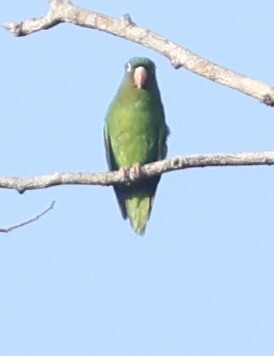
17 cm, with a short, pointed tail and a pale, horn-coloured bill. The plumage is green, slightly darker on the head. There is a small brownish or orange spot on the chin and a narrow, dark band on the forehead above the bill. The primary coverts are orange to golden yellow and form a patch in the wing that is mainly visible in flight. The sexes are alike; juveniles show less orange in the wing.
Confusion species
Cobalt-winged Parakeet Brotogeris cyanoptera has blue flight feathers, a yellowish forehead and no orange wing patch. Orange-chinned Parakeet Brotogeris jugularis has an orange chin spot and brown shoulders, but green primary coverts, and in the guide area occurs only in northern Colombia. Tui Parakeet Brotogeris sanctithomae has a yellow forehead and lives along the Amazon and its tributaries. White-winged Parakeet Brotogeris versicolurus has white and yellow panels in the wing.
Habitat
Humid lowland forest, forest edges, savanna woodland and semi-open country with scattered trees, also plantations and gardens, mostly below 1000 m. It eats fruit, seeds, flowers and nectar, often in small groups high in the trees. The nest is in a tree cavity or in an arboreal termite nest.
Where the bird is most at home, classified by the vegetation units of the Andes and the west coast.


Range and movements
In Colombia only a few unconfirmed records in the east, near the borders with Venezuela and Brazil; the species is listed there as hypothetical. Absent from Ecuador, Peru, Bolivia and the Galápagos. Outside the guide area in eastern Venezuela, the Guianas and Brazilian Amazonia, mainly east of the Rio Negro and along the lower Amazon.
How and when to look
There is no regular site in the guide area. Check small groups of Brotogeris parakeets in the far east of Colombia for orange in the wing and document any sighting with photographs or sound recordings.
Conservation status
Least Concern. Within its range the species is common; locally it is trapped for the cage-bird trade.
Scientific name
Brotogeris chrysoptera | (Linnaeus, 1766)
Linnaeus described the species in 1766 as Psittacus chrysopterus; because it was later moved to another genus, the author and year stand in brackets. The genus Brotogeris was introduced in 1825 by Vigors. The genus name comes from Greek brotos, 'man, mortal', and gērus, 'voice, speech', for the ability to mimic human speech. The species name comes from Greek khrusos, 'gold', and pteron, 'wing', for the orange-yellow wing patch. The specimen the first description was based on came from the Guianas.