All species › Parrots › African and New World parrots › Bronze-winged Parrot
Bronze-winged Parrot | Pionus chalcopterus
Bronsvleugelmargrietje | Loro alibronceado | Maitaca-de-asa-bronzeada
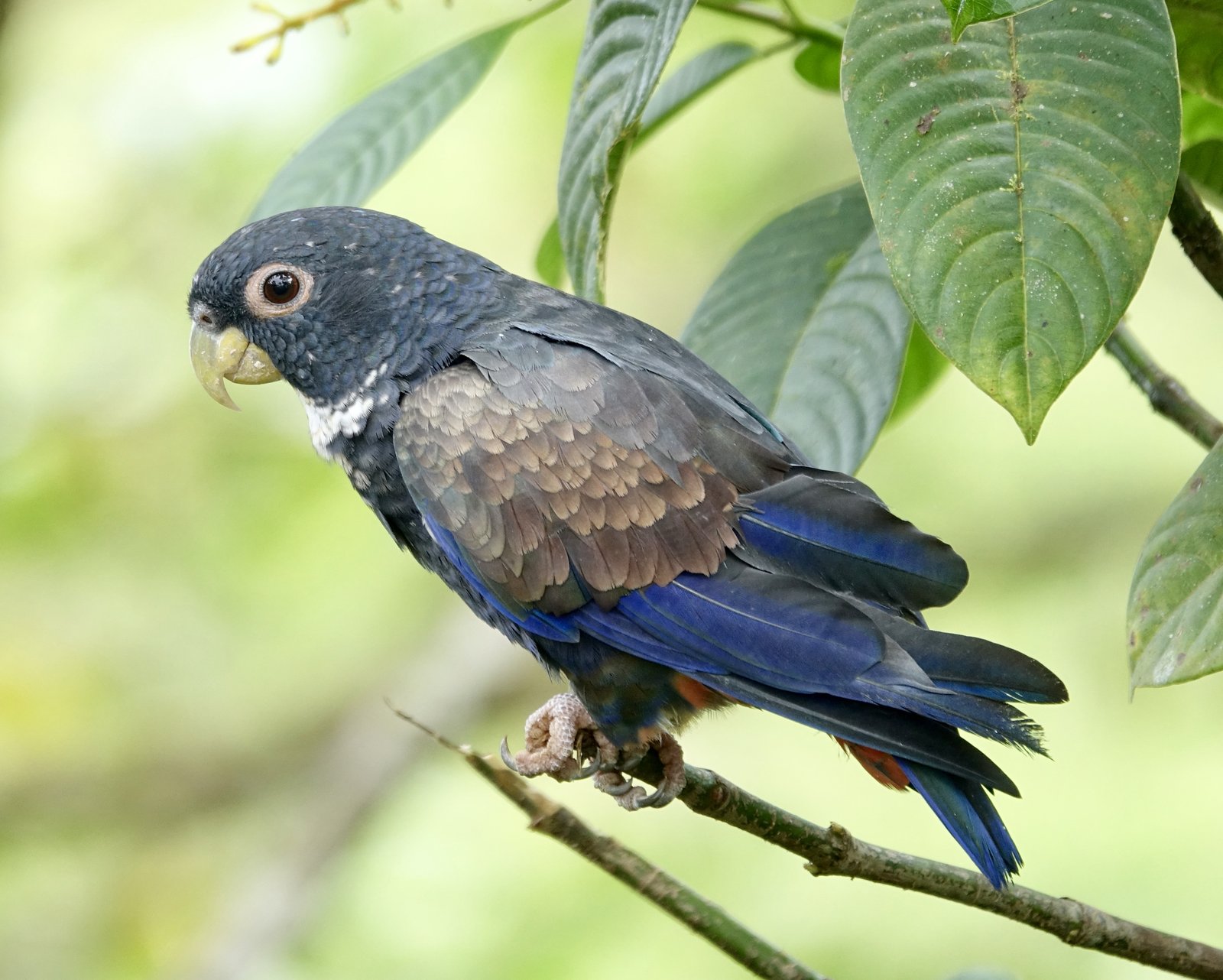
The Bronze-winged Parrot is a dark-coloured Pionus parrot of the montane forests of the northern Andes. The plumage is largely dark blue and bronze-brown, without the green of the other species of the genus Pionus. In flight the blue flight feathers and pale blue underwing stand out.
Voice
A hoarse, harsh call such as kraak-kraak, repeated in flight, and soft chattering from perched flocks.
Recording: Brian Cox — CC BY-NC-SA 4.0 · xeno-canto
Identification
28 cm, stocky, with a short, square tail and a yellowish bill. The head and underparts are dark bluish violet; the chin is white, with a pink patch on the throat below it. The mantle and wing coverts are dark bronze-brown. The flight feathers and tail are blue, and the underwing is pale blue. There is a bare pink ring around the eye. The undertail coverts are red. The sexes are alike. Juveniles are duller, with greenish feather edges.
Confusion species
Red-billed Parrot Pionus sordidus is olive green, with a red bill. Blue-headed Parrot Pionus menstruus has a bright blue head and a green body, and lives lower. Speckle-faced Parrot Pionus tumultuosus has a green body and a whitish or purplish red, speckled head, and lives higher. In silhouette all Pionus parrots look alike; in good light the dark colour of this species is the main feature.
Habitat
Humid foothill and montane forest, cloud forest, forest edges and semi-open country with tall trees, also coffee plantations, roughly between 500 and 2800 m, locally lower in western Ecuador. It eats fruit, seeds and flowers in the canopy. It nests in tree cavities.
Where the bird is most at home, classified by the vegetation units of the Andes and the west coast.


Range and movements
In Colombia in all three Andean ranges, mainly on the slopes above the Magdalena and Cauca valleys and on the western slope of the Western Andes. In Ecuador on the western slope of the Andes and in the south, locally into the western lowlands. In Peru only in the far north-west. Absent from Bolivia and the Galápagos. Outside the guide area in the Serranía de Perijá and the Andes of western Venezuela.
- Resident
- dark = core range, pale = thinly spread
How and when to look
Along roads through montane forest on the western slope in northern Ecuador, for example around Mindo, and in the Colombian Andes; in the morning and evening flocks fly calling across the valleys. In flight look for the dark colour and pale blue underwing.
Conservation status
Least Concern. The species tolerates partly deforested landscapes, but deforestation of the Andean slopes and trapping for the trade are local threats.
Scientific name
Pionus chalcopterus | (Fraser, 1841)
Fraser described the species in 1841 as Psittacus chalcopterus; because it was later moved to another genus, the author and year stand in brackets. The genus Pionus was introduced in 1832 by Wagler. The genus name comes from Greek piōn, 'fat, plump', for the stocky build. The species name comes from Greek khalkos, 'bronze, copper', and pteron, 'wing'. The specimen the first description was based on came from Bogotá, Colombia.