All species › Parrots › African and New World parrots › Blue-headed Parrot
Blue-headed Parrot | Pionus menstruus
Zwartoormargrietje | Loro cabeciazul | Maitaca-de-cabeça-azul
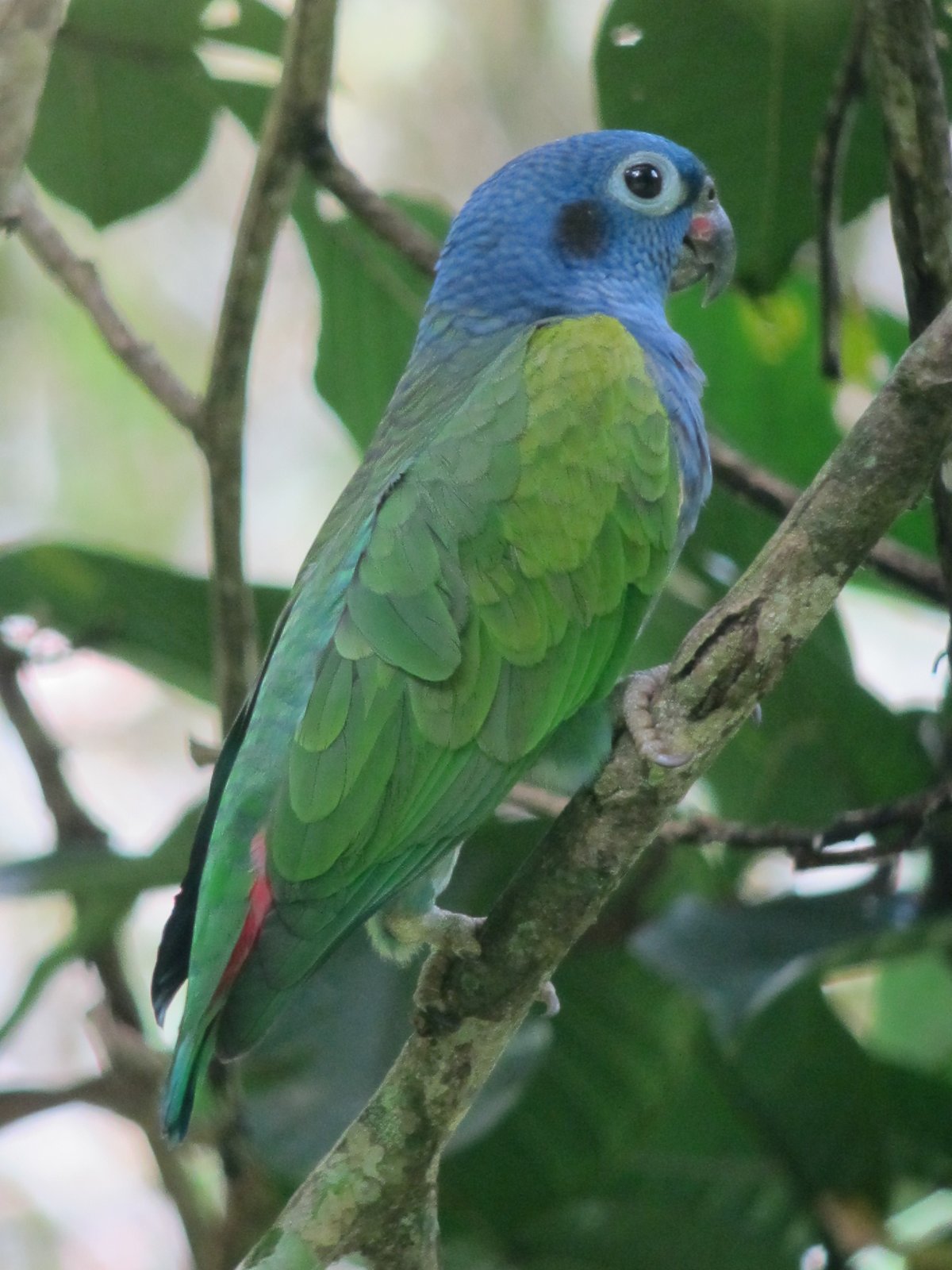
The Blue-headed Parrot is the most widespread Pionus parrot in the lowlands of the guide area, with a bright blue head and neck above a green body. Pairs and flocks fly high over the forest with the deep wingbeats of the genus Pionus, which reach far below the body line. In south-eastern Peru the species is a regular visitor to clay licks along the rivers.
Voice
A high, shrill call such as kwee-kweek, repeated in flight; flock members call over each other and can be heard from far away.
Recording: JAYRSON ARAUJO DE OLIVEIRA — CC BY-NC-SA 4.0 · xeno-canto
Identification
27 cm, stocky, with a short, square tail. The head, neck and upper breast are bright blue, with a black patch across the ear coverts; the throat often shows some pink or red. The body is green. The bill is dark, with red at the base of the upper mandible. The undertail coverts are red, and the tail feathers are red at the base. The sexes are alike. Juveniles have a largely green head with little blue.
Confusion species
Red-billed Parrot Pionus sordidus has an entirely red bill and a duller, olive green head with a blue wash, and lives higher. Bronze-winged Parrot Pionus chalcopterus is dark bluish brown with bronze wings. Orange-cheeked Parrot Pyrilia barrabandi has a black head with an orange cheek patch. Short-tailed Parrot Graydidascalus brachyurus is all green. Amazons of the genus Amazona are larger, with a longer tail and no blue head.
Habitat
Humid terra firme lowland forest, flooded forest, foothill forest, forest edges, secondary forest and semi-open country with tall trees, from the lowlands to roughly 1500 m. It eats fruit, seeds and flowers in the canopy and visits clay licks. It nests in tree cavities, including dead palms.
Where the bird is most at home, classified by the vegetation units of the Andes and the west coast.


Range and movements
In Colombia east of the Andes, and west of them in the lowlands of the Chocó, the north and the Magdalena Valley. In Ecuador in the eastern lowlands and foothills, and in the west, mainly the north-west. In Peru in the Amazonian lowlands and the foothills of the eastern slope. In Bolivia in the lowlands of the north and centre. Absent from the Galápagos. Outside the guide area from Costa Rica and Panama to Venezuela, the Guianas, Trinidad and much of Brazil.
- Resident
- dark = core range, pale = thinly spread
How and when to look
From canopy towers or at clay licks in the Amazonian lowlands of Ecuador and Peru, where flocks arrive calling in the morning. In flight the blue head shows in good light.
Conservation status
Not Evaluated in this taxonomic treatment. The species is common over much of its range and tolerates forest edges and secondary forest; trapping for the trade and deforestation are local threats.
Scientific name
Pionus menstruus | (Linnaeus, 1766)
Linnaeus described the species in 1766 as Psittacus menstruus; because it was later moved to another genus, the author and year stand in brackets. The genus Pionus was introduced in 1832 by Wagler. The genus name comes from Greek piōn, 'fat, plump', for the stocky build. The species name comes from Latin menstruus, 'monthly, menstrual', from mensis, 'month'; it possibly refers to the red undertail coverts. The specimen the first description was based on came from Suriname.