All species › Parrots › African and New World parrots › Speckle-faced Parrot
Speckle-faced Parrot | Pionus tumultuosus
Pruimkopmargrietje | Loro tumultuoso | Maitaca-de-cara-pintada
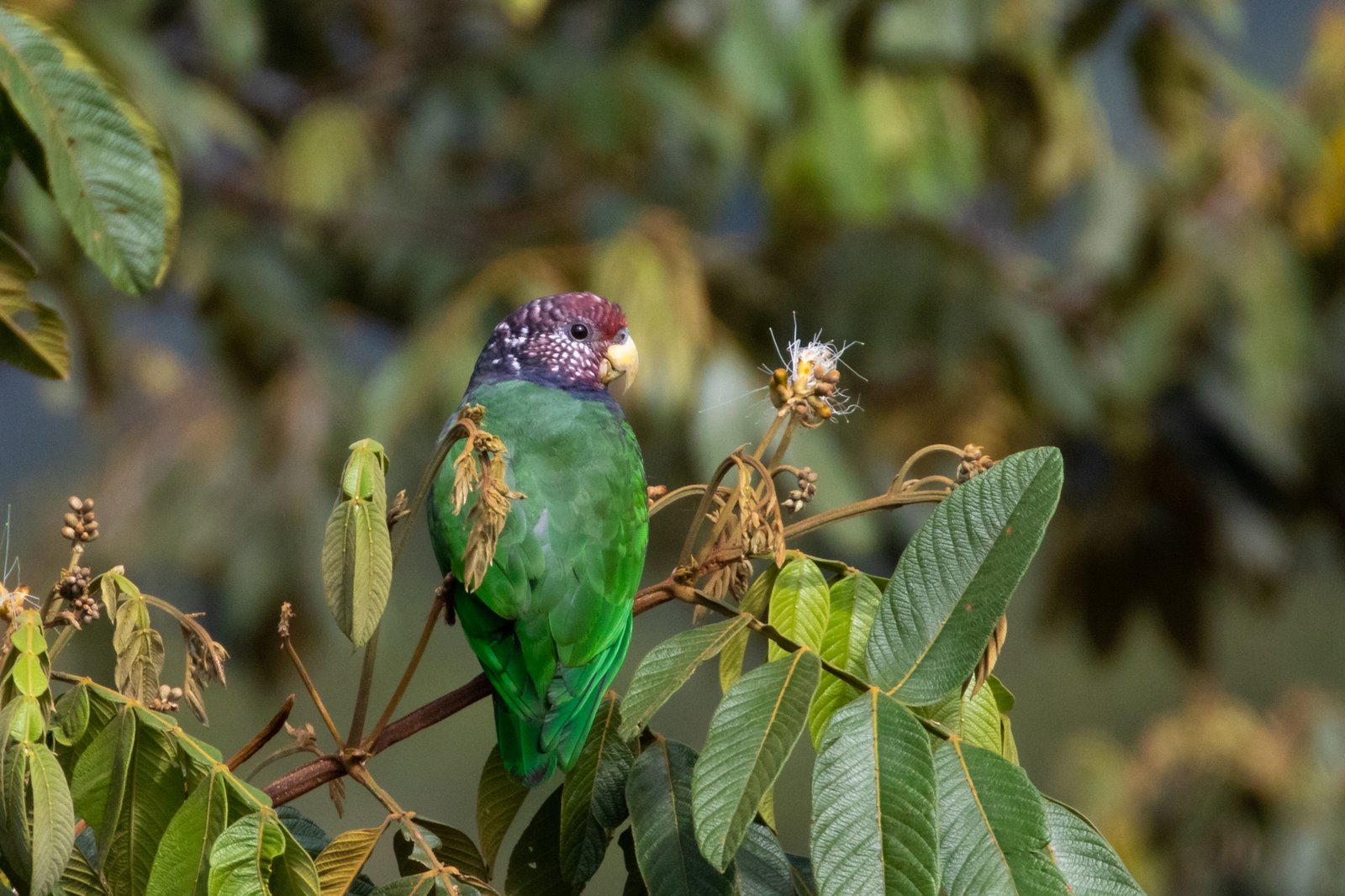
The Speckle-faced Parrot is the Pionus parrot of the upper montane forest of the Andes. In the broad treatment followed here the species comprises two clearly different forms: in the south a form with a purplish red, speckled head, and in the north a form with a whitish, dark-speckled head, often treated as a separate species, Pionus seniloides. Flocks fly with deep wingbeats over the cloud forest.
Voice
A hoarse, harsh call such as kraak, repeated in flight, and chattering notes from perched flocks.
Recording: Jacob Wijpkema — CC BY-NC-SA 4.0 · xeno-canto
Identification
29 cm, stocky, with a short, square tail and a yellowish bill. The body is green. In the southern form the head and throat are purplish red to plum-coloured with white speckles, and the breast is dull purplish. In the northern form the head is whitish with grey and dark speckles, and the breast dull purplish grey. There is a bare grey ring around the eye. The undertail coverts are red. The sexes are alike. Juveniles are greener on the head and breast.
Confusion species
Red-billed Parrot Pionus sordidus has a red bill and a bluish head, and lives lower. Bronze-winged Parrot Pionus chalcopterus is dark bluish brown with bronze wings and also lives lower. Scaly-naped Amazon Amazona mercenarius is larger, with a longer tail and a green head with a scaly nape. Rusty-faced Parrot Hapalopsittaca amazonina and its relatives are smaller, with red or orange on the face and blue in the wing.
Habitat
Humid montane forest, cloud forest and their edges, also partly cleared slopes with scattered trees, roughly between 1500 and 3300 m. It eats fruit, seeds and flowers in the canopy and wanders with the food supply, sometimes lower down the slopes. It nests in tree cavities.
Where the bird is most at home, classified by the vegetation units of the Andes and the west coast.


Range and movements
In Colombia (northern form) in the Andes, mainly the Central and Eastern Andes. In Ecuador (northern form) on both slopes of the Andes. In Peru the northern form in the north, and further south along the eastern slope the southern form. In Bolivia (southern form) on the eastern slope, in La Paz and Cochabamba. Absent from the Galápagos. Outside the guide area in the Andes of Venezuela.
- Resident
- dark = core range, pale = thinly spread
How and when to look
Along roads through cloud forest on the eastern slope, for example in northern Ecuador or on the road to Manu in Peru; in the morning flocks fly calling over the slopes. In fruiting trees they often sit still and hidden in the foliage.
Conservation status
Not Evaluated in this taxonomic treatment. The species occurs over a large area and tolerates some forest disturbance, but deforestation of montane forest is a local threat.
Scientific name
Pionus tumultuosus | (Tschudi, 1844)
Tschudi described the species in 1844 as Psittacus tumultuosus; because it was later moved to another genus, the author and year stand in brackets. The genus Pionus was introduced in 1832 by Wagler. The genus name comes from Greek piōn, 'fat, plump', for the stocky build. The species name comes from Latin tumultuosus, 'uproarious, noisy', from tumultus, 'uproar'. The specimen the first description was based on came from Peru.