All species › Parrots › African and New World parrots › Scaly-headed Parrot
Scaly-headed Parrot | Pionus maximiliani
Maximiliaanmargrietje | Loro choclero | Maitaca-verde
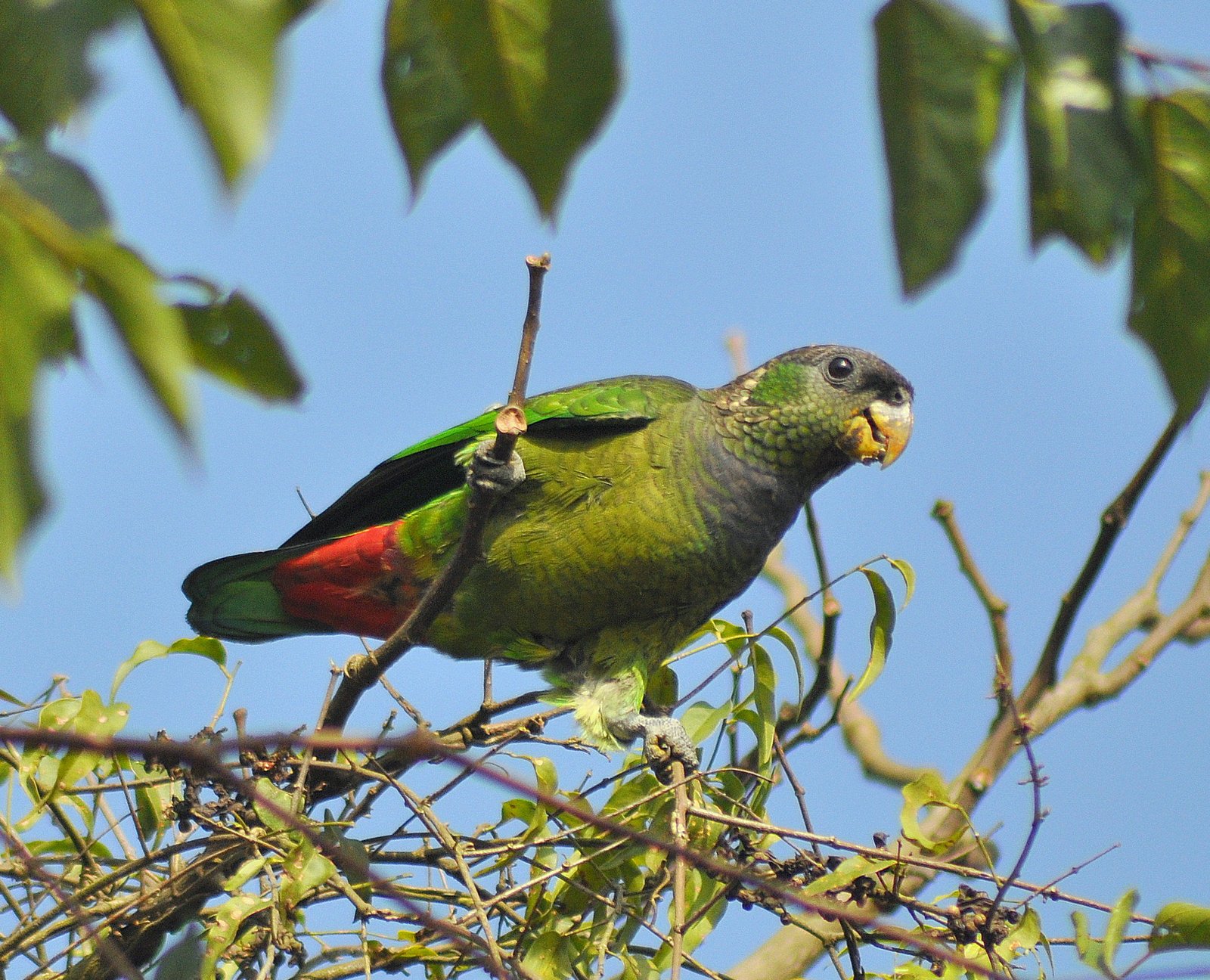
The Scaly-headed Parrot is a medium-sized, short-tailed parrot of dry and semi-humid forests in central and eastern South America, which in the guide area occurs only in south-eastern Bolivia. Its scientific name honours Prince Maximilian of Wied-Neuwied, who collected birds in Brazil. Pairs and flocks fly with the deep wingbeats typical of the genus Pionus.
Voice
A hoarse, shrill call such as kree-kree or chek, repeated in flight. Perched flocks give softer chattering notes.
Recording: Marcos E. Sosa — CC BY-NC-SA 4.0 · xeno-canto
Identification
29 cm, stocky, with a short, square tail. The plumage is dull green; the feathers of the head and neck have dark edges, giving a scaly pattern. The throat and upper breast are dull purplish blue. There is a bare, whitish ring around the eye. The bill is yellowish with a dark base. The undertail coverts are red. The sexes are alike. Juveniles are greener, with less blue on the breast.
Confusion species
Blue-headed Parrot Pionus menstruus has a bright blue head and breast and a black ear patch, and lives in the humid lowlands further north. Turquoise-fronted Amazon Amazona aestiva is larger, with a blue forehead, yellow on the face and a red speculum. Tucuman Amazon Amazona tucumana is larger, with a red forehead, and lives in montane forest. Green-cheeked Parakeet Pyrrhura molinae is smaller, with a long, reddish brown tail.
Habitat
Chiquitano dry forest, Chaco, semi-humid forest in the Andean foothills (Tucuman-Bolivian forest), gallery forest and open country with trees, from the lowlands to roughly 2000 m. It eats fruit, seeds and flowers and also visits maize fields. It nests in tree cavities.
Where the bird is most at home, classified by the vegetation units of the Andes and the west coast.


Range and movements
In Bolivia in the south-east, in Santa Cruz, Chuquisaca and Tarija, both in the lowlands and in the eastern foothills of the Andes. Absent from Colombia, Ecuador, Peru and the Galápagos. Outside the guide area in eastern and central Brazil, Paraguay and northern Argentina.
- Resident
- dark = core range, pale = thinly spread
How and when to look
In south-eastern Bolivia along forest edges and gallery forest in the foothills, for example around Santa Cruz and Tarija. In the morning and evening flocks fly calling between roosts and feeding areas.
Conservation status
Least Concern. The species has a large range and tolerates partly cleared landscapes, but deforestation in the Chaco and trapping for the cage-bird trade are local threats.
Scientific name
Pionus maximiliani | (Kuhl, 1820)
Kuhl described the species in 1820 as Psittacus Maximiliani; because it was later moved to another genus, the author and year stand in brackets. The genus Pionus was introduced in 1832 by Wagler. The genus name comes from Greek piōn, 'fat, plump', for the stocky build. The species name honours Prince Maximilian of Wied-Neuwied (1782–1867), German naturalist who collected in Brazil from 1815 to 1817. The specimen the first description was based on came from Rio Peruípe, Bahia, Brazil.