All species › Grebes › Grebes › Eared Grebe
Eared Grebe | Podiceps nigricollis
Geoorde fuut | Zampullín cuellinegro | Mergulhão-de-pescoço-preto
The Eared Grebe is a small grebe of the northern hemisphere and Africa. North American birds winter south to Mexico and Central America. In the guide area it is known only as a very rare vagrant; the Colombian Grebe is sometimes treated as a subspecies of this species.
Voice
On the breeding grounds a rising, whistled poo-eep; otherwise usually silent.
Recording: Stanislas Wroza — CC BY-NC-SA 4.0 · xeno-canto
Identification
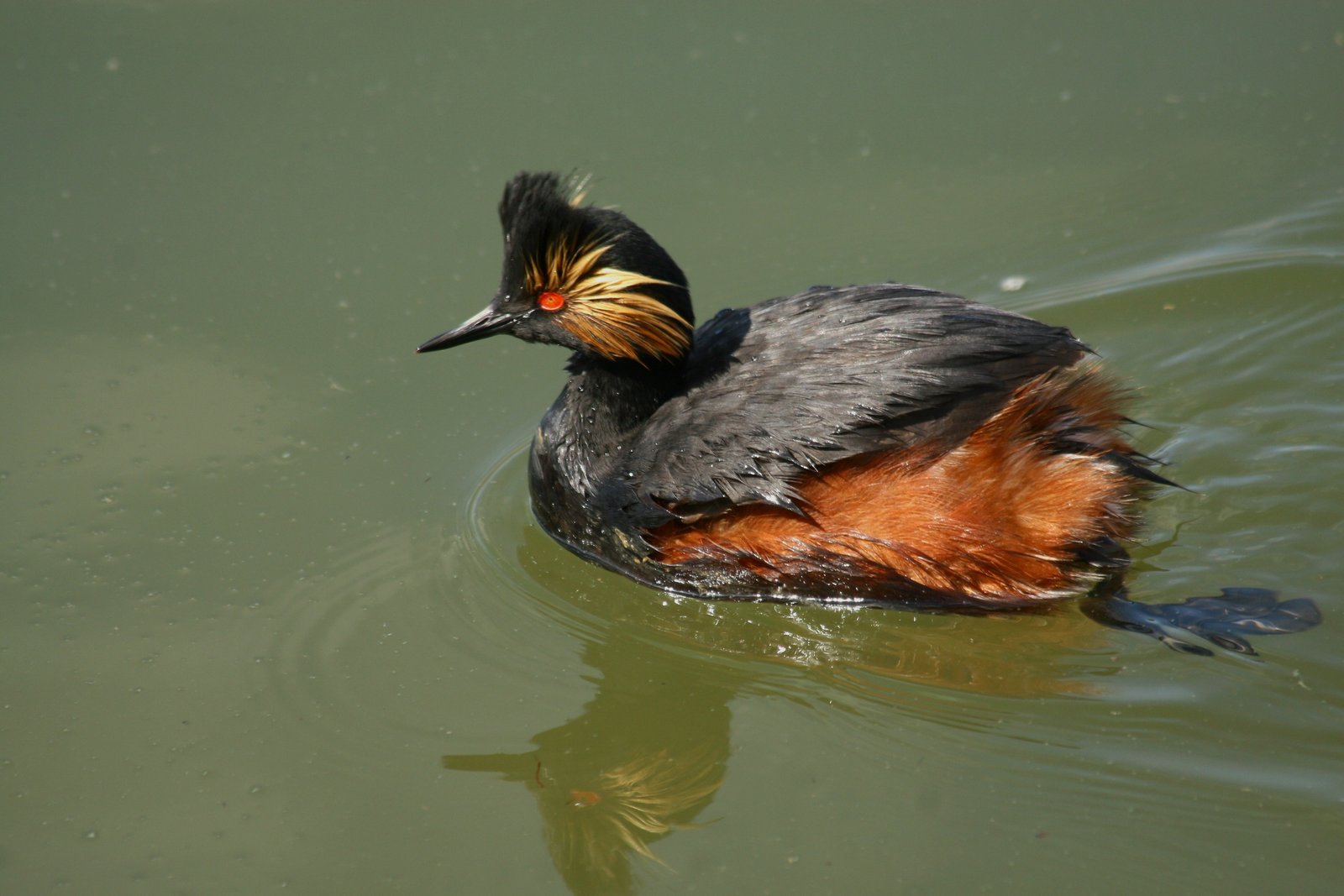
28–34 cm, with a steep forehead, a high crown and a thin, slightly upturned bill. In breeding plumage the head, neck and back are black, with a fan of golden-yellow plumes behind the red eye and chestnut flanks. In non-breeding plumage the bird is grey and white, with a dark cap reaching below the eye, a dusky neck and white ear coverts. The sexes are alike.
Confusion species
Silvery Grebe Podiceps occipitalis is paler grey, with a white foreneck and a grey head without black breeding plumage. Pied-billed Grebe Podilymbus podiceps is browner, with a thick, short bill. The extinct Colombian Grebe Podiceps andinus closely resembled this species, but had a chestnut lower neck in breeding plumage.
Habitat
Breeds on shallow lakes with marginal vegetation; outside the breeding season also on larger open lakes, salt lakes and lagoons. It dives for insects, small crustaceans and small fish. Does not breed in the guide area.
Where the bird is most at home, classified by the vegetation units of the Andes and the west coast.


Range and movements
In the guide area reported only as a very rare vagrant; older Colombian specimens of black-necked grebes belong to the Colombian Grebe. Absent from the Galápagos. Outside the guide area the American subspecies breeds in western North America south to Mexico and winters south to Central America; other subspecies live in Europe, Asia and Africa.
How and when to look
A vagrant may turn up among other grebes on Andean lakes. Look for a grebe with a steep forehead, a thin, upturned bill and a dark cap reaching below the eye.
Conservation status
Least Concern. The species has a large range and large numbers.
Scientific name
Podiceps nigricollis | Brehm, 1831
Brehm described the species in 1831 and placed it straight away in the genus where it still stands. The genus Podiceps was introduced in 1787 by Latham. The genus name comes from Latin podex (genitive podicis), 'rump, vent', and pes, 'foot', for the legs set far back on the body. The species name comes from Latin niger, 'black', and collum, 'neck', for the black neck in breeding plumage. The specimen the first description was based on came from Germany.