All species › Grebes › Grebes › Junin Grebe
Junin Grebe | Podiceps taczanowskii
Punafuut | Zambullidor de Junín | Mergulhão-de-junín
The Junin Grebe lives only on Lake Junín on the high plateau of central Peru. It almost never flies and does not leave the lake. With a population of a few hundred birds, the survival of the species depends on the water level and water quality of this one lake.
Voice
Soft whistled and twittering calls, mainly at the nests and between pairs.
Recording: Ross Gallardy — CC BY-NC-SA 4.0 · xeno-canto
Identification
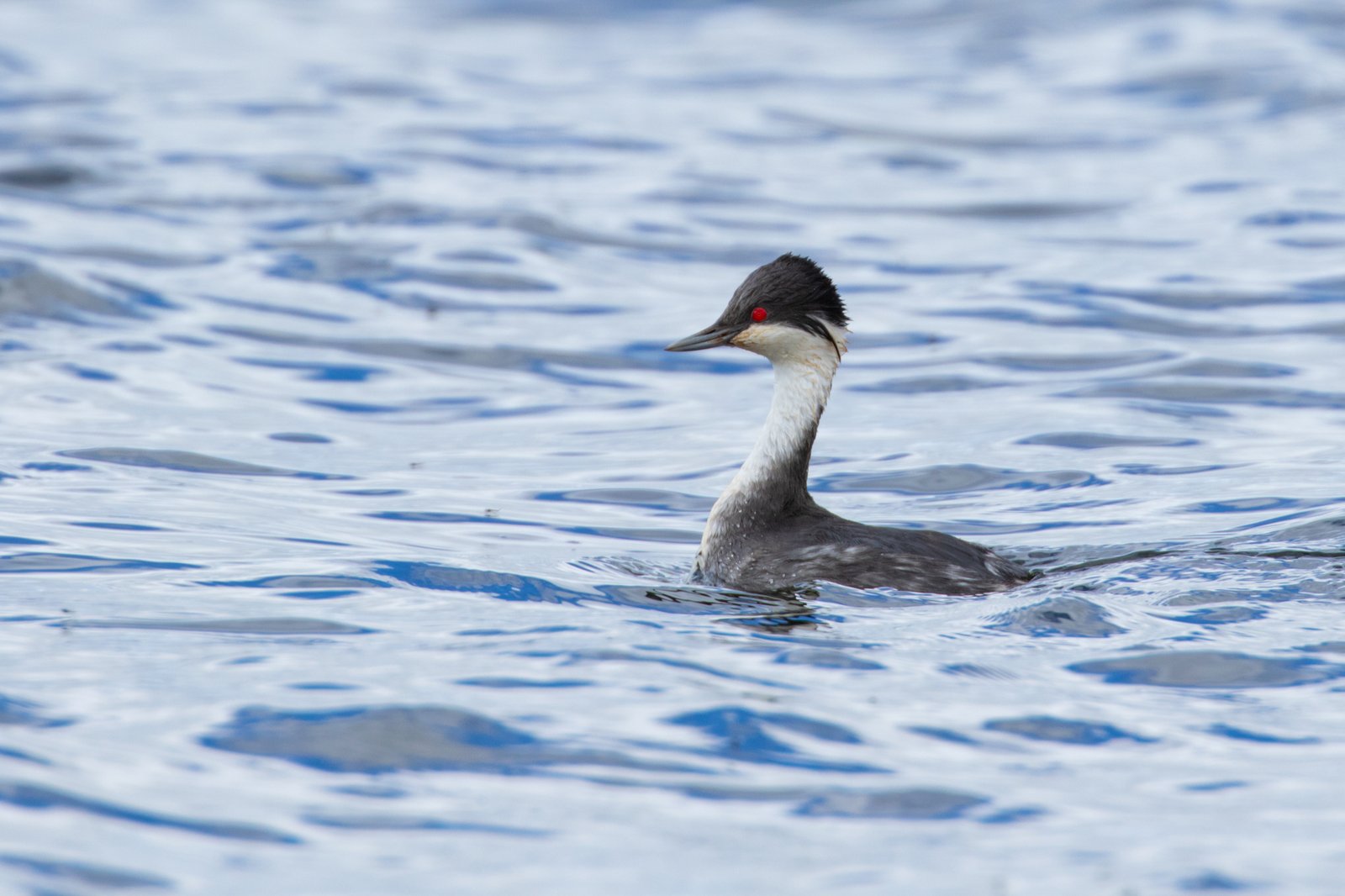
33–35 cm, slender, with a long, thin neck and a long, pointed bill. The back and wings are dark grey, the underparts and foreneck white. The crown and hindneck are dark slate-grey; behind the red eye there is a short, greyish plume. Juveniles have a paler head. The sexes are alike.
Confusion species
Silvery Grebe Podiceps occipitalis is smaller and stockier, with a shorter neck, a short bill and a rounded head; it occurs on the same lake. White-tufted Grebe Rollandia rolland is smaller and dark, with a black neck and a white cheek patch. Pied-billed Grebe Podilymbus podiceps is brown, with a thick, short bill.
Habitat
Open water of Lake Junín at about 4080 m, breeding in the reed zone and among aquatic plants along the edges. It dives mainly for small fish of the genus Orestias, supplemented with invertebrates. It breeds on floating nests of plant debris, mainly in the rainy season, when the marginal zone is flooded.
Where the bird is most at home, classified by the vegetation units of the Andes and the west coast.


Range and movements
Only in Peru: Lake Junín (Chinchaycocha) in the departments of Junín and Pasco. Absent from Colombia, Ecuador, Bolivia and the Galápagos.
- Resident
- dark = core range, pale = thinly spread
How and when to look
From the shore and especially by boat on the open water of Lake Junín, among the much more numerous Silvery Grebes. Calm, windless mornings give the best view over the water.
Conservation status
Endangered. The population numbers a few hundred birds and fluctuates strongly. Threats are water-level regulation for a dam, pollution from mining waste, eutrophication and drought; the lake is protected as a national reserve.
Scientific name
Podiceps taczanowskii | Berlepsch & Sztolcman, 1894
Berlepsch & Sztolcman described the species in 1894 and placed it straight away in the genus where it still stands. The genus Podiceps was introduced in 1787 by Latham. The genus name comes from Latin podex (genitive podicis), 'rump, vent', and pes, 'foot', for the legs set far back on the body. The species name honours Władysław Taczanowski (1819–1890), a Polish zoologist who described the birds of Peru. The specimen the first description was based on came from Lake Junín, Peru.