All species › Grebes › Grebes › Silvery Grebe
Silvery Grebe | Podiceps occipitalis
Zilverfuut | Zambullidor plateado | Mergulhão-de-orelha-amarela
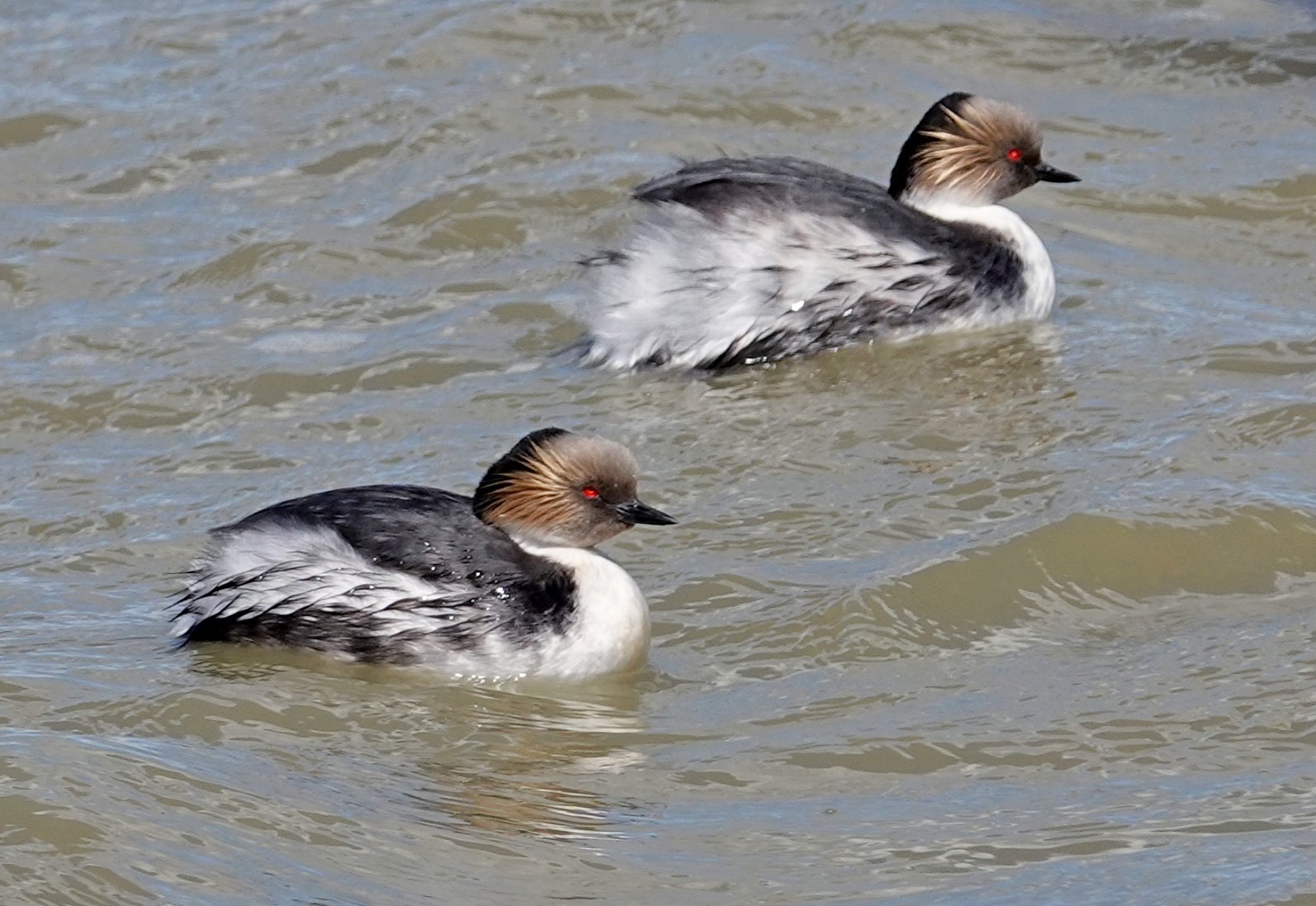
The Silvery Grebe is the common grebe of high Andean lakes. It is grey and white, with a red eye, and often lives in flocks; it breeds in colonies with floating nests. The birds in the guide area belong to the northern subspecies juninensis, which some authors treat as a separate species.
Voice
Short, whistled calls; in colonies often a soft twittering of many birds at once.
Recording: Fabio Schunck — CC BY-NC-SA 4.0 · xeno-canto
Identification
25–28 cm, with a rounded head, a short, thin bill and a red eye. The back and wings are grey, the underparts and foreneck white. The crown and hindneck are dark grey to blackish. In breeding plumage greyish to pale yellow plumes grow behind the eye; in northern birds these are shorter and less conspicuous than in southern ones. In flight a white wing stripe. The sexes are alike; juveniles are browner.
Confusion species
Junin Grebe Podiceps taczanowskii is larger and slimmer, with a longer neck and a long, pointed bill, and lives only on Lake Junín. White-tufted Grebe Rollandia rolland is smaller and darker, with a black neck and a white cheek patch. Titicaca Grebe Rollandia microptera is larger, with a chestnut neck and a long bill, and lives in the Titicaca basin. Pied-billed Grebe Podilymbus podiceps is brown, with a thick bill.
Habitat
Open Andean lakes and lagoons with submerged aquatic plants, also more saline lakes, mostly between 2500 and 4800 m. It dives for insect larvae, small crustaceans and other small aquatic animals. It breeds in colonies on floating nests of plant debris.
Where the bird is most at home, classified by the vegetation units of the Andes and the west coast.


Range and movements
In Colombia rare and very local in the south. In Ecuador local on high Andean lakes. In Peru widespread on Andean lakes, including Lake Junín and Lake Titicaca. In Bolivia on the altiplano, including Lake Titicaca. Absent from the Galápagos. Outside the guide area in Chile and Argentina, with the southern subspecies south to Patagonia.
- Resident
- dark = core range, pale = thinly spread
How and when to look
Scan open lakes in the puna, such as Lake Junín and the lakes around Lake Titicaca; the birds often swim in flocks far from the shore. In Ecuador on high Andean lakes.
Conservation status
Not Evaluated in this species concept; locally numerous in the Andes. Water pollution from mining, changes in water level and drought threaten lakes locally.
Scientific name
Podiceps occipitalis | Garnot, 1826
Garnot described the species in 1826 and placed it straight away in the genus where it still stands. The genus Podiceps was introduced in 1787 by Latham. The genus name comes from Latin podex (genitive podicis), 'rump, vent', and pes, 'foot', for the legs set far back on the body. The species name comes from Latin occiput (genitive occipitis), 'back of the head', for the distinctive nape feathers. The specimen the first description was based on came from Falkland Islands.