All species › Cuckoos › Cuckoos › Guira Cuckoo
Guira Cuckoo | Guira guira
Guirakoekoek | Pirincho | Anu-branco
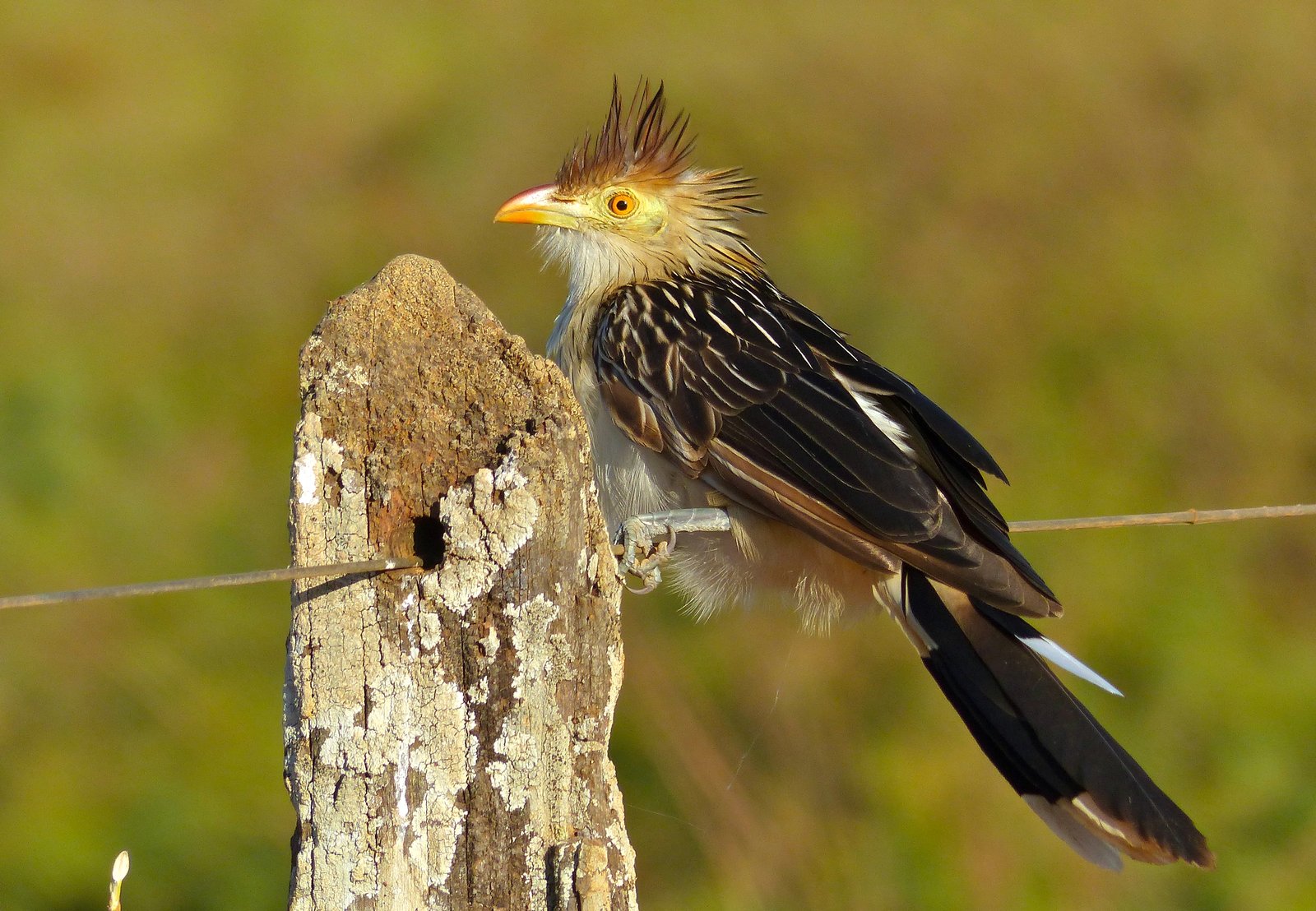
The Guira Cuckoo is a scruffy-looking, pale cuckoo with a ragged rufous crest and a long tail that moves through open country in groups. It is related to the anis and, like them, raises its own young, often with several birds sharing one nest. In the guide area it lives mainly in the savannas and farmland of Bolivia.
Voice
A loud, descending series of plaintive whistles, pee-oo pee-oo pee-oo, ending in a rattle, often given by several birds at once. Groups keep in contact with short, hoarse calls.
Recording: Franco Vushurovich — CC BY-NC-SA 4.0 · xeno-canto
Identification
36–40 cm, more than half of which is tail. The head and crest are rufous-brown with dark streaks; the ragged crest is often held erect. The back and wings are dark brown with pale, creamy streaks and fringes. The rump is white and conspicuous in flight. The underparts are creamy white, finely streaked dark on the throat and breast. The long tail is dark brown with a broad white tip. The bill is orange-yellow, the bare skin around the eye yellowish and the iris orange. The sexes are alike; juveniles are more heavily streaked dark, with a dark iris.
Confusion species
Striped Cuckoo Tapera naevia is smaller and solitary; it has unstreaked white underparts, a pale supercilium and no white rump or white tail band. Smooth-billed Ani Crotophaga ani also moves through open country in groups, but is entirely black, with a tall black bill.
Habitat
Open country with scattered trees and shrubs: savanna, pasture, field edges, dry Chaco scrub, edges of marshes and villages, in the lowlands and locally in dry valleys up to about 2000 m. Groups of six to fifteen birds sit huddled together on branches and often sun themselves with spread wings. It searches the ground and low vegetation for large insects, spiders, frogs, lizards and nestling birds. The nest is a large cup of sticks in a tree, in which several females often lay their blue-green eggs.
Where the bird is most at home, classified by the vegetation units of the Andes and the west coast.


Range and movements
In Bolivia widespread in the lowlands of Beni, Santa Cruz and the Chaco, and in the dry valleys at the foot of the Andes. In Peru only a few recent records in the southeast, probably birds entering open, deforested country from Bolivia. Absent from Colombia, Ecuador and the Galápagos. Outside the guide area in eastern and central Brazil, Paraguay, Uruguay and northern and central Argentina.
- Resident
- dark = core range, pale = thinly spread
How and when to look
Along roads through pasture and savanna in the lowlands of Santa Cruz and Beni, where groups perch on fences, shrubs and low trees. In the cool morning they often sun themselves together on a bare branch.
Conservation status
Least Concern. It benefits from deforestation and cattle ranching and is expanding locally.
Scientific name
Guira guira | (Gmelin, 1788)
Gmelin described the species in 1788 as Cuculus Guira; because it was later moved to another genus, the author and year stand in brackets. The genus Guira was introduced in 1830 by Lesson. The genus name comes from Guarani güirá, 'bird'. The species name guira, like the genus, comes from Guarani güirá, 'bird'. The specimen the first description was based on came from Brazil.