All species › Cuckoos › Cuckoos › Greater Ani
Greater Ani | Crotophaga major
Grote ani | Garrapatero mayor | Anu-coroca
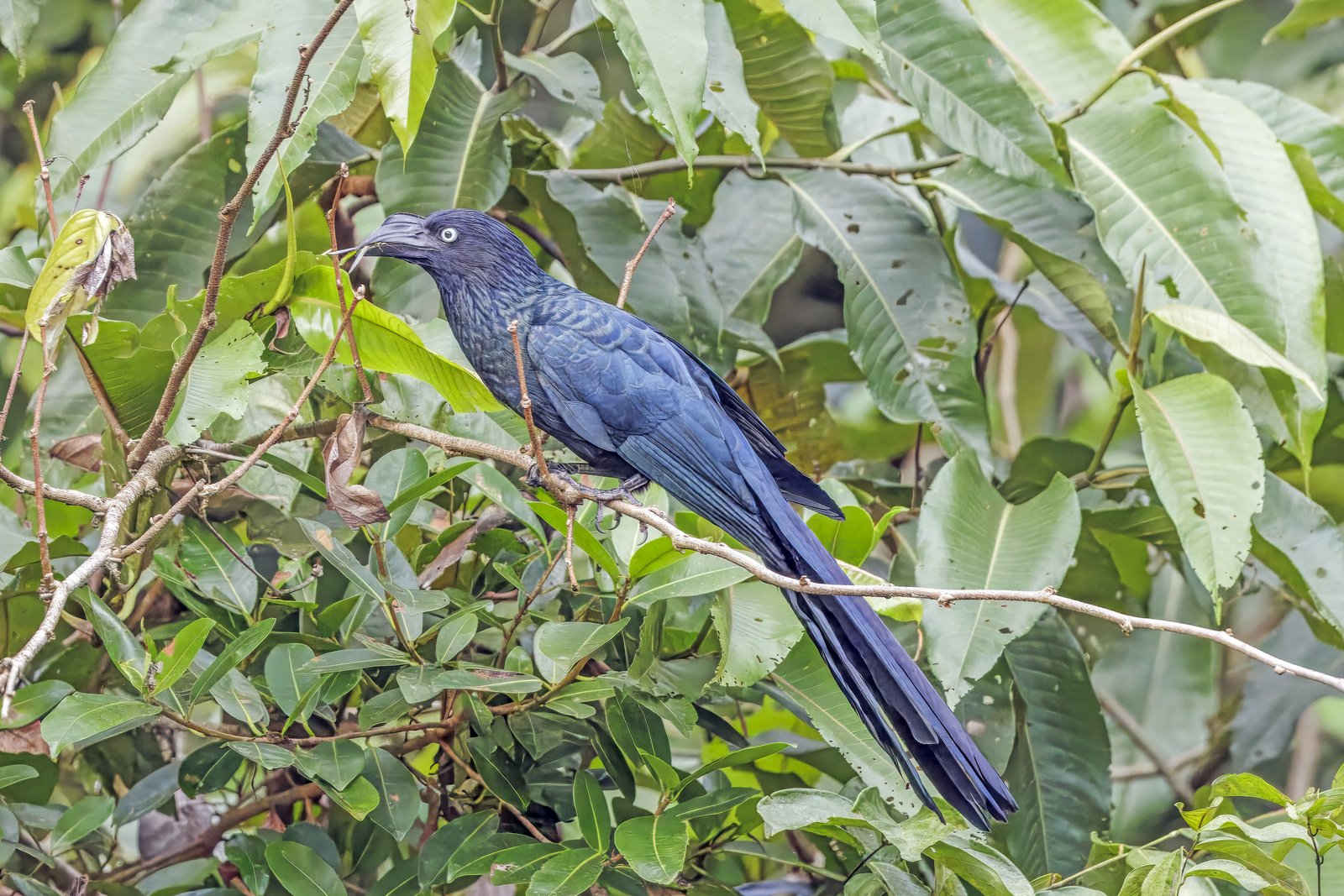
The Greater Ani is the largest ani, a glossy blue-black cuckoo with a white iris that lives in noisy groups along rivers and lakes. Groups breed together, with several pairs laying their eggs in one nest and raising the young jointly. In the Amazonian lowlands it is a regular inhabitant of riverside vegetation and flooded forest.
Voice
Groups produce a bubbling, boiling chorus, kro-kro-kro-kro, with several birds calling at once, interspersed with growling, grating and barking sounds. In flight a harsh, raw croak.
Recording: Fabrício Grigolin — CC BY-NC-SA 4.0 · xeno-canto
Identification
46–48 cm, with a long, broad tail. The plumage is black with a strong blue to purplish gloss, with a greenish or bronzy sheen on the back and wings; the feathers of the upperparts have narrow glossy fringes. The bill is black, tall and laterally flattened, with a ridge that rises only on the basal half of the upper mandible. The iris is white to yellowish white. The sexes are alike; juveniles are duller, with a dark iris and a smaller bill ridge.
Confusion species
Smooth-billed Ani Crotophaga ani is much smaller, dull black, with a dark iris and a smooth bill ridge that rises above the forehead; it lives mainly in pasture and thickets. Groove-billed Ani Crotophaga sulcirostris is also much smaller, with grooves on the bill and a dark iris, and lives mainly in dry regions.
Habitat
Riverside vegetation, shrubs and low trees along rivers, lakes and oxbow lakes, várzea and igapó, palm swamps, mangroves and marsh edges, in the lowlands up to about 500 m. Groups of five to twenty birds move through the vegetation searching for large insects, spiders, lizards and frogs; they also follow army ants and cattle. The nest is a large cup of sticks above the water, used jointly by several pairs.
Where the bird is most at home, classified by the vegetation units of the Andes and the west coast.


Range and movements
In Colombia in the Caribbean lowlands, the Magdalena valley, the Llanos and Amazonia. In Ecuador and Peru in the Amazonian lowlands east of the Andes. In Bolivia in the northern and eastern lowlands, including Pando, Beni and Santa Cruz. Absent from the dry coastal region of Peru and from the Galápagos. Outside the guide area from Panama through Venezuela and the Guianas to northern Argentina; southern birds partly migrate during the austral winter.
- Resident
- dark = core range, pale = thinly spread
How and when to look
Travel slowly by boat along the banks of Amazonian rivers and oxbow lakes, where groups clamber through the riverside scrub and announce themselves with their bubbling chorus.
Conservation status
Least Concern. Widespread and locally common along water in the lowlands.
Scientific name
Crotophaga major | Gmelin, 1788
Gmelin described the species in 1788 and placed it straight away in the genus where it still stands. The genus Crotophaga was introduced in 1758 by Linnaeus. The genus name comes from Greek krotōn, 'tick', and -phagos, '-eating': 'tick-eater'. The species name major is Latin for 'greater'. The specimen the first description was based on came from Cayenne, French Guiana.