All species › Cuckoos › Cuckoos › Smooth-billed Ani
Smooth-billed Ani | Crotophaga ani
Kleine ani | Garrapatero piquiliso | Anu-preto
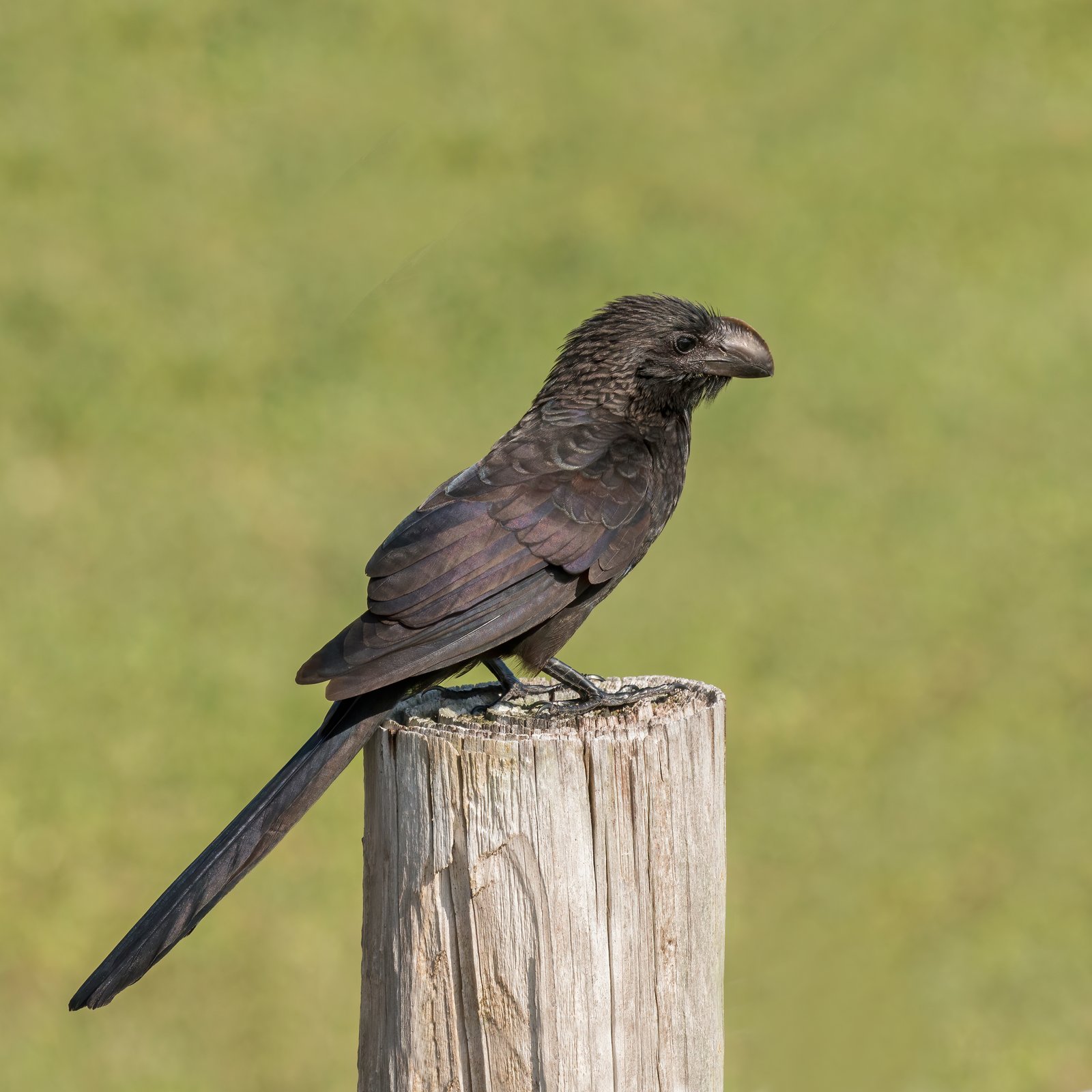
The Smooth-billed Ani is an all-black, long-tailed cuckoo with a tall, laterally flattened bill that moves through pasture and scrub in noisy groups. Unlike many cuckoos it raises its own young, in groups that share a single large nest. On the Galápagos it was introduced by people and is considered a problem species.
Voice
A plaintive, rising whistle, oo-eek, often given by several birds at once, also in flight. Groups also make various grating and croaking sounds.
Recording: JAYRSON ARAUJO DE OLIVEIRA — CC BY-NC-SA 4.0 · xeno-canto
Identification
33–36 cm, almost half of which is tail; the long tail is often held loosely and askew. The plumage is dull black with a faint blue gloss; the feathers of the head and breast have narrow glossy fringes. The bill is black, tall and arched, with a smooth, hump-shaped ridge on the upper mandible that rises above the forehead. The iris is dark. The sexes are alike; juveniles have a smaller bill ridge.
Confusion species
Groove-billed Ani Crotophaga sulcirostris is slightly smaller and has grooves on the bill, without a hump above the forehead; it lives mainly in dry regions, including the Pacific coast of Ecuador and Peru, and has a different call. Greater Ani Crotophaga major is much larger, with glossy blue-black plumage and a white iris, and lives along rivers and in flooded forest.
Habitat
Pasture with shrubs, forest edges, thickets, secondary forest, marsh and riverside vegetation, plantations and gardens, mainly in the lowlands and locally into the lower Andean valleys. On the Galápagos in the agricultural areas of the highlands. Groups search for insects on the ground and in low vegetation, often near grazing cattle, and also eat lizards, frogs and fruit.
Where the bird is most at home, classified by the vegetation units of the Andes and the west coast.


Range and movements
In Colombia widespread in the lowlands and the large inter-Andean valleys; in Ecuador, Peru and Bolivia mainly in the lowlands east of the Andes. Absent from the dry coastal desert of Peru. On the Galápagos introduced and established on a few inhabited islands. Outside the guide area from Florida and the Caribbean through southern Central America to northern Argentina.
- Resident
- dark = core range, pale = thinly spread
How and when to look
In pasture and along roads in the Amazonian lowlands, where groups perch on fences and shrubs and forage near cattle. On the Galápagos in the agricultural zone of Santa Cruz.
Conservation status
Least Concern. It benefits from deforestation and cattle ranching. On the Galápagos an introduced species that can threaten native wildlife.
Scientific name
Crotophaga ani | Linnaeus, 1758
Linnaeus described the species in 1758 and placed it straight away in the genus where it still stands. He introduced the genus Crotophaga in that same work. The genus name comes from Greek krotōn, 'tick', and -phagos, '-eating': 'tick-eater'. The species name ani goes back to a name used by Marcgrave in 1648, probably from the Tupi language. The specimen the first description was based on came from Jamaica.