All species › Cuckoos › Cuckoos › Groove-billed Ani
Groove-billed Ani | Crotophaga sulcirostris
Groefsnavelani | Garrapatero piquiestriado | Anu-de-bico-sulcado
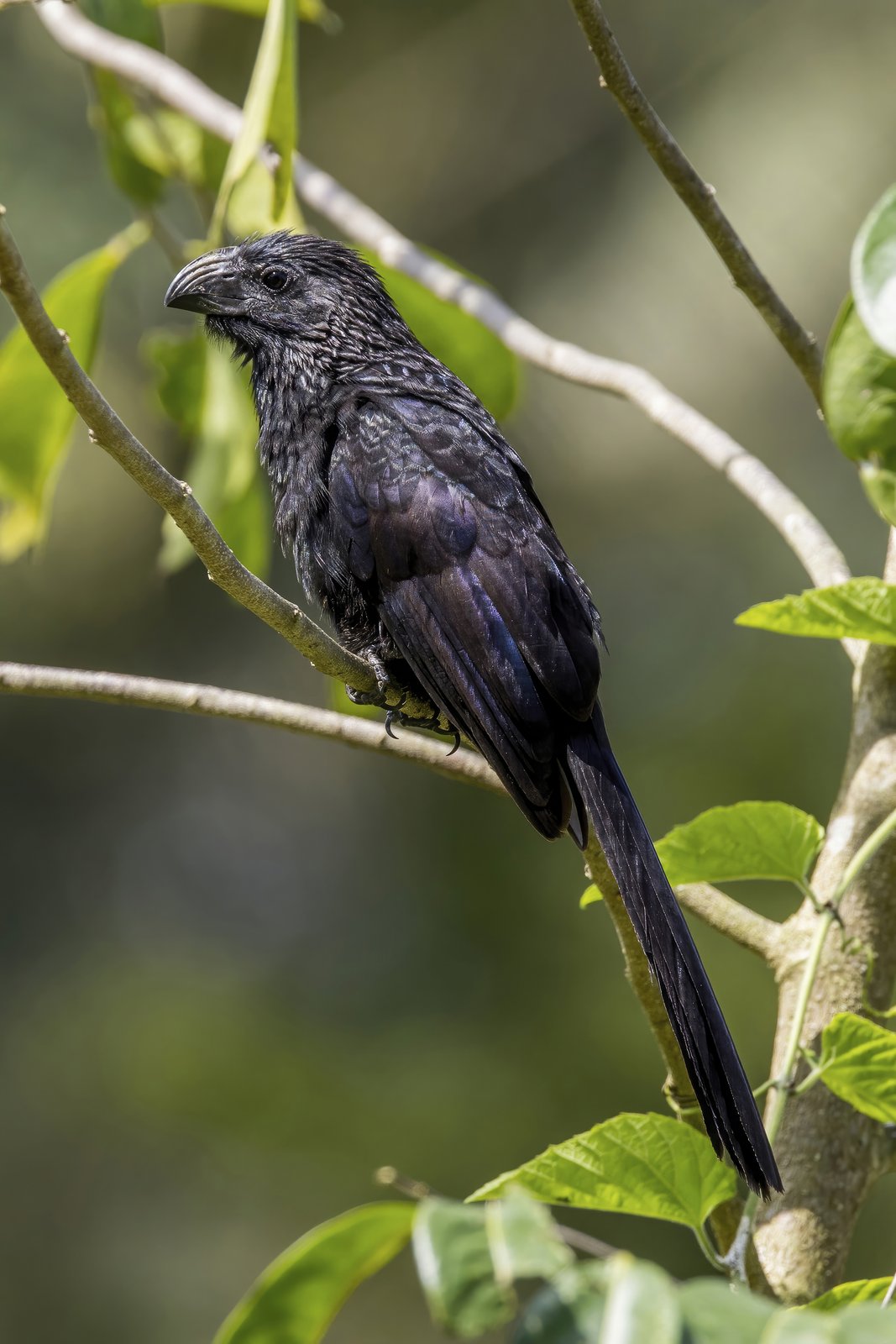
The Groove-billed Ani is a small, all-black ani with fine grooves on the bill, the ani of dry regions. Along the desert coast of Peru it is a common bird of green river valleys, fields and scrub. Like the other anis it lives in groups that share a single nest.
Voice
A clear, liquid two-syllable call, tee-ho or pee-jo, stressed on the first syllable, often repeated rapidly by several birds. Also soft, clucking contact calls.
Recording: Johan Chaves — CC BY-NC-SA 4.0 · xeno-canto
Identification
30–33 cm, about half of which is tail; the tail is long and is often held loosely and swung from side to side. The plumage is dull black with a faint blue or greenish gloss; the feathers of the head, neck and breast have narrow, bronzy glossy fringes. The bill is black, tall and laterally flattened, with three or four parallel grooves on the upper mandible; the culmen forms a smooth arc, without a hump above the forehead. The iris is dark. The sexes are alike; juveniles are browner black and have a smooth bill without grooves.
Confusion species
Smooth-billed Ani Crotophaga ani is slightly larger, with a smooth bill and a tall, hump-shaped ridge that rises above the forehead; young Groove-billed Anis with smooth bills can therefore be confused with it, but lack the hump. It lives mainly in more humid lowlands, and its call differs. Greater Ani Crotophaga major is much larger, with glossy blue-black plumage and a white iris, and lives along rivers in Amazonia.
Habitat
Dry scrub, thorn forest, riverside vegetation in desert valleys, fields, irrigated farmland, pasture with shrubs, hedges and gardens, from sea level up to about 2500 m in dry inter-Andean valleys. Groups search the ground and low vegetation for grasshoppers and other insects, often near grazing cattle or along ploughing farm machinery. The nest is a cup of sticks in a shrub or tree, in which several females lay their eggs; the group feeds the young together.
Where the bird is most at home, classified by the vegetation units of the Andes and the west coast.


Range and movements
In Colombia in the dry Caribbean lowlands and in the dry valleys of the Magdalena and Cauca. In Ecuador in the western lowlands and along the coast, and locally in dry Andean valleys. In Peru along the entire Pacific coast, in river valleys and farmland to the far south, and in the dry Marañón valley. Absent from Bolivia, from the Amazonian lowlands apart from a few vagrants, and from the Galápagos. Outside the guide area from southern Texas through Mexico and Central America to northern Venezuela, and in the far north of Chile.
- Resident
- dark = core range, pale = thinly spread
How and when to look
Along fields, reedbeds and shrubs in the green river valleys of the Peruvian coast and around the lagoons near Lima, where groups perch on fences and shrubs. In western Ecuador along roads through pasture and dry forest.
Conservation status
Least Concern. It benefits from agriculture and irrigation in dry regions.
Scientific name
Crotophaga sulcirostris | Swainson, 1827
Swainson described the species in 1827 and placed it straight away in the genus where it still stands. The genus Crotophaga was introduced in 1758 by Linnaeus. The genus name comes from Greek krotōn, 'tick', and -phagos, '-eating': 'tick-eater'. The species name sulcirostris comes from Latin sulcus, 'groove', and rostrum, 'bill', after the grooves on the bill. The specimen the first description was based on came from Temascaltepec, Mexico.