All species › Cuckoos › Cuckoos › Striped Cuckoo
Striped Cuckoo | Tapera naevia
Gestreepte koekoek | Cuclillo rayado | Saci
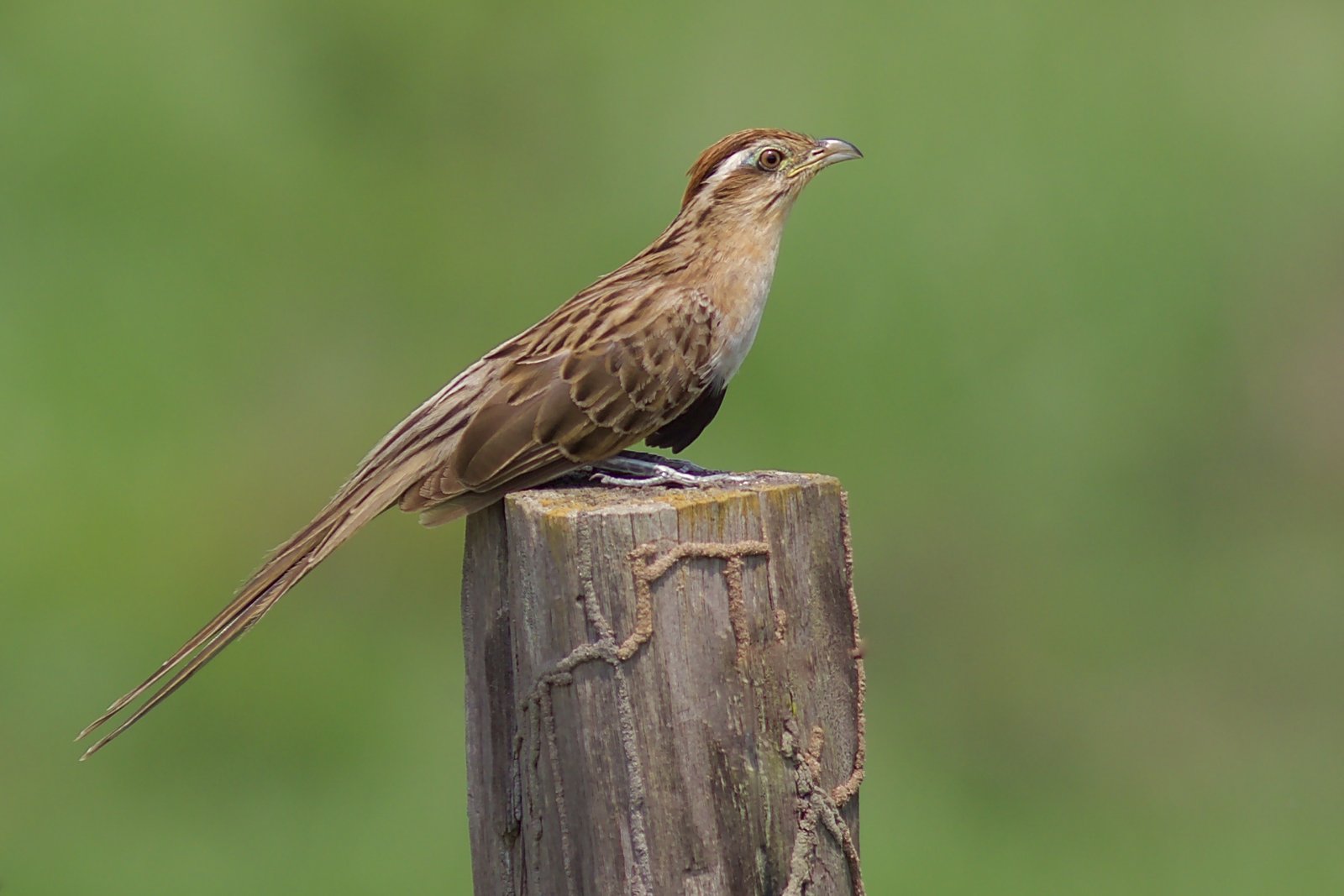
The Striped Cuckoo is a slender, brown-streaked cuckoo with a rufous crest of open, shrubby country. It is the only brood parasite among the open-country cuckoos in the guide area and lays its eggs mainly in the closed stick nests of spinetails. Its two-note whistle, often also at night, is a familiar sound in the lowlands.
Voice
A clear, melancholy two-note whistle, see-see, the second slightly higher, sometimes with a third and fourth note, see-see si-si. The song is ventriloquial and carries far; the bird often sings from an exposed perch, by day and also on moonlit nights.
Recording: Paul Molina Abril — CC BY-NC-SA 4.0 · xeno-canto
Identification
27–29 cm, with a long, graduated tail. The crown and short crest are rufous with black streaks; the crest is often raised. There is a long, pale supercilium and a narrow dark malar stripe. The upperparts are greyish brown with black and buff streaks. The underparts are white to pale grey, unstreaked, with a buff wash on the throat. The alula is black and is conspicuously extended while singing and when excited. The bill is short and grey. The sexes are alike; juveniles have pale spots on the upperparts and a finely barred throat.
Confusion species
Pheasant Cuckoo Dromococcyx phasianellus and Pavonine Cuckoo Dromococcyx pavoninus live in the forest interior, have a small head and a broad, fan-shaped tail with white spots, and Pheasant Cuckoo has a spotted breast. Guira Cuckoo Guira guira lives in groups and is larger, with streaked underparts, a white rump and a white tail tip.
Habitat
Open country with shrubs and thickets, pasture with scattered trees, forest edges, clearings with regrowth, savanna and marsh edges, mainly in the lowlands and up to about 1500 m. It is solitary and searches low vegetation and the ground for grasshoppers, caterpillars and other insects. A brood parasite: the female lays her eggs in the nests of spinetails such as Synallaxis, Certhiaxis and Phacellodomus.
Where the bird is most at home, classified by the vegetation units of the Andes and the west coast.


Range and movements
In Colombia widespread in the lowlands and warm valleys west and east of the Andes. In Ecuador in the western lowlands and in the east. In Peru in the Amazonian lowlands and in the northwest, including Tumbes and Piura and the Marañón valley. In Bolivia in the northern and eastern lowlands. Absent from the desert coast of central and southern Peru and from the Galápagos. Outside the guide area from southern Mexico through Central America to northern Argentina.
- Resident
- dark = core range, pale = thinly spread
How and when to look
In the morning and towards dusk in shrubby pasture and clearings in the lowlands; a singing bird often sits on a post, a wire or a projecting branch and can be tracked by its whistle.
Conservation status
Least Concern. It benefits from deforestation, which creates open, shrubby country.
Scientific name
Tapera naevia | (Linnaeus, 1766)
Linnaeus described the species in 1766 as Cuculus naevius; because it was later moved to another genus, the author and year stand in brackets. The genus Tapera was introduced in 1819 by Thunberg. The genus name comes from the Tupi name taperá, 'home-living (bird)', for a kind of swallow. The species name is Latin naevius, 'spotted', from naevus, 'mole, birthmark', after the streaked plumage. The specimen the first description was based on came from Cayenne, French Guiana.