All species › Cuckoos › Cuckoos › Pheasant Cuckoo
Pheasant Cuckoo | Dromococcyx phasianellus
Fazantkoekoek | Cuclillo faisán | Peixe-frito-verdadeiro
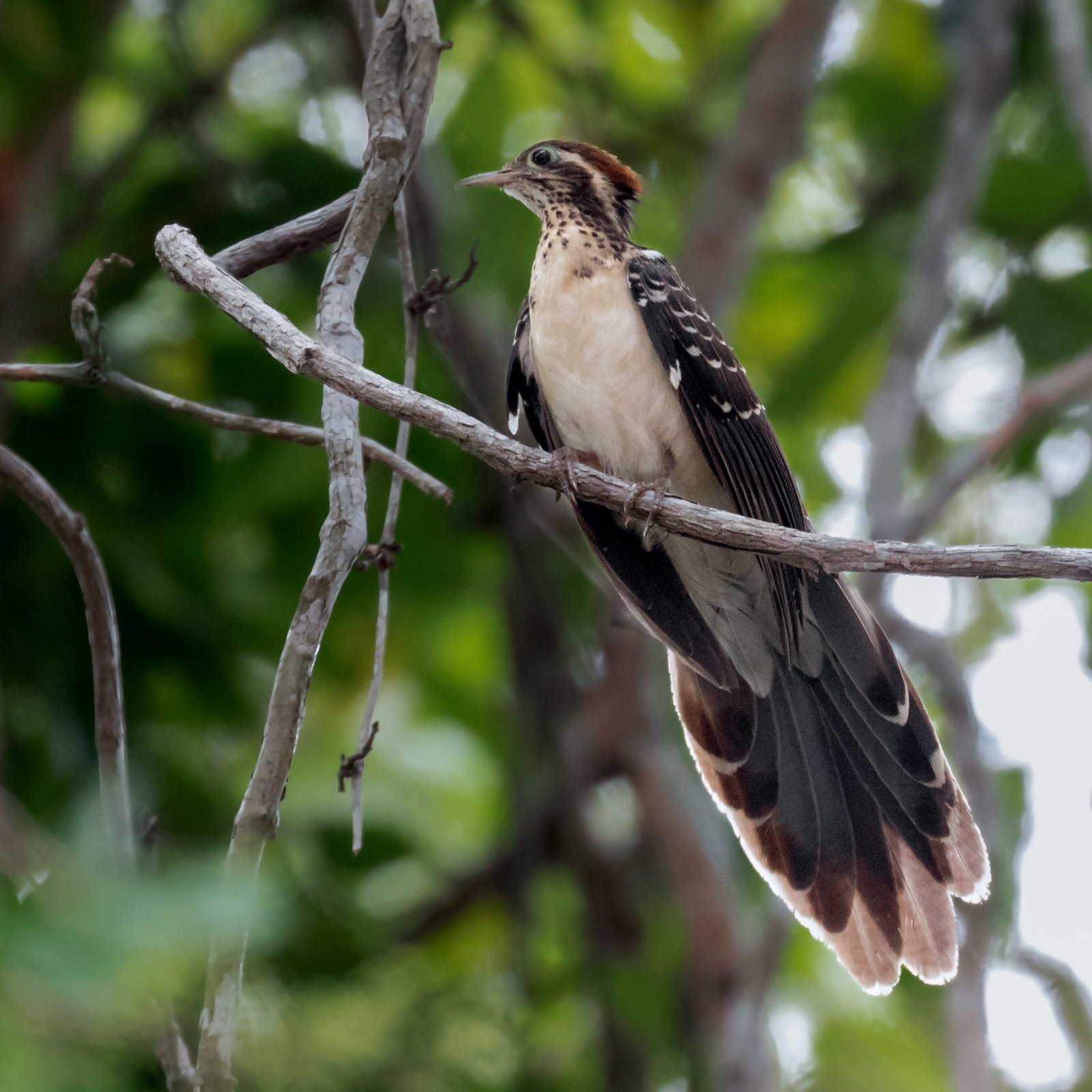
The Pheasant Cuckoo is a brown forest bird with a small, crested head and a long, broad tail reminiscent of a pheasant. It lives hidden in dense forest and is usually only heard. It is a brood parasite whose host species are still poorly known.
Voice
Two or three clear whistles followed by a tremulous trill, whoo-whee whrrrr, repeated at long intervals, especially at dusk and at night. A singing bird usually sits hidden in the middle levels of the forest.
Recording: Juan Freile — CC BY-NC-SA 4.0 · xeno-canto
Identification
36–38 cm, with a small head, a thin neck and a long, broad, graduated tail; the uppertail coverts are almost as long as the tail and have white tips, so that the tail looks spotted and fan-shaped. The crown and short crest are rufous. A white stripe runs behind the eye. The upperparts are dark brown with pale fringes and spots. The throat and breast are pale buff with dark brown spots and streaks; the belly is white. The sexes are alike; juveniles are plainer brown, with a less marked breast.
Confusion species
Pavonine Cuckoo Dromococcyx pavoninus is smaller and darker, with an unspotted, rusty-buff throat and breast. Striped Cuckoo Tapera naevia lives in open country, has streaked upperparts, unspotted white underparts and a narrower tail without white spots. Common Squirrel Cuckoo Piaya cayana is rufous, with a grey belly and a long white-tipped tail, and stays high in the trees.
Habitat
Humid and semi-humid lowland and foothill forest, old secondary forest, dense forest edges and vine tangles, locally also more humid parts of dry forest, up to about 1000 m, locally higher. It is solitary, low to mid-level in dense vegetation, and eats large insects and lizards. A brood parasite; the known hosts are mainly small tyrant flycatchers that build closed or semi-closed nests.
Where the bird is most at home, classified by the vegetation units of the Andes and the west coast.


Range and movements
In Colombia in the lowlands west and east of the Andes, including the Caribbean north and the Magdalena valley. In Ecuador scarce, in the western lowlands and in the east. In Peru in the Amazonian lowlands and the foothills of the eastern slope, and locally in the northwest. In Bolivia in the northern and eastern lowlands. Absent from the Galápagos. Outside the guide area from southern Mexico through Central America to eastern Brazil, Paraguay and northeastern Argentina.
- Resident
- dark = core range, pale = thinly spread
How and when to look
At dusk and on moonlit nights, listen for the tremulous call at forest edges and in dense secondary forest in the lowlands; a calling bird sometimes responds by coming closer, but usually stays within the vegetation.
Conservation status
Least Concern. Widespread but scarce and seldom recorded; sensitive to forest loss.
Scientific name
Dromococcyx phasianellus | (Spix, 1824)
Spix described the species in 1824 as Macropus phasianellus; because it was later moved to another genus, the author and year stand in brackets. The genus Dromococcyx was introduced in 1832 by Wied-Neuwied. The genus name comes from Greek dromos, 'running', and kokkux, 'cuckoo': 'running cuckoo'. The species name phasianellus is a diminutive of Latin phasianus, 'pheasant': 'little pheasant'. The specimen the first description was based on came from Tonantins, Amazonas, Brazil.