All species › Cuckoos › Cuckoos › Pavonine Cuckoo
Pavonine Cuckoo | Dromococcyx pavoninus
Pauwkoekoek | Cuclillo pavonino | Peixe-frito-pavonino
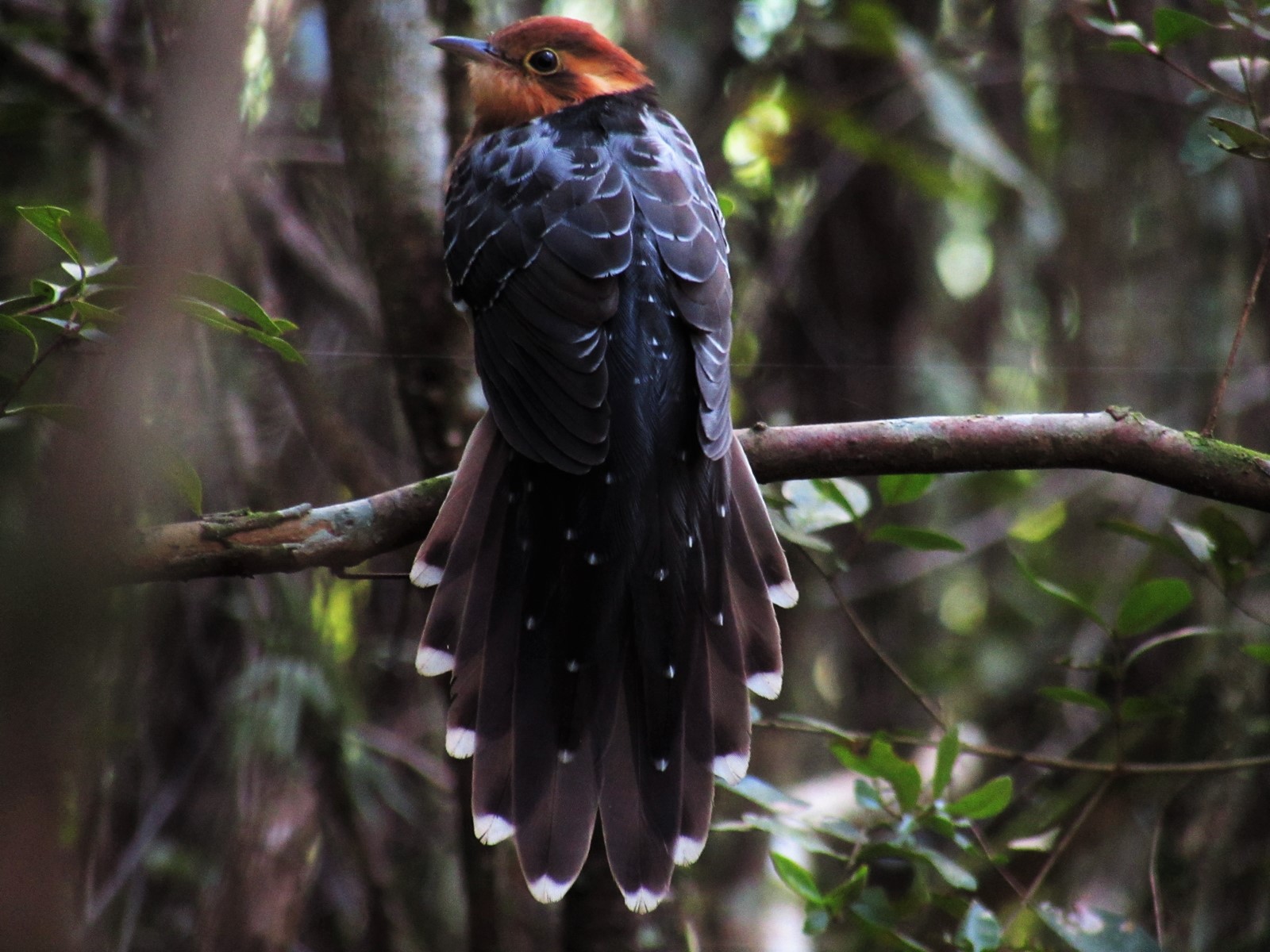
The Pavonine Cuckoo is a small, dark forest bird with a broad, spotted tail, the smaller relative of the Pheasant Cuckoo. It lives hidden in the understorey of lowland and foothill forest and is noticed almost only by its call. It is a brood parasite of small songbirds.
Voice
A series of clear, high whistles, pee-pee pee-pee-pee, two notes followed by three faster ones, the last sometimes tremulous; repeated at intervals, especially at dusk and at night.
Recording: Fabrício Grigolin — CC BY-NC-SA 4.0 · xeno-canto
Identification
27–30 cm, with a small head, a short dark crest and a long, broad, graduated tail; the uppertail coverts are elongated and, like the tail feathers, tipped white. The crown and crest are dark rufous-brown to blackish. A narrow rusty-buff stripe runs behind the eye. The upperparts are dark chocolate-brown with small pale spots on the wing coverts. The throat and breast are uniform rusty buff, without spots; the belly is white. The sexes are alike; juveniles are duller, with less distinct pale spots.
Confusion species
Pheasant Cuckoo Dromococcyx phasianellus is larger and paler brown, with a rufous crest, a white stripe behind the eye and a dark-spotted breast. Striped Cuckoo Tapera naevia lives in open country, is streaked on the upperparts and has white underparts and a narrower tail without white spots.
Habitat
The understorey and middle levels of humid terra firme lowland and foothill forest, locally in bamboo and dense secondary forest, up to about 1100 m. It is solitary in dense vegetation, often in vines and saplings, and eats large insects. A brood parasite; it lays its eggs in the nests of small tyrant flycatchers, including species with a closed or pendent nest.
Where the bird is most at home, classified by the vegetation units of the Andes and the west coast.


Range and movements
Local and scarce. In Colombia in the east, at the foot of the Andes and in Amazonia. In Ecuador only a few records in the eastern lowlands. In Peru in the Amazonian lowlands and the foothills of the eastern slope, mainly in the centre and south. In Bolivia in the northern lowlands and the foothills of the Yungas. Absent from the Pacific side and the Galápagos. Outside the guide area in southern Venezuela, the Guianas, Amazonian Brazil, the Atlantic Forest of eastern Brazil, Paraguay and northeastern Argentina.
- Resident
- dark = core range, pale = thinly spread
How and when to look
At dusk, listen for the high whistled series in the foothill forest of southeastern Peru and northern Bolivia, for example in the Manu area. The bird sings from dense vegetation and usually stays hidden there.
Conservation status
Least Concern. Scarce and seldom recorded; sensitive to deforestation in the lowlands and foothills.
Scientific name
Dromococcyx pavoninus | Pelzeln, 1870
Pelzeln described the species in 1870 and placed it straight away in the genus where it still stands. The genus Dromococcyx was introduced in 1832 by Wied-Neuwied. The genus name comes from Greek dromos, 'running', and kokkux, 'cuckoo': 'running cuckoo'. The species name pavoninus is Latin for 'peacock-like', patterned or coloured like a peacock's tail, from pavo, 'peacock'. The specimen the first description was based on came from Engenho do Gama and Arimani, Brazil.