All species › Cuckoos › Cuckoos › Rufous-vented Ground Cuckoo
Rufous-vented Ground Cuckoo | Neomorphus geoffroyi
Roodbuikgrondkoekoek | Cuco hormiguero ventrirrufo | Jacu-estalo
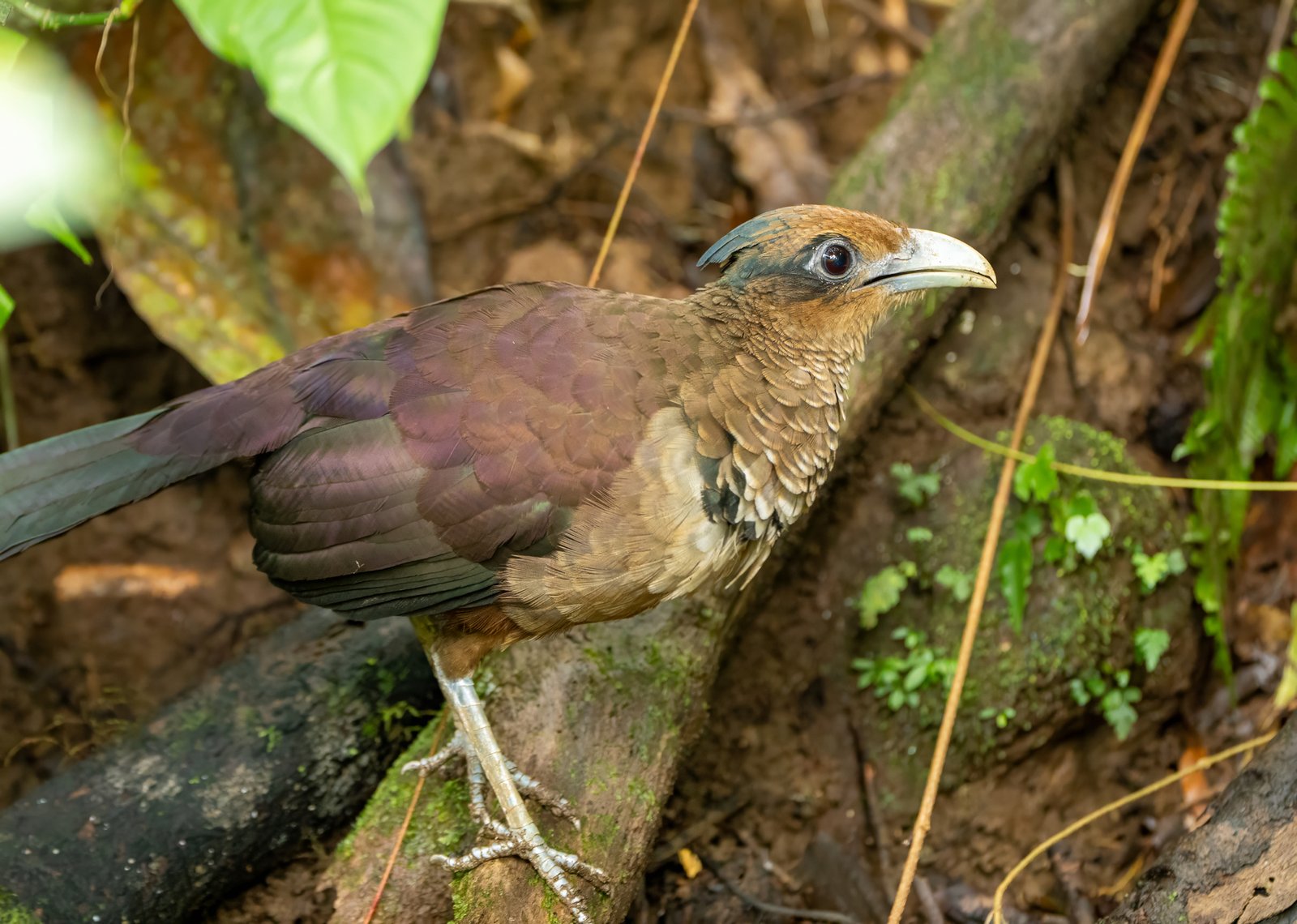
The Rufous-vented Ground Cuckoo is a large cuckoo that walks and runs across the forest floor, with an erect dark crest and a long, glossy tail. It follows army ant swarms and herds of peccaries and catches the animals they flush. It lives in undisturbed rainforest and is seldom seen.
Voice
A low, moaning, dove-like call, hoooo, drawn out and slightly descending. When excited a loud, hollow bill-clacking that carries far through the forest.
Recording: Odirlei Vieira da Fonseca — CC BY-NC-SA 4.0 · xeno-canto
Identification
46–51 cm, with long, strong legs, a long tail and a bushy crest. The crown and crest are blackish with a blue gloss. The nape and upperparts are olive-brown with a bronzy gloss; the wings have a purplish sheen and the long tail is glossed green and purple. The throat and breast are pale buff to greyish, with fine dark scaling and a narrow black breast band. The belly is paler; the flanks, lower belly and undertail coverts are rufous-brown. The bill is heavy, curved and greenish yellow; there is a patch of bare blue skin behind the eye. The sexes are alike; juveniles are darker and duller, without a distinct breast band.
Confusion species
Red-billed Ground Cuckoo Neomorphus pucheranii, in the eastern lowlands of Ecuador and Peru, has a red bill and red legs, a grey neck and no rufous lower belly. Banded Ground Cuckoo Neomorphus radiolosus, in the Chocó of Colombia and northwestern Ecuador, is dark and heavily barred and has a black crest. Pavonine Cuckoo Dromococcyx pavoninus and Pheasant Cuckoo Dromococcyx phasianellus are much smaller and do not live on the ground.
Habitat
The floor of tall, humid terra firme lowland and foothill forest, locally at the edge of flooded forest, up to about 1200 m. It walks and runs across the forest floor, alone or in pairs, and catches large insects, scorpions, centipedes, frogs and lizards, often at the edge of army ant swarms or behind herds of peccaries. The nest is a flat cup of sticks low in a tree or vine tangle.
Where the bird is most at home, classified by the vegetation units of the Andes and the west coast.


Range and movements
In Colombia in the north and northwest and in the eastern lowlands at the foot of the Andes. In Ecuador in the Amazonian lowlands and the foothills of the eastern slope. In Peru in the Amazonian lowlands and foothills. In Bolivia in the northern lowlands and foothills, including Pando, Beni and La Paz. Absent from the Pacific side south of Colombia and from the Galápagos. Outside the guide area from Nicaragua through Costa Rica and Panama, and in Amazonian Brazil.
- Resident
- dark = core range, pale = thinly spread
How and when to look
The best chance is in large, undisturbed forest, such as Manu and Tambopata in Peru, at army ant swarms; listen for the bill-clacking and watch trails where peccaries are active.
Conservation status
Not Evaluated under the current species limits. It occurs at low density, depends on large, undisturbed forest and disappears where forest is cut or fragmented; it has declined strongly in the north of its range.
Scientific name
Neomorphus geoffroyi | (Temminck, 1820)
Temminck described the species in 1820 as Coccyzus geoffroyi; because it was later moved to another genus, the author and year stand in brackets. The genus Neomorphus was introduced in 1827 by Gloger. The genus name comes from Greek neos, 'new', and morphē, 'form': 'new form'. The species name geoffroyi honours Étienne Geoffroy Saint-Hilaire (1772–1844), French zoologist. The specimen the first description was based on came from Vicinity of Belém, Pará, Brazil.