All species › Cuckoos › Cuckoos › Banded Ground Cuckoo
Banded Ground Cuckoo | Neomorphus radiolosus
Gebandeerde grondkoekoek | Cuco hormiguero escamoso | Jacu-estalo-barrado
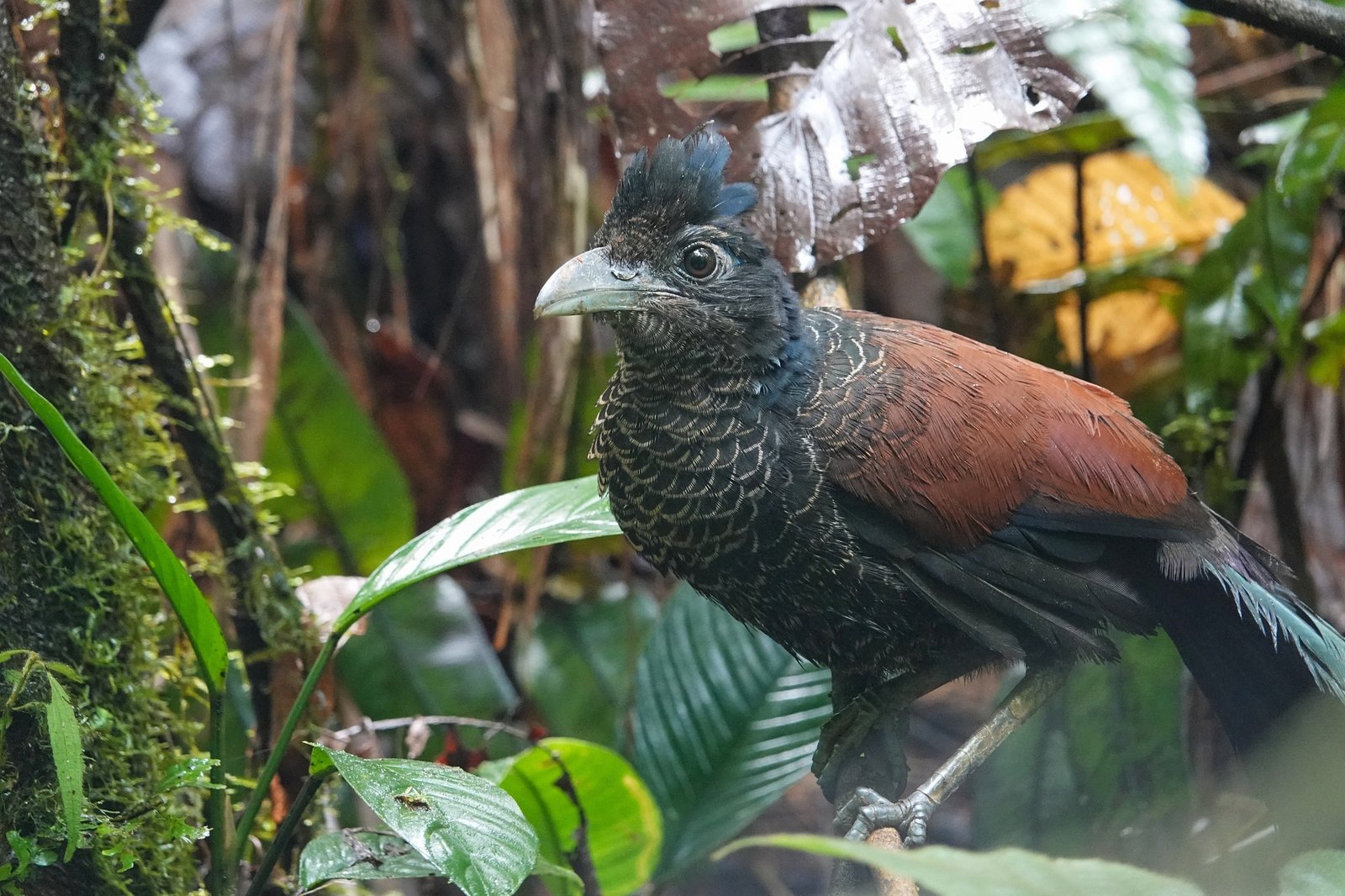
The Banded Ground Cuckoo is a large, long-tailed cuckoo that mostly walks and runs on the forest floor. It occurs only in the humid forests of the Chocó in southwestern Colombia and northwestern Ecuador and is therefore endemic to the guide area. It often follows army ant swarms and groups of peccaries to catch flushed prey.
Voice
A low, dull hoo or woo, sometimes repeated, which does not carry far. When excited a loud, dry bill-clacking, often the first sign of the bird.
Recording: Manuel Sanchez — CC BY-NC-SA 4.0 · xeno-canto
Identification
46–50 cm, with a long, broad tail and a heavy, slightly curved bill. The head and crest are black; behind the eye is a patch of bare blue skin. Mantle, breast and belly are black with dense white to pale buff barring, giving the bird a scaly look. Lower back, wings and tail are chestnut to dark rufous-brown with a purplish gloss. The legs are long and grey. The sexes are alike; juveniles are duller and less sharply marked.
Confusion species
No other ground cuckoo occurs on the Pacific side of the guide area. Rufous-vented Ground Cuckoo Neomorphus geoffroyi lives in northwestern Colombia and in the Amazonian lowlands, and has a plain brown back, a narrow black breast band and a rufous vent, without barring on the underparts. Common Squirrel Cuckoo Piaya cayana is smaller, rufous with a grey belly, and lives in the treetops.
Habitat
Undisturbed humid lowland and foothill forest and lower montane rainforest on the Pacific slope, roughly from 100 to 1500 m, with an open understory. Lives on the ground and follows army ant swarms and groups of peccaries; eats large insects, scorpions, frogs and lizards fleeing from the ants and mammals. Few nests have been described; the nest is a flat structure of twigs in low vegetation.
Where the bird is most at home, classified by the vegetation units of the Andes and the west coast.


Range and movements
In Colombia on the Pacific slope in the southwest, from Valle del Cauca through Cauca to Nariño. In Ecuador in the northwest, in Esmeraldas, Carchi, Imbabura and northwestern Pichincha, south to about Santo Domingo. Absent from Peru, Bolivia and the Galápagos. Does not occur outside the guide area.
- Resident
- dark = core range, pale = thinly spread
How and when to look
Most often seen in protected forests in Esmeraldas and northwestern Pichincha, such as the Río Canandé reserve. Watch for army ant swarms on the forest floor and listen for bill-clacking; the bird often walks some distance behind the ants.
Conservation status
Vulnerable. The population is small and fragmented by the conversion of lowland forest to farmland, oil palm plantations and logging; locally also by hunting. It benefits from large, continuous forest reserves.
Scientific name
Neomorphus radiolosus | Sclater & Salvin, 1878
Sclater & Salvin described the species in 1878 and placed it straight away in the genus where it still stands. The genus Neomorphus was introduced in 1827 by Gloger. The genus name comes from Greek neos, 'new', and morphē, 'form': 'new form'. The species name radiolosus is New Latin for 'heavily barred', from Latin radiolus, 'small rod' (diminutive of radius, 'rod, spoke'). The specimen the first description was based on came from Intag, Imbabura, Ecuador.