All species › Cuckoos › Cuckoos › Red-billed Ground Cuckoo
Red-billed Ground Cuckoo | Neomorphus pucheranii
Roodsnavelgrondkoekoek | Cuco hormiguero piquirrojo | Jacu-estalo-de-bico-vermelho
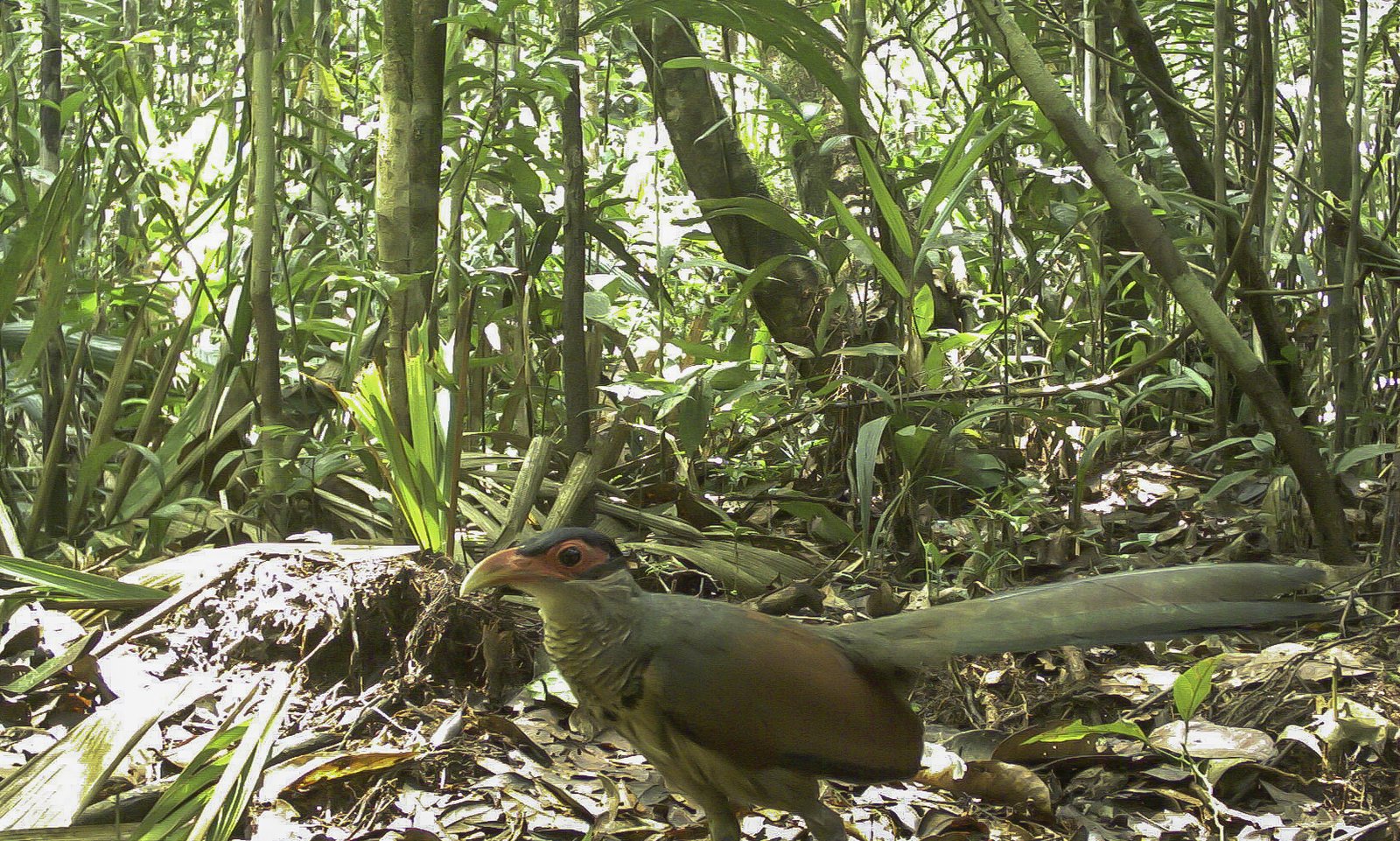
The Red-billed Ground Cuckoo is the ground cuckoo of western Amazonia, recognizable by its red bill and red legs. It walks on the forest floor and follows army ant swarms and groups of peccaries. In the guide area it lives in the lowlands of southeastern Colombia, eastern Ecuador and northeastern Peru, but it is seldom recorded.
Voice
A low, moaning hoo-oo, sometimes repeated, which does not carry far. When excited a loud, dry bill-clacking.
Recording: Diego Calderon-F. — CC BY-NC-SA 4.0 · xeno-canto
Identification
46–50 cm, with a long tail, a crest and long legs. Bill and legs are red; around the eye is bare skin that is red behind the eye and blue in front of it. The crown and crest are blue-black. Back and upperwing are olive-brown to greyish brown; wings and tail have a green to purple gloss. Throat and breast are greyish to pale buff with black scaling and a narrow black breast band; the belly is pale buff to grey. The sexes are alike.
Confusion species
Rufous-vented Ground Cuckoo Neomorphus geoffroyi, which lives south of the Amazon in Peru and Bolivia, has a greenish bill, grey legs and a rufous vent. Rufous-winged Ground Cuckoo Neomorphus rufipennis of the Guiana Shield has rufous primaries and a yellowish bill.
Habitat
Humid terra firme lowland forest, locally also forest in the transition to várzea, mostly below 700 m. Lives on the ground and follows army ant swarms and groups of peccaries; eats large insects, spiders, frogs and lizards. Little is known about the nest.
Where the bird is most at home, classified by the vegetation units of the Andes and the west coast.


Range and movements
In Colombia in the far southeast (Putumayo and Amazonas). In Ecuador in the lowlands east of the Andes, scarce. In Peru in the northeast, north and south of the Amazon, south to about the Ucayali. Absent from Bolivia and the Galápagos. Outside the guide area in western Amazonas in Brazil.
How and when to look
Encounters are largely by chance, usually at army ant swarms in terra firme forest around lodges in eastern Ecuador and northeastern Peru. Listen for bill-clacking and watch for a large bird running across the forest trail.
Conservation status
Least Concern, although it occurs at low density everywhere. Sensitive to forest fragmentation; disappears from areas where the forest is disturbed.
Scientific name
Neomorphus pucheranii | (Deville, 1851)
Deville described the species in 1851 as Cultrides Pucheranii; because it was later moved to another genus, the author and year stand in brackets. The genus Neomorphus was introduced in 1827 by Gloger. The genus name comes from Greek neos, 'new', and morphē, 'form': 'new form'. The species name pucheranii honours Jacques Pucheran (1817–1894), French zoologist and explorer. The specimen the first description was based on came from Río Yaguas, Peru.