All species › Passerines › Antbirds › East Amazonian Fire-Eye
East Amazonian Fire-Eye | Pyriglena leuconota
Witrugvuuroog | Ojo de fuego dorsiblanco | Papa-taoca
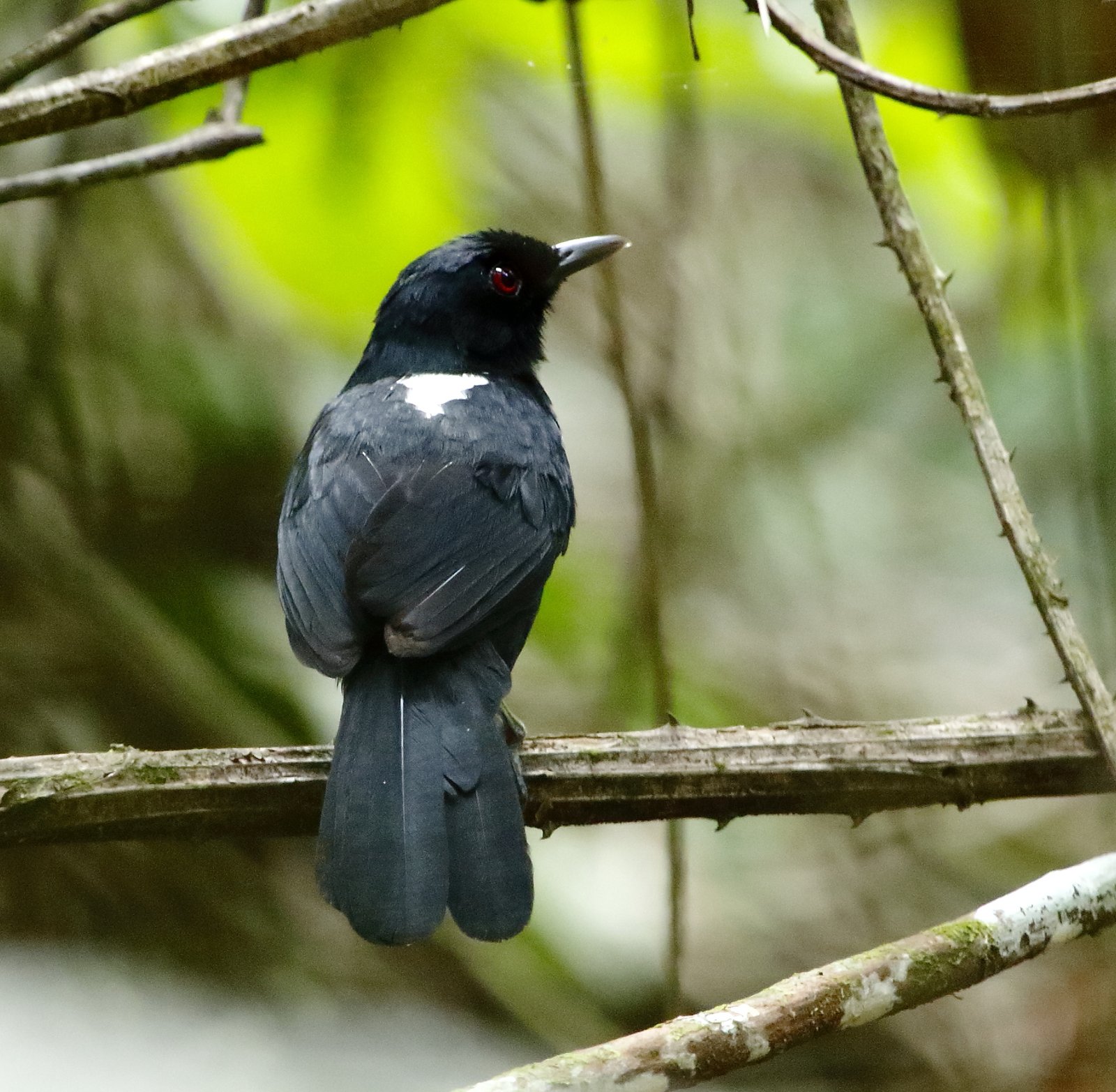
The East Amazonian Fire-Eye is a large, long-tailed antbird of the understorey of foothill and lower montane forest on both sides of the Andes. The name refers to the bright red iris and the male's white back patch. The populations in the guide area are treated in recent classifications as a separate species, Western Fire-Eye Pyriglena maura; females differ strongly by region.
Voice
The male sings a series of about two seconds of evenly paced short whistles, rising and falling slightly; the female sings higher and longer, often starting during the male's song. Calls include a soft, sputtering pit-cht-cht and a sharp pick.
Recording: Sidnei Dantas — CC BY-NC-SA 4.0 · xeno-canto
Identification
17 cm, with a bright red iris and a long tail. The male is glossy black, with a partly hidden white patch between the scapulars that becomes visible when excited. The female in western Ecuador and north-western Peru is dark reddish brown above and greyish olive-brown below; in the Andes of Colombia and eastern Ecuador mostly sooty black with a dark chestnut-brown mantle and wings; in Peru and Bolivia rufous-brown above, partly with a white supercilium and a black eye-stripe.
Confusion species
Sooty Antbird Hafferia fortis of the Amazonian lowlands is also black with a red iris, but has blue bare skin around the eye and no white back patch. Blue-lored Antbird Hafferia immaculata and Zeledon's Antbird Hafferia zeledoni have blue bare skin in front of the eye and a brown iris. The male White-shouldered Antbird Akletos melanoceps has a white shoulder patch and lives in the lowlands.
Habitat
Dense understorey of evergreen lowland and foothill forest, especially at forest edges, in older secondary forest and in gaps. In western Ecuador from sea level to 1350 m, on the east slope of the Andes mostly 500–2200 m. It regularly follows army-ant swarms to catch flushed insects. The nest is a cup or ball low in dense vegetation.
Where the bird is most at home, classified by the vegetation units of the Andes and the west coast.


Range and movements
Colombia: on the slopes of the Central and Eastern Andes and in the upper Magdalena valley, 500–2500 m. Ecuador: in the west from the coast into the foothills and on the east slope of the Andes. Peru: in the far north-west (Tumbes) and along the whole east slope of the Andes. Bolivia: on the east slope of the Andes and in eastern Santa Cruz. Absent from the Galápagos. Outside the guide area in western Mato Grosso in Brazil and northern Paraguay.
- Resident
- dark = core range, pale = thinly spread
How and when to look
Search forest edges and trails in foothill forest, for example in north-western Ecuador or along the road to Manu in Peru, and watch for army-ant swarms, which it joins.
Conservation status
Not Evaluated as a separate species; the broader species is Least Concern. Locally fairly common and able to persist in older secondary forest; the populations of western Ecuador and Peru have lost more of their habitat to deforestation.
Scientific name
Pyriglena leuconota | (Spix, 1824)
Spix described the species in 1824 as Myothera leuconota; because it was later moved to another genus, the author and year stand in brackets. The genus Pyriglena was introduced in 1847 by Cabanis. The genus name comes from Greek pur, 'fire', and glēnē, 'eyeball', for the red eye. The species name comes from Greek leukos, 'white', and nōtos, 'back'. The specimen the first description was based on came from Pará, Brazil.