All species › Passerines › Antbirds › Cordillera Azul Antbird
Cordillera Azul Antbird | Myrmoderus eowilsoni
Cordilleraazulmiervogel | Hormiguero de la Cordillera Azul | Formigueiro-da-cordilheira-azul
The Cordillera Azul Antbird was described only in 2018, from birds of the Cordillera Azul in northern Peru. It is endemic to Peru and lives on a few level ridges at middle elevations, where it walks on the forest floor. Its closest relative is the Ferruginous-backed Antbird of the Guiana Shield; the scientific name honours the biologist E.O. Wilson.
Voice
The male's song is a short series of whistled notes arranged in pairs. The female's song is more variable, with three to six slower, raspier notes. The call is a sputtering series of notes.
Recording: Iván Lau — CC BY-NC-SA 4.0 · xeno-canto
Identification
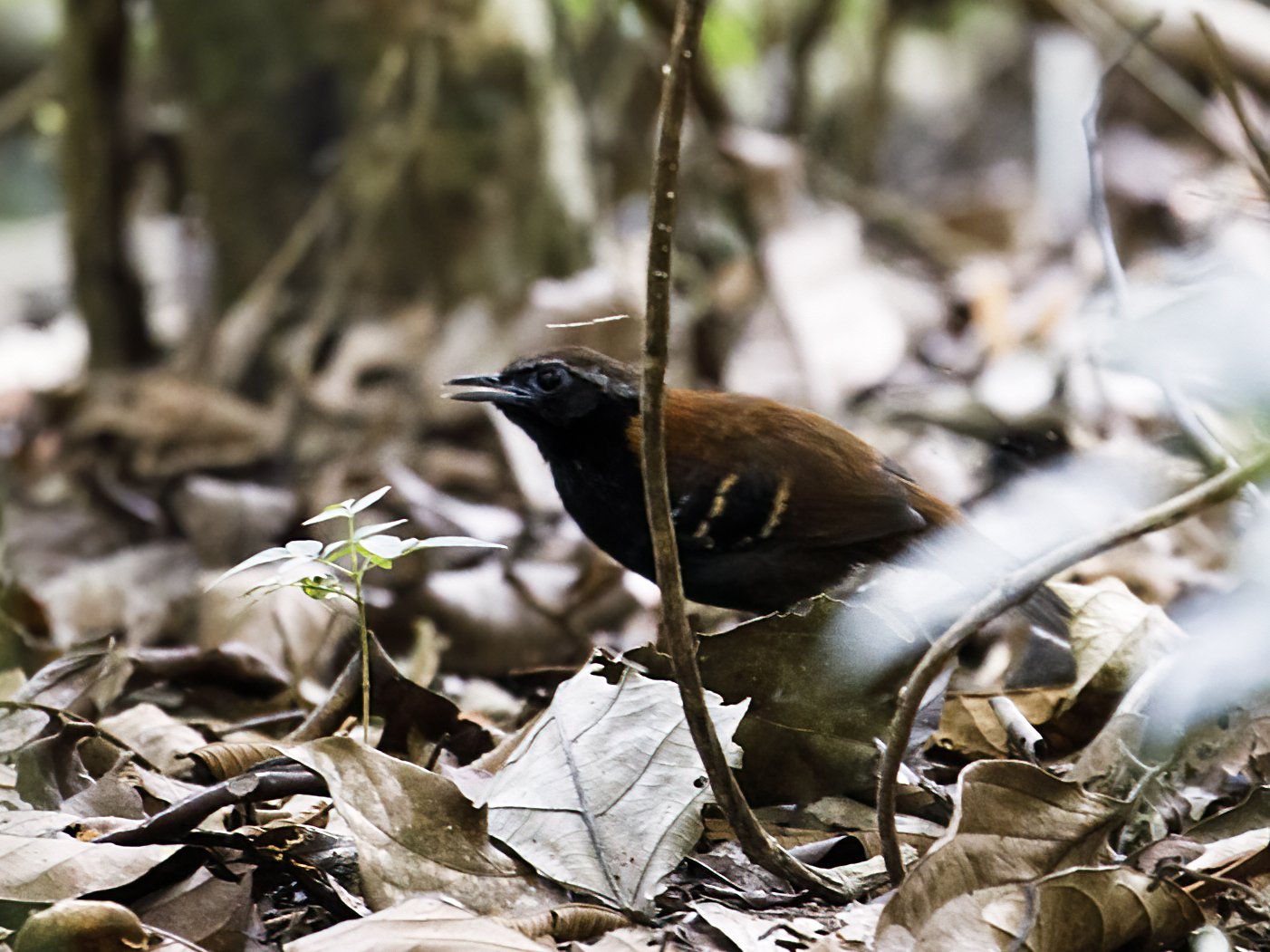
14–15 cm, with long legs and bare blue-grey skin around the eye. The male has a brown crown and nape, brown upperparts with a small white patch between the shoulders and black wing coverts with broad buff tips. The face and throat are largely black, with a pale grey supercilium. The female has a white throat and cheeks with black feather tips, orange-brown breast and flanks and a dark grey centre to the belly.
Confusion species
Within its habitat no other species closely resembles it. White-browed Antbird Myrmoborus leucophrys lacks the spotted wing, perches more above the ground and mainly lives lower. Common Scale-backed Antbird Willisornis poecilinotus has a scaled back and lives in lowland forest. Ferruginous-backed Antbird Myrmoderus ferrugineus is more chestnut and does not occur in Peru.
Habitat
Tall evergreen montane forest with an undisturbed understorey and a thick layer of leaf litter, mainly on level ridgetops, between about 1300 and 1700 m. It walks on the ground and picks arthropods from the litter, within about a metre of the ground. Almost nothing is known about its breeding.
Where the bird is most at home, classified by the vegetation units of the Andes and the west coast.

Range and movements
Colombia: absent. Ecuador: absent. Peru: known only from the Cordillera Azul in San Martín, on a few ridges outside and possibly inside the national park. Bolivia: absent. Absent from the Galápagos. Does not occur outside the guide area.
- Resident
- dark = core range, pale = thinly spread
How and when to look
The species can only be reached on remote ridges in San Martín. In the early morning listen for the paired whistles over leafy forest floor and stand still; the birds walk on the ground.
Conservation status
Near Threatened. The range is small and the forest on the ridges is being cleared for coffee plantations; the population is thought to be declining. Whether the species occurs inside the national park remains to be confirmed.
Scientific name
Myrmoderus eowilsoni | Moncrieff, Johnson, Lane, Beck, Angulo P & Fagan, 2017
Moncrieff, Johnson, Lane, Beck, Angulo P & Fagan described the species in 2017 and placed it straight away in the genus where it still stands. The genus Myrmoderus was introduced in 1909 by Ridgway. The genus name combines Greek murmos, 'ant', with derō, 'to flay, to cudgel'. The species name honours Edward Osborne Wilson (1929–2021), American biologist and ant specialist, for his devotion to conservation and his support of Rainforest Trust. The specimen the first description was based on came from Near Flor de Café, Cordillera Azul, San Martín, Peru.