All species › Passerines › Antbirds › Great Antshrike
Great Antshrike | Taraba major
Grote mierklauwier | Batará mayor | Choró-boi
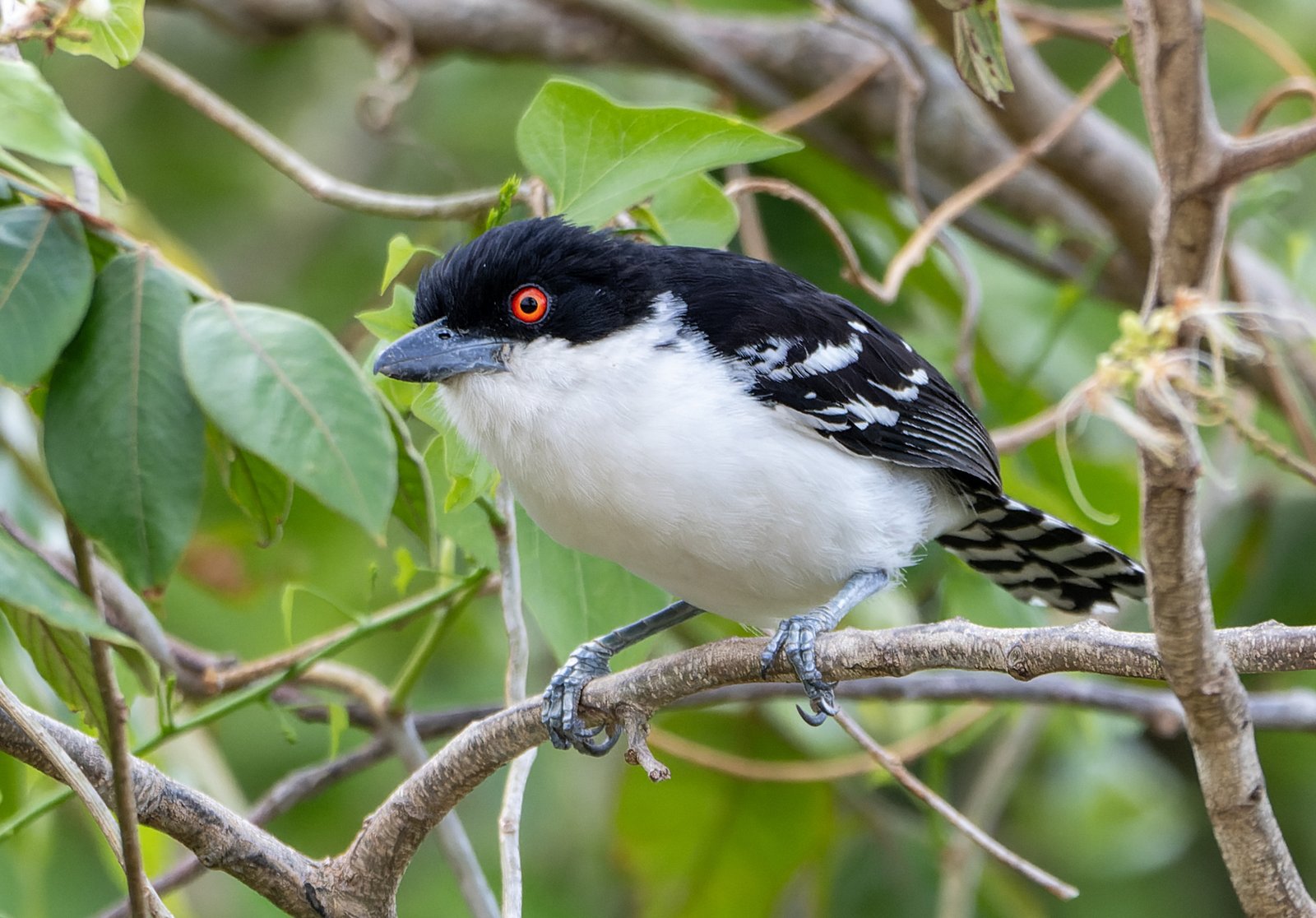
The Great Antshrike is over most of its range the largest antshrike: black and white (male) or rufous and white (female), with a crest, a heavy, hooked bill and a red eye. It lives in dense thickets and forest edges from the lowlands into the foothills. In the guide area it occurs in all four countries, west and east of the Andes.
Voice
The song is an accelerating series of hollow, mellow notes ending in a short growl: hoo-hoo-hoo-hoohoohoo-grrr. Also a grating, growling call.
Recording: Daan van der Hoeven — CC BY-NC-SA 4.0 · xeno-canto
Identification
19–20 cm, with a crest, a heavy, hook-tipped bill and a red eye. The male is black above, with a concealed white back patch and narrow white wing bars, and white below. The female is rufous above and white below.
Confusion species
Black-crested Antshrike Sakesphorus canadensis is smaller; the male has a black head and throat and the female a rufous crest and a black-and-white streaked head. Collared Antshrike Thamnophilus bernardi of western Ecuador and Peru is smaller, with a white collar. Giant Antshrike Batara cinerea in Bolivia is much larger, long-tailed and finely barred. White-shouldered Antshrike Thamnophilus aethiops is plain blackish (male) or rufous (female), without white underparts.
Habitat
Dense thickets, forest edges, overgrown clearings, secondary forest, river islands and scrub along rivers and lagoons, also in drier woodland; from sea level to about 1500 m, locally higher. It searches low in the vegetation for large insects, but also takes small lizards and frogs. The nest is a deep cup, low in a shrub.
Where the bird is most at home, classified by the vegetation units of the Andes and the west coast.


Range and movements
Colombia: widespread in the lowlands on both sides of the Andes and in the inter-Andean valleys. Ecuador: in the west, from Esmeraldas to El Oro and Loja, and in the eastern lowlands. Peru: in the far north-west (Tumbes), in the Marañón valley and throughout the Amazonian lowlands and the foothills of the eastern slope. Bolivia: widespread in the lowlands, from Pando and Beni to Santa Cruz and the Chaco of Tarija. Absent from the Galápagos. Outside the guide area from southern Mexico through Central America to Venezuela, the Guianas, Brazil, Paraguay and northern Argentina.
- Resident
- dark = core range, pale = thinly spread
How and when to look
Listen along forest edges, river islands and scrub for the accelerating series of hollow notes with its growling end. Birds usually stay deep in cover.
Conservation status
Least Concern. Common and benefits from forest edges and secondary growth.
Scientific name
Taraba major | (Vieillot, 1816)
Vieillot described the species in 1816 as Thamnophilus major; because it was later moved to another genus, the author and year stand in brackets. The genus Taraba was introduced in 1831 by Lesson. The genus name Taraba is an anagram of Batara, a genus name Lesson used for antshrikes in 1830. The species name comes from Latin maior, 'greater, larger'. The specimen the first description was based on came from Paraguay.