All species › Woodpeckers and allies › Woodpeckers › Ecuadorian Piculet
Ecuadorian Piculet | Picumnus sclateri
Ecuadordwergspecht | Carpinterito ecuatoriano | Pica-pau-anão-do-equador
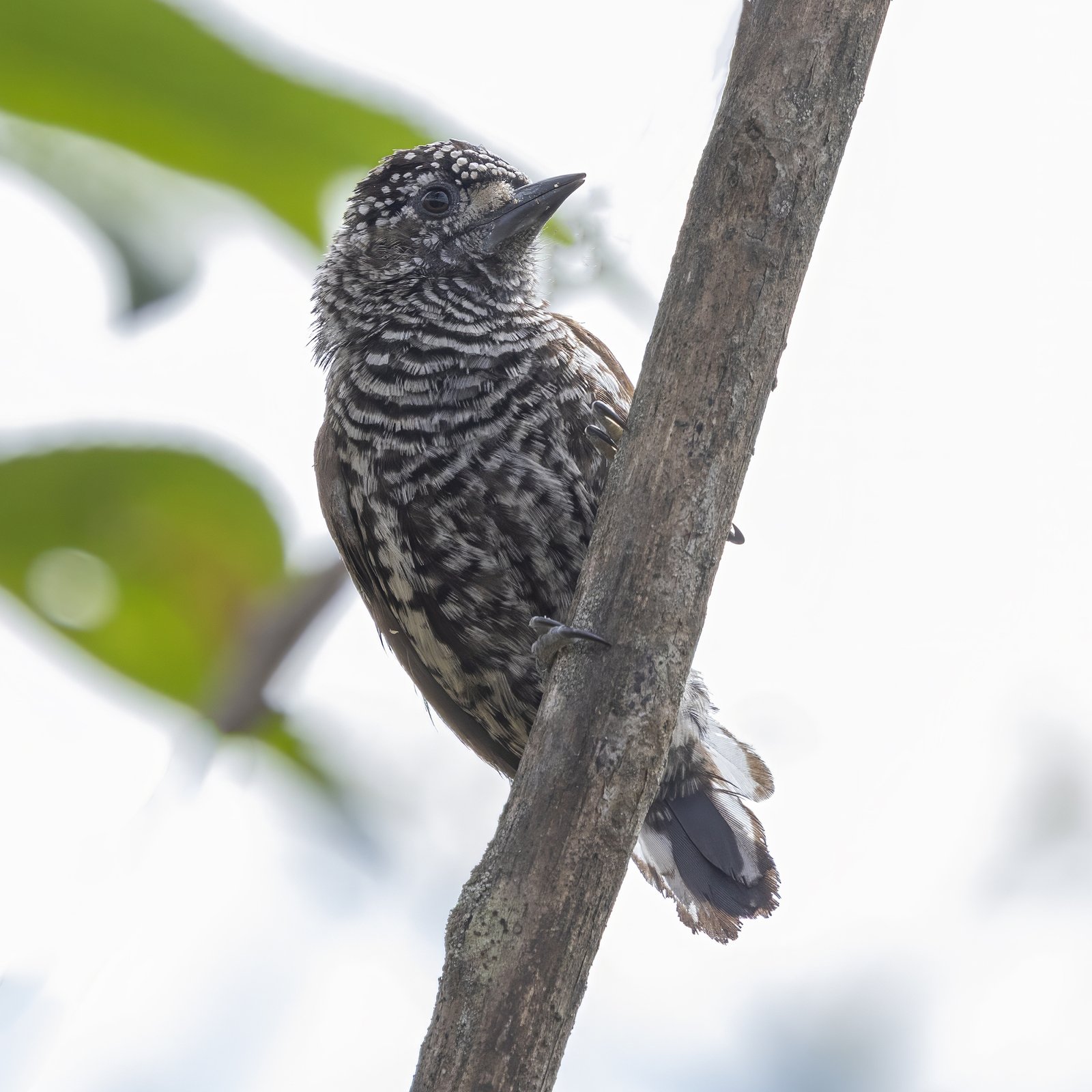
The Ecuadorian Piculet is the piculet of the Tumbesian region, the dry west of Ecuador and north-western Peru, and occurs only in the guide area. In the dry forest and thorn scrub of that region it is the only piculet. It forages in thin twigs of shrubs and low trees.
Voice
A high, thin, rapid trill, often slightly descending, and short, sharp tsit calls. Drums softly and briefly on thin twigs; a soft tapping is often heard while it feeds.
Recording: John V. Moore — CC BY-NC-SA 4.0 · xeno-canto
Identification
9–10 cm, with a short, pointed bill. The upperparts are greyish brown, with fine pale spots or bars on the mantle. The crown is black; in the male with red to orange-yellow dots on the forecrown and white ones behind, in the female with white dots only. The throat and breast are whitish with black bars, and the belly is white with dark streaks. The short tail is black with white stripes. Young birds are more dully marked.
Confusion species
Olivaceous Piculet Picumnus olivaceus lives in more humid forest, mainly north of this species' range, and has an olive-green back and an olive, faintly streaked breast without black bars. No other piculets occur in the Tumbesian dry forest.
Habitat
Dry forest, thorn scrub, shrubby slopes and forest edges with low trees, from sea level to about 2000 m, highest in north-western Peru. It searches thin twigs, vines and dead wood for ants, termites and their larvae and eggs. The nest is a small cavity it excavates in a thin dead branch or trunk.
Where the bird is most at home, classified by the vegetation units of the Andes and the west coast.


Range and movements
In Ecuador in the dry west and south-west, from Manabí to El Oro and Loja. In Peru in the north-west, in Tumbes, Piura and Lambayeque and on the adjacent western slope of the Andes. Absent from Colombia, Bolivia and the Galápagos. Does not occur outside the guide area.
- Resident
- dark = core range, pale = thinly spread
How and when to look
Search the dry forest of south-western Ecuador, for example in the Jorupe reserve near Macará, and the dry forest of Tumbes and Piura. It often joins mixed flocks of small birds in the lower storeys.
Conservation status
Least Concern. The Tumbesian dry forest is heavily fragmented by logging and grazing, but the species tolerates degraded forest and scrub.
Scientific name
Picumnus sclateri | Taczanowski, 1877
Taczanowski described the species in 1877 and placed it straight away in the genus where it still stands. The genus Picumnus was introduced in 1825 by Temminck. The genus name refers to Picumnus, a Roman god of fertility and agriculture, brother of Pilumnus, whose name is related to Latin picus, 'woodpecker'. The species name honours Philip Lutley Sclater (1829–1913), a British ornithologist and long-time secretary of the Zoological Society of London. The specimen the first description was based on came from Lechugal, Tumbes, Peru.