All species › Woodpeckers and allies › Woodpeckers › Golden-spangled Piculet
Golden-spangled Piculet | Picumnus exilis
Kleine dwergspecht | Carpinterito capirotado | Pica-pau-anão-de-pintas-amarelas
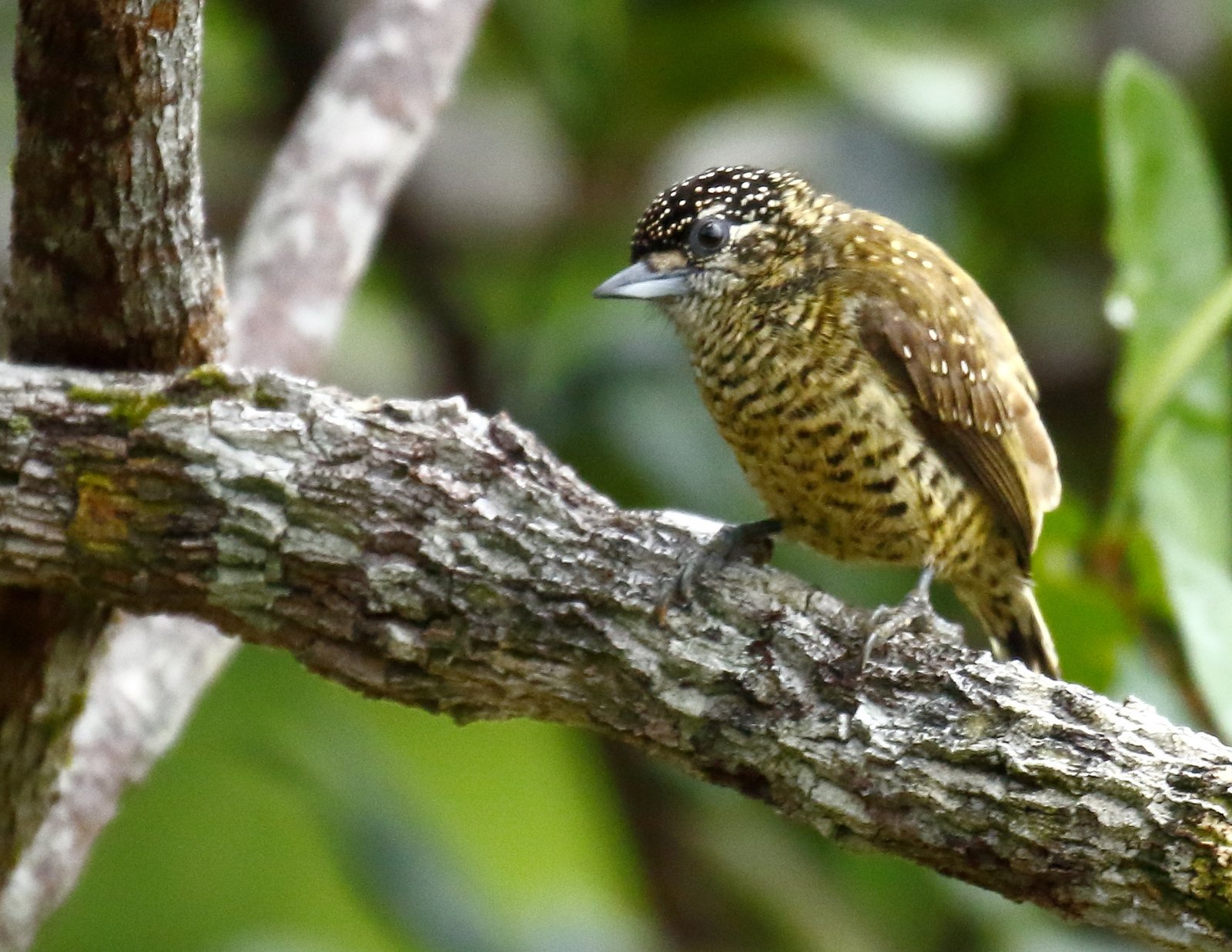
The Golden-spangled Piculet is a piculet of north-eastern South America, with yellow, dark-edged spangles on the back that give it its name. In the guide area it occurs only in the far east of Colombia, near the borders with Venezuela and Brazil. It forages in thin twigs and vines in forest and scrub.
Voice
A high, thin, rapid trill, often slightly descending, and short, sharp tsit calls. Drums softly and briefly on thin twigs; a soft tapping is often heard while it feeds.
Recording: JAYRSON ARAUJO DE OLIVEIRA — CC BY-NC-SA 4.0 · xeno-canto
Identification
9–10 cm, with a short, pointed bill. The upperparts are olive-green to olive-brown, with yellow or pale spots and black edges to the feathers, giving a scaled pattern. The crown is black; in the male with red dots on the forecrown and white ones behind, in the female with white dots only. The underparts are yellowish white with black barring. The short tail is black with pale inner webs. Young birds are duller, with fewer spangles.
Confusion species
Orinoco Piculet Picumnus pumilus has a plain olive-green back without spangles and more finely barred underparts. Lafresnaye's Piculet Picumnus lafresnayi has a barred rather than spangled back and lives further south-west. White-bellied Piculet Picumnus spilogaster has a greyish-brown back and white underparts with only small spots.
Habitat
Humid lowland forest and forest edges, low forest and scrub on white sand, secondary forest and gallery forest; in the guide area in the lowlands, elsewhere up into the lower mountains. It searches thin twigs, vines and dead wood for ants, termites and their larvae and eggs. The nest is a small cavity it excavates in a thin dead branch or trunk.
Where the bird is most at home, classified by the vegetation units of the Andes and the west coast.


Range and movements
In the guide area only in the far east of Colombia, in Guainía, among other places around Inírida. Absent from Ecuador, Peru, Bolivia and the Galápagos. Outside the guide area in southern and eastern Venezuela, the Guianas and large parts of Brazil, as far as the Atlantic Forest.
- Resident
- dark = core range, pale = thinly spread
How and when to look
Around Inírida search the edges of low forest and scrub on white sand, often in mixed flocks of small birds. Listen for soft tapping in thin twigs and for the high trill.
Conservation status
Least Concern. The range is very large; in the guide area the species is confined to a small part of eastern Colombia.
Scientific name
Picumnus exilis | (Lichtenstein, 1823)
Lichtenstein described the species in 1823 as Picus exilis; because it was later moved to another genus, the author and year stand in brackets. The genus Picumnus was introduced in 1825 by Temminck. The genus name refers to Picumnus, a Roman god of fertility and agriculture, brother of Pilumnus, whose name is related to Latin picus, 'woodpecker'. The species name comes from Latin exilis, 'small, slender'. The specimen the first description was based on came from Bahia, Brazil.