All species › Parrots › African and New World parrots › El Oro Parakeet
El Oro Parakeet | Pyrrhura orcesi
El-oroparkiet | Perico de El Oro | Tiriba-de-el-oro
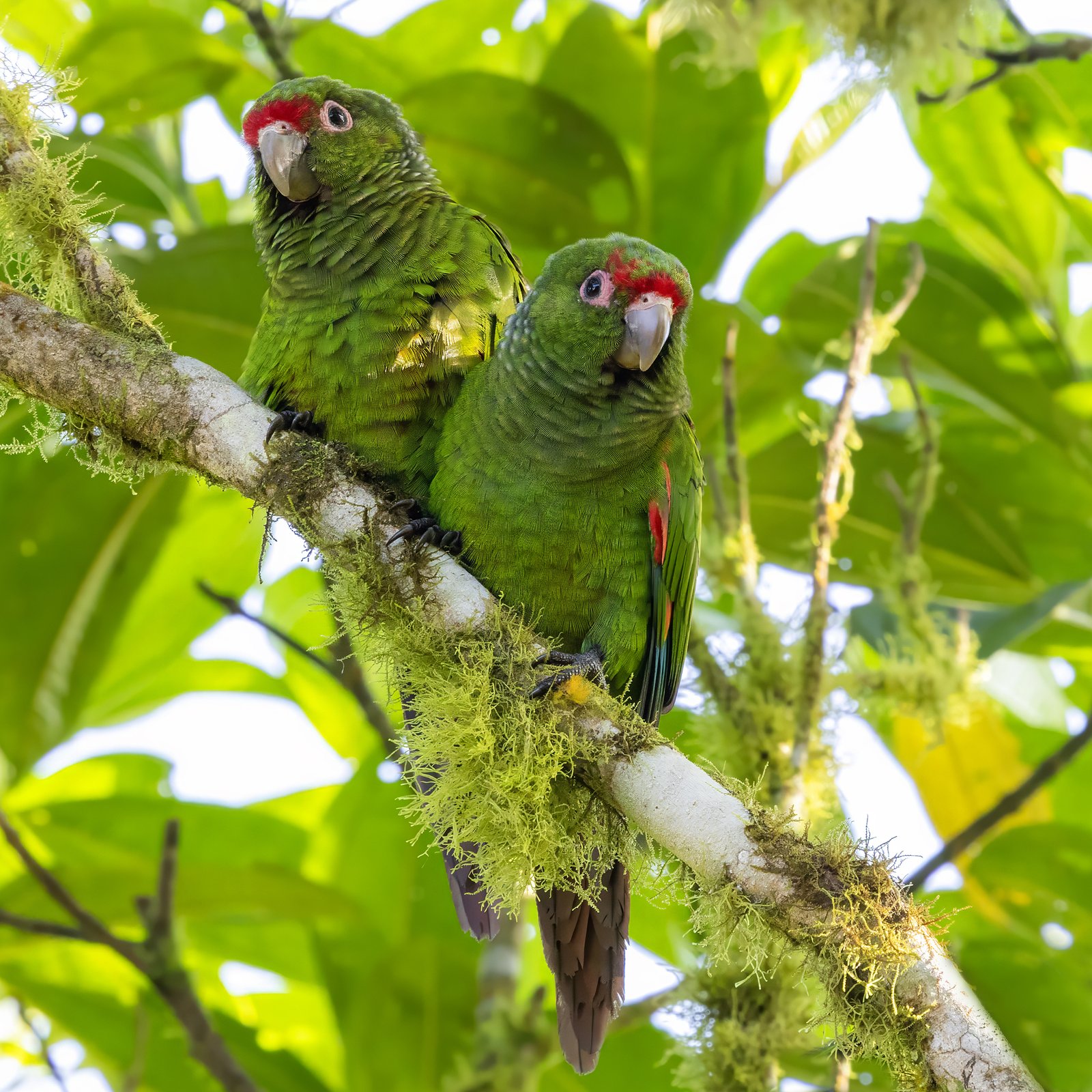
The El Oro Parakeet is a small Pyrrhura found only on the western slope of the Andes in south-western Ecuador. It was discovered only in 1980 and described in 1988. The entire population lives in a narrow belt of humid forest at low to middle elevations, most of which has been cleared.
Voice
High, harsh chattering, such as a fast, repeated kreek-kreek-kreek, mainly in flight; flocks in a tree make soft, babbling sounds.
Recording: Jarol Fernando Vaca — CC BY-NC-SA 4.0 · xeno-canto
Identification
22 cm, with a long, pointed tail and a pale, horn-coloured bill. The plumage is mainly green, with a red forehead and red lores. The breast is green with faint dark scaling and the belly has a vague maroon patch. The primary coverts are red, forming a patch on the forewing. The tail is maroon above and below. A bare, pale ring surrounds the eye. The sexes are alike; juveniles show less red on the forehead.
Confusion species
Red-masked Parakeet Psittacara erythrogenys is larger, with a red head and a green tail, and lives mainly in drier, lower forest. Maroon-tailed Parakeet Pyrrhura melanura occurs farther north on the Pacific side and has a dark, pale-scaled breast without a red forehead. Bronze-winged Parrot Pionus chalcopterus is larger and dark, with a short tail.
Habitat
Humid and very humid forest of the western slope, its edges and forest edges along pastures, mostly between 600 and 1300 m, locally lower. It feeds on fruit, flowers and seeds in the canopy. It nests in tree cavities; flocks roost together in cavities and also use nest boxes. It breeds cooperatively, with helpers feeding the young.
Where the bird is most at home, classified by the vegetation units of the Andes and the west coast.


Range and movements
Only in Ecuador, on the western slope of the Andes in El Oro and Azuay, with a few records farther north in Cañar and Chimborazo. Absent from Colombia, Peru, Bolivia and the Galápagos. Endemic to the guide area.
- Resident
- dark = core range, pale = thinly spread
How and when to look
In the Buenaventura reserve near Piñas (El Oro), where flocks forage along the forest edges and near the nest boxes. In the early morning, watch for chattering flocks flying over the slopes.
Conservation status
Endangered. The species has a very small range and a small population. Forest on the western slope has largely been converted to pasture, and the species depends on large trees with cavities. Protection of the remaining forest and nest boxes in the Buenaventura reserve have helped the population locally.
Scientific name
Pyrrhura orcesi | Ridgely & Robbins, 1988
Ridgely & Robbins described the species in 1988 and placed it straight away in the genus where it still stands. The genus Pyrrhura was introduced in 1856 by Bonaparte. The genus name comes from Greek purrhos, 'flame-coloured', and oura, 'tail'. Named after Gustavo Orcés V. (1903–1996), Ecuadorian zoologist. The specimen the first description was based on came from El Oro, Ecuador.