All species › Parrots › African and New World parrots › Black-capped Parakeet
Black-capped Parakeet | Pyrrhura rupicola
Zwartkopparkiet | Cotorra capirotada | Tiriba-rupestre
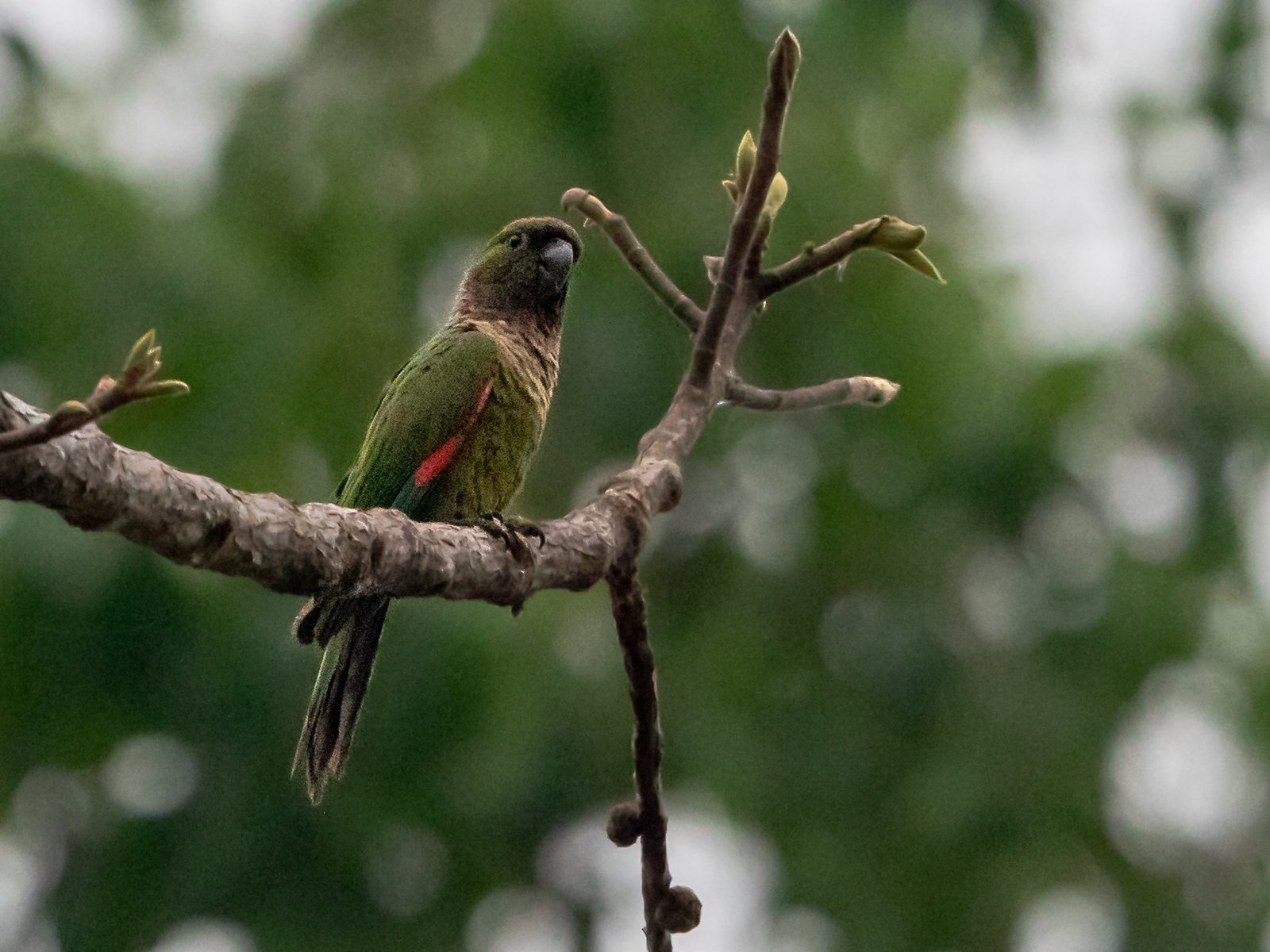
The Black-capped Parakeet is a Pyrrhura of the south-western Amazon, with a dark cap and a heavily scaled breast. Flocks move through the canopy of lowland forest and are mainly heard in flight. It is the only Pyrrhura with a green tail within its range.
Voice
A shrill, harsh kreek or kee-kee, often rapidly repeated in flight; flocks in a tree make soft, babbling sounds.
Recording: Jacob Wijpkema — CC BY-NC-SA 4.0 · xeno-canto
Identification
25 cm, with a long, pointed tail and a dark grey bill. The crown and nape are blackish brown. The throat, sides of the neck and breast are dark with broad white to yellowish-white feather edges, giving a bold scaled pattern. The rest of the plumage is green; the primary coverts and the bend of the wing are red. The tail is green. A narrow, bare, grey ring surrounds the eye. The sexes are alike; juveniles show less red in the wing.
Confusion species
Painted Parakeet Pyrrhura picta has a blue forehead, red or blue on the face, a red belly patch and a maroon tail. Santarem Parakeet Pyrrhura amazonum in northern Bolivia has a red belly, a maroon tail and a pale ear patch. Crimson-bellied Parakeet Pyrrhura perlata has a red belly and blue cheeks. Manu Parrotlet Nannopsittaca dachilleae is much smaller and short-tailed.
Habitat
Humid lowland forest on terra firme, flooded forest, bamboo forest and forest edges, mostly below 1000 m. It feeds on fruit, seeds and flowers in the canopy and middle storey. It nests in tree cavities.
Where the bird is most at home, classified by the vegetation units of the Andes and the west coast.


Range and movements
In Peru in the Amazonian lowlands of the centre and south, from Huánuco and Ucayali south to Madre de Dios and Puno. In Bolivia in the north-western lowlands of Pando, La Paz and Beni. Absent from Colombia, Ecuador and the Galápagos. Outside the guide area in western Brazil (Acre).
- Resident
- dark = core range, pale = thinly spread
How and when to look
In the lowlands of Madre de Dios, such as around Tambopata and in the lowland part of Manu, where flocks forage in the treetops along forest edges and rivers. Watch for fast, chattering flocks flying over the forest.
Conservation status
Least Concern. The range is large and largely forested; locally forest is lost to clearing, road building and gold mining.
Scientific name
Pyrrhura rupicola | (Tschudi, 1844)
Tschudi described the species in 1844 as Conurus rupicola; because it was later moved to another genus, the author and year stand in brackets. The genus Pyrrhura was introduced in 1856 by Bonaparte. The genus name comes from Greek purrhos, 'flame-coloured', and oura, 'tail'. Latin rupes, 'rock', and -cola, 'dweller': 'rock-dweller'. The specimen the first description was based on came from Peru.