All species › Parrots › African and New World parrots › White-breasted Parakeet
White-breasted Parakeet | Pyrrhura albipectus
Witnekparkiet | Perico pechiblanco | Tiriba-de-peito-branco
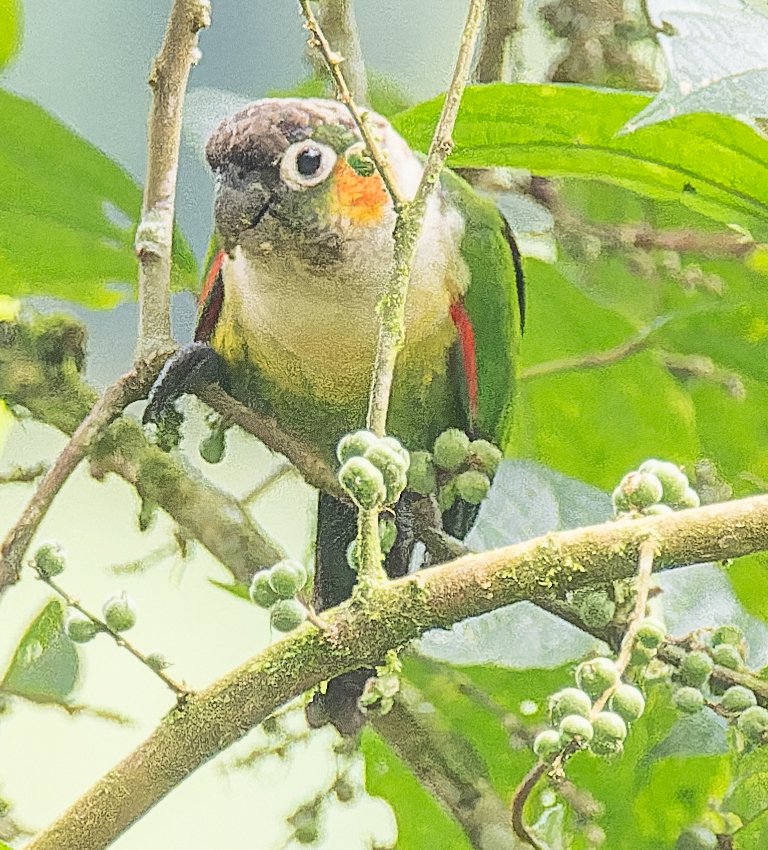
The White-breasted Parakeet is a Pyrrhura with a whitish throat and breast, found only in the mountains of south-eastern Ecuador and adjacent northern Peru. It lives in flocks in foothill forest and lower montane forest. The pale breast band separates it from all other Pyrrhura species in the guide area.
Voice
Shrill, harsh chattering, such as a repeated kreek-kreek, mainly in flight; flocks in a tree make soft, babbling sounds.
Recording: Mitch Lysinger — CC BY-NC-SA 4.0 · xeno-canto
Identification
24 cm, with a long, pointed tail and a pale, horn-coloured bill. The crown is dark brown, the ear coverts orange-yellow. The throat, sides of the neck and upper breast form a whitish band with a yellow to orange-yellow wash. The rest of the plumage is green, with a vague orange-red patch on the belly. The primary coverts are red. The tail is green above with a maroon tip and dull maroon below. A bare, whitish ring surrounds the eye. The sexes are alike.
Confusion species
Maroon-tailed Parakeet Pyrrhura melanura occurs in the lowlands and foothills nearby but has a dark, pale-scaled breast and no white band or orange ear patch. Golden-plumed Parakeet Leptosittaca branickii is larger and plain green, with a yellow plume behind the eye, and lives higher in the mountains.
Habitat
Humid foothill forest and lower montane rainforest, also forest edges and semi-open country with tall trees, mostly between 900 and 2000 m. It feeds on fruit, seeds and flowers in the canopy. It nests in tree cavities.
Where the bird is most at home, classified by the vegetation units of the Andes and the west coast.


Range and movements
In Ecuador in the south-east, in Morona-Santiago and Zamora-Chinchipe, including the Cordillera del Cóndor and the lower parts of Podocarpus National Park. In Peru in the north, in the Cordillera del Cóndor and adjacent Amazonas and Cajamarca. Absent from Colombia, Bolivia and the Galápagos. Endemic to the guide area.
- Resident
- dark = core range, pale = thinly spread
How and when to look
In the lowest part of Podocarpus National Park near Zamora, such as the Bombuscaro valley, and around Copalinga, where flocks forage in the treetops along the forest edge. In the morning, watch for chattering flocks flying over the valley.
Conservation status
Vulnerable. The species has a small range and a small population. Forest in the valleys of south-eastern Ecuador is being converted to pasture, and mining in the Cordillera del Cóndor is a growing threat.
Scientific name
Pyrrhura albipectus | Chapman, 1914
Chapman described the species in 1914 and placed it straight away in the genus where it still stands. The genus Pyrrhura was introduced in 1856 by Bonaparte. The genus name comes from Greek purrhos, 'flame-coloured', and oura, 'tail'. Latin albus, 'white', and pectus, 'breast'. The specimen the first description was based on came from Zamora, Zamora-Chinchipe, Ecuador.