All species › Parrots › African and New World parrots › Flame-winged Parakeet
Flame-winged Parakeet | Pyrrhura calliptera
Bruinborstparkiet | Periquito aliamarillo | Tiriba-de-asa-amarela
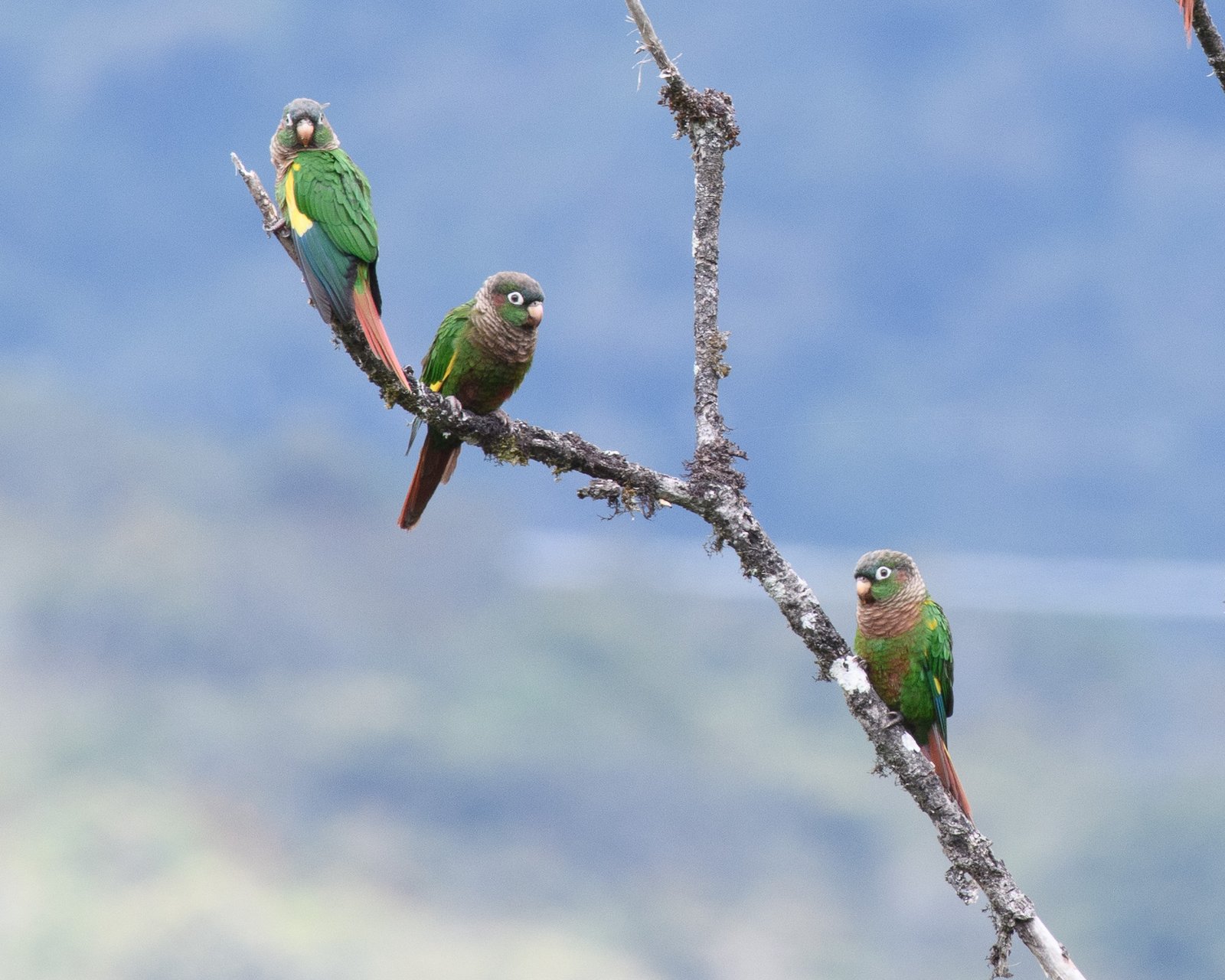
The Flame-winged Parakeet is a small Pyrrhura of the upper cloud forest of the Eastern Andes of Colombia. In flight the yellow-orange wing patch, which gives the species its name, is evident. It lives in flocks up to near the treeline and the páramo, higher than most other parakeets.
Voice
Shrill, harsh chattering, such as a repeated kreek-kreek or kree-ek, mainly in flight; flocks in a tree make soft, babbling sounds.
Recording: David Bradley — CC BY-NC-SA 4.0 · xeno-canto
Identification
22 cm, with a long, pointed tail and a pale, horn-coloured bill. The crown is brown and the ear coverts maroon. The throat and breast are brownish with fine, paler scaling, and the belly has a maroon patch. The rest of the plumage is green. The primary coverts and the bend of the wing are yellow to orange-yellow and form a broad patch on the forewing. The tail is maroon above. A bare, pale ring surrounds the eye. The sexes are alike; juveniles show less yellow in the wing.
Confusion species
Golden-plumed Parakeet Leptosittaca branickii is larger and plain green, with a yellow plume behind the eye, and lacks the brown breast and yellow wing patch. Perija Parakeet Pyrrhura caeruleiceps lives farther north in the Serranía de Perijá and has a blue crown and a red belly patch. Speckle-faced Parrot Pionus tumultuosus and Rusty-faced Parrot Hapalopsittaca amazonina are stocky and short-tailed.
Habitat
Upper cloud forest and montane forest, forest edges, scrub at the treeline and the transition to páramo, mostly between 1700 and 3400 m. It feeds on fruit, seeds, flowers and buds, and also visits maize fields. It nests in tree cavities and in cavities in palms.
Where the bird is most at home, classified by the vegetation units of the Andes and the west coast.


Range and movements
Only in Colombia, in the Eastern Andes, in Boyacá, Cundinamarca, Santander, Casanare and Meta. Absent from Ecuador, Peru, Bolivia and the Galápagos. Endemic to the guide area.
- Resident
- dark = core range, pale = thinly spread
How and when to look
In Chingaza National Park near Bogotá and in the reserves of the eastern slope in Boyacá, where flocks forage at the forest edge and in the scrub at the treeline. Watch for chattering flocks flying low over the slopes, showing yellow-orange wing patches.
Conservation status
Vulnerable. The species has a small, fragmented range and a small population. Upper montane forest in the Eastern Andes has been widely converted to pasture and fields, and fires at the transition to páramo further reduce its habitat.
Scientific name
Pyrrhura calliptera | (Massena & de Souancé, 1854)
Massena & de Souancé described the species in 1854 as Conurus callipterus; because it was later moved to another genus, the author and year stand in brackets. The genus Pyrrhura was introduced in 1856 by Bonaparte. The genus name comes from Greek purrhos, 'flame-coloured', and oura, 'tail'. Greek kallos, 'beauty', and pteron, 'wing', after the coloured wing patches. The specimen the first description was based on came from Colombia.