All species › Passerines › Ovenbirds and woodcreepers › Elegant Woodcreeper
Elegant Woodcreeper | Xiphorhynchus elegans
Druppelmuisspecht | Trepatroncos elegante | Arapaçu-elegante
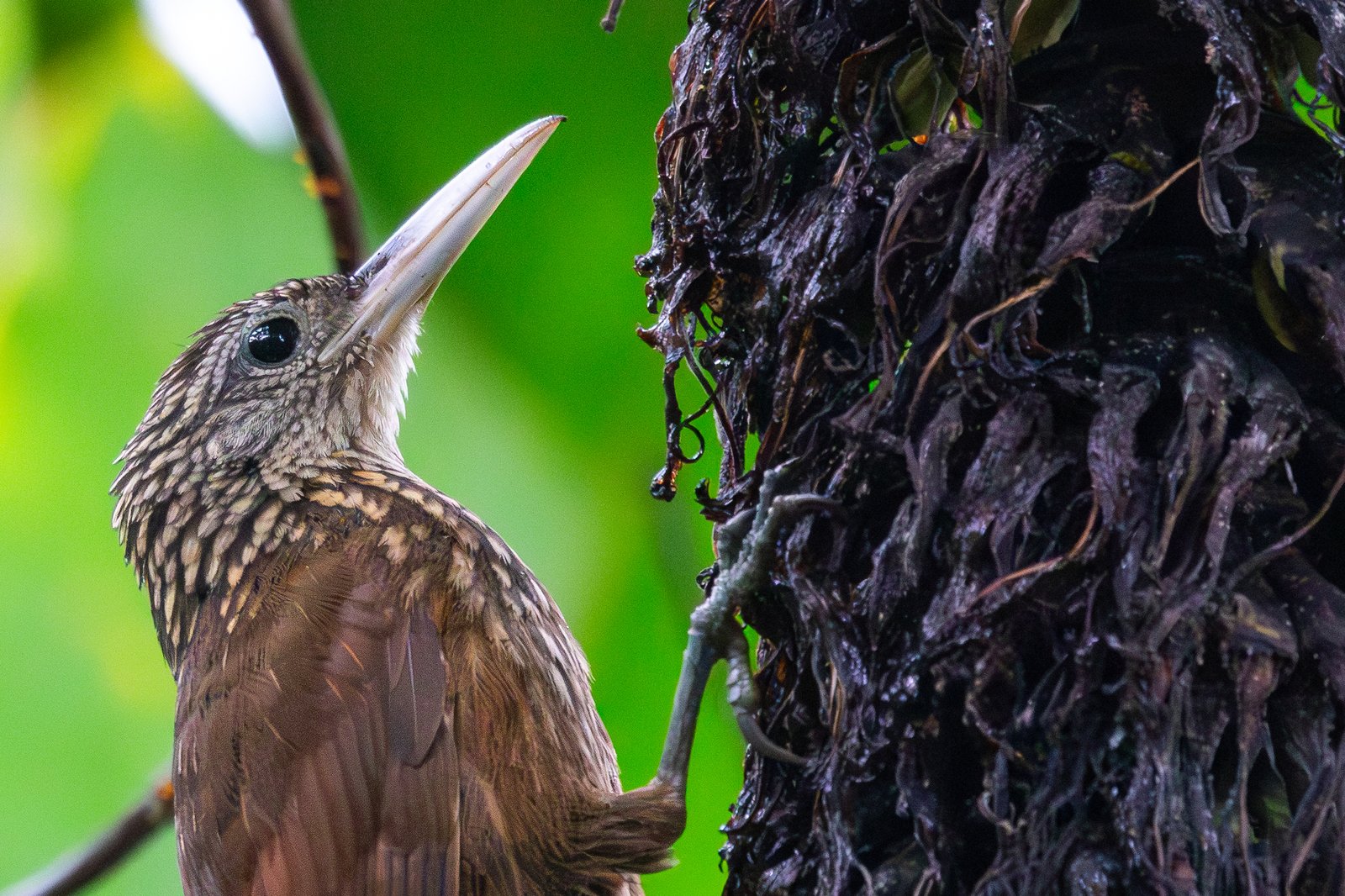
The Elegant Woodcreeper is a medium-sized woodcreeper of rainforest in the western and southern Amazon basin. It differs from related species in having pale drops and streaks not only on the breast but also on the mantle. It climbs trunks in the forest interior, often with mixed flocks.
Voice
The song is a descending series of about thirty clear, ringing whistles that starts softly and slows at the end, mainly at dawn and dusk. The call consists of sharp chip notes followed by a whine.
Recording: JAYRSON ARAUJO DE OLIVEIRA — CC BY-NC-SA 4.0 · xeno-canto
Identification
19–22 cm, with a rather slender, slightly decurved bill: the upper mandible dark, the lower paler. The upperparts are olive-brown; the crown, nape and mantle bear buff drops and short streaks with dark edges. The rump, wings and tail are rufous. The throat is buff. The breast and upper belly show buff, dark-edged drops. The sexes are alike.
Confusion species
Ocellated Woodcreeper Xiphorhynchus ocellatus has an almost plain mantle and pale drops mainly on the crown and nape. Buff-throated Woodcreeper Xiphorhynchus guttatus is larger, with a long, pale bill. Striped Woodcreeper Xiphorhynchus obsoletus is streaked rather than spotted and lives in flooded forest. Spix's Woodcreeper Xiphorhynchus spixii is almost identical in appearance, but occurs only east of the guide area, in Brazil.
Habitat
The interior and edges of humid evergreen rainforest, mainly terra firme, locally várzea, igapó and river islands, also secondary forest. Mostly below 600 m, on the eastern slope of the Andes locally up to 1500 m. It climbs trunks at lower and middle levels and searches bark, moss and dead leaves for insects and spiders. It follows mixed flocks and sometimes army ants. The nest is in a cavity in a trunk.
Where the bird is most at home, classified by the vegetation units of the Andes and the west coast.


Range and movements
Colombia: in the south-east north of the Amazon and on the eastern slope of the Eastern Andes, in the upper Orinoco drainage. Ecuador: locally in the eastern lowlands. Peru: in the Amazonian lowlands and the foothills of the eastern slope. Bolivia: in the north-west and the far east. Absent from the Galápagos. Outside the guide area in western and southern Amazonian Brazil.
- Resident
- dark = core range, pale = thinly spread
How and when to look
In terra firme forest look for understorey mixed flocks, and check the mantle of every medium-sized woodcreeper: pale drops there point to this species. The descending series of whistles is heard mainly at dawn and dusk.
Conservation status
Least Concern. The species has a large range, but depends on continuous forest and is declining where Amazonian forest is cleared.
Scientific name
Xiphorhynchus elegans | (Pelzeln, 1868)
Pelzeln described the species in 1868 as Dendrornis elegans; because it was later moved to another genus, the author and year stand in brackets. The genus Xiphorhynchus was introduced in 1827 by Swainson. The genus name comes from Greek xiphos, 'sword', and rhunkhos, 'bill'. The species name comes from Latin elegans, 'refined, choice'. The specimen the first description was based on came from Engenho do Gama, Mato Grosso, Brazil.