All species › Swifts › Hummingbirds › Empress Brilliant
Empress Brilliant | Heliodoxa imperatrix
Keizerinbriljantkolibrie | Brillante emperatriz | Brilhante-imperatriz
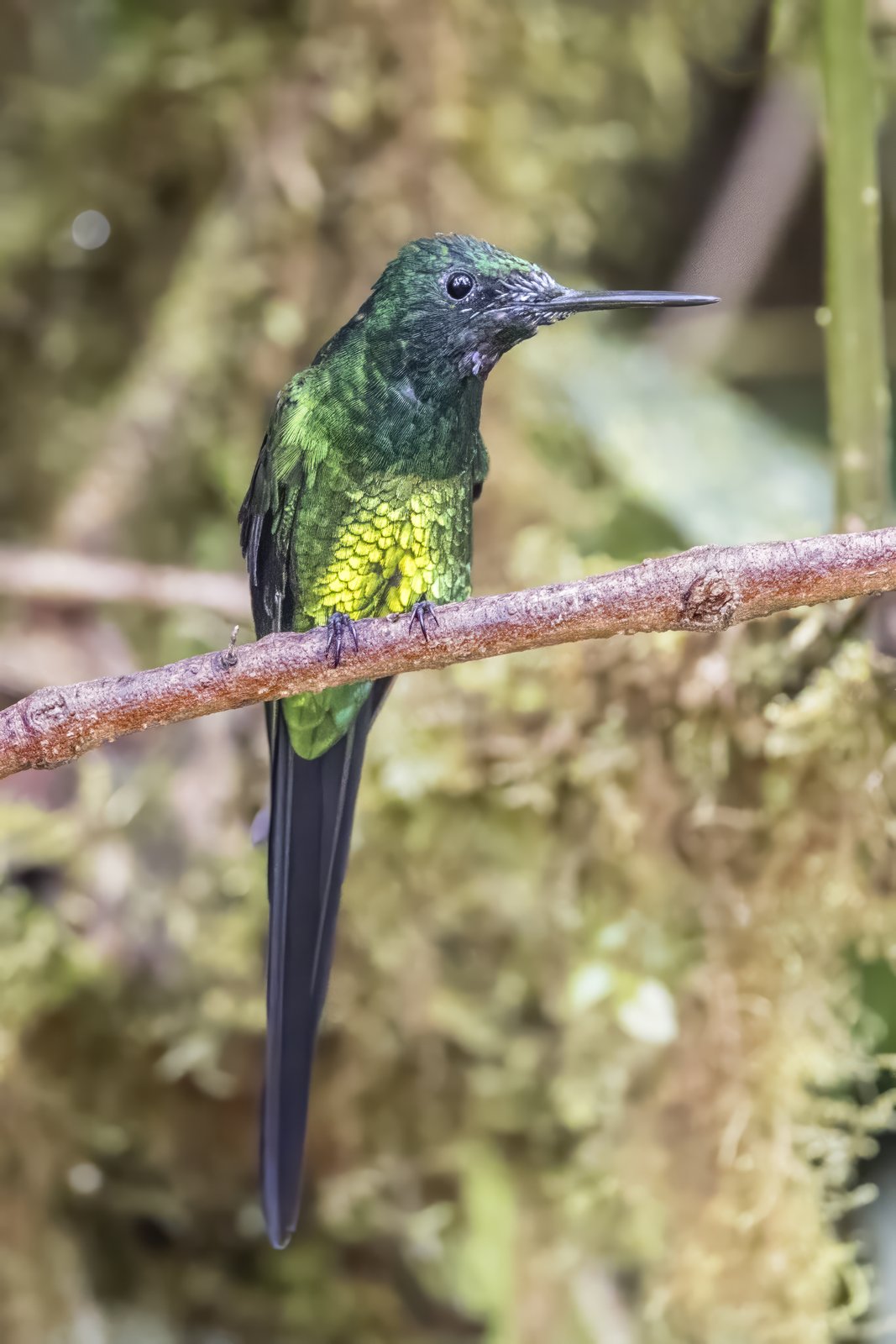
The Empress Brilliant is the largest brilliant of the Chocó slopes in western Colombia and north-western Ecuador. The male stands out by its long, deeply forked tail and glittering golden green belly. The species lives in very wet montane forest and feeds from the middle strata up into the canopy.
Voice
A repeated single tsit, also given while hovering at flowers.
Recording: Lelis Navarrete — CC BY-NC-SA 4.0 · xeno-canto
Identification
12–17 cm; the male is clearly larger than the female because of its long tail. Straight black bill and a small white spot behind the eye. The male is glittering dark green on the forehead, face and breast, with a small, pale violet patch on the throat and a glittering golden green belly; the long, deeply forked tail is black with a bronze sheen. The female is bronzy green above, with a greyish throat and breast flecked bronzy green, a golden green belly and a shorter, duller tail.
Confusion species
Green-crowned Brilliant Heliodoxa jacula is smaller, with a shorter blue-black tail and a white vent; the female has white underparts spotted green, a white malar stripe and white tail tips. Velvet-purple Coronet Boissonneaua jardini is dark velvet-purple and green, with a largely white tail. Violet-tailed Sylph Aglaiocercus coelestis also has a long tail, but it is violet and the body is smaller, with a short bill.
Habitat
The interior and edges of very wet foothill forest, lower montane forest and cloud forest, also mature secondary forest, roughly between 400 and 2000 m. Both sexes feed from the middle strata up into the canopy, females also in the understorey. It takes nectar from flowers of vines such as Marcgravia and hovers beneath drooping flowers of Ericaceae; it also catches small insects.
Where the bird is most at home, classified by the vegetation units of the Andes and the west coast.


Range and movements
In Colombia on the western slope of the Western Andes, from Chocó south to Nariño. In Ecuador on the western slope in the north-west, south to Pichincha. Absent from Peru, Bolivia and the Galápagos. Does not occur outside the guide area.
- Resident
- dark = core range, pale = thinly spread
How and when to look
In cloud forest on the western slope in north-western Ecuador, at lodge feeders between about 1200 and 2000 m around Mindo and the road to Nanegalito. Males often sit on a regular lookout perch in the middle stratum.
Conservation status
Least Concern. The range is small and deforestation on the western slope affects its habitat.
Scientific name
Heliodoxa imperatrix | (Gould, 1856)
Gould described the species in 1856 as Eugenia imperatrix; because it was later moved to another genus, the author and year stand in brackets. The genus Heliodoxa was introduced in 1850 by Gould. The genus name combines Greek hēlios, 'sun', with doxa, 'glory' or 'splendour'. The species name is Latin imperatrix, 'empress'; Gould described it as Eugenia imperatrix, after Empress Eugénie of France (1826–1920). The specimen the first description was based on came from Vicinity of Quito, Ecuador.